

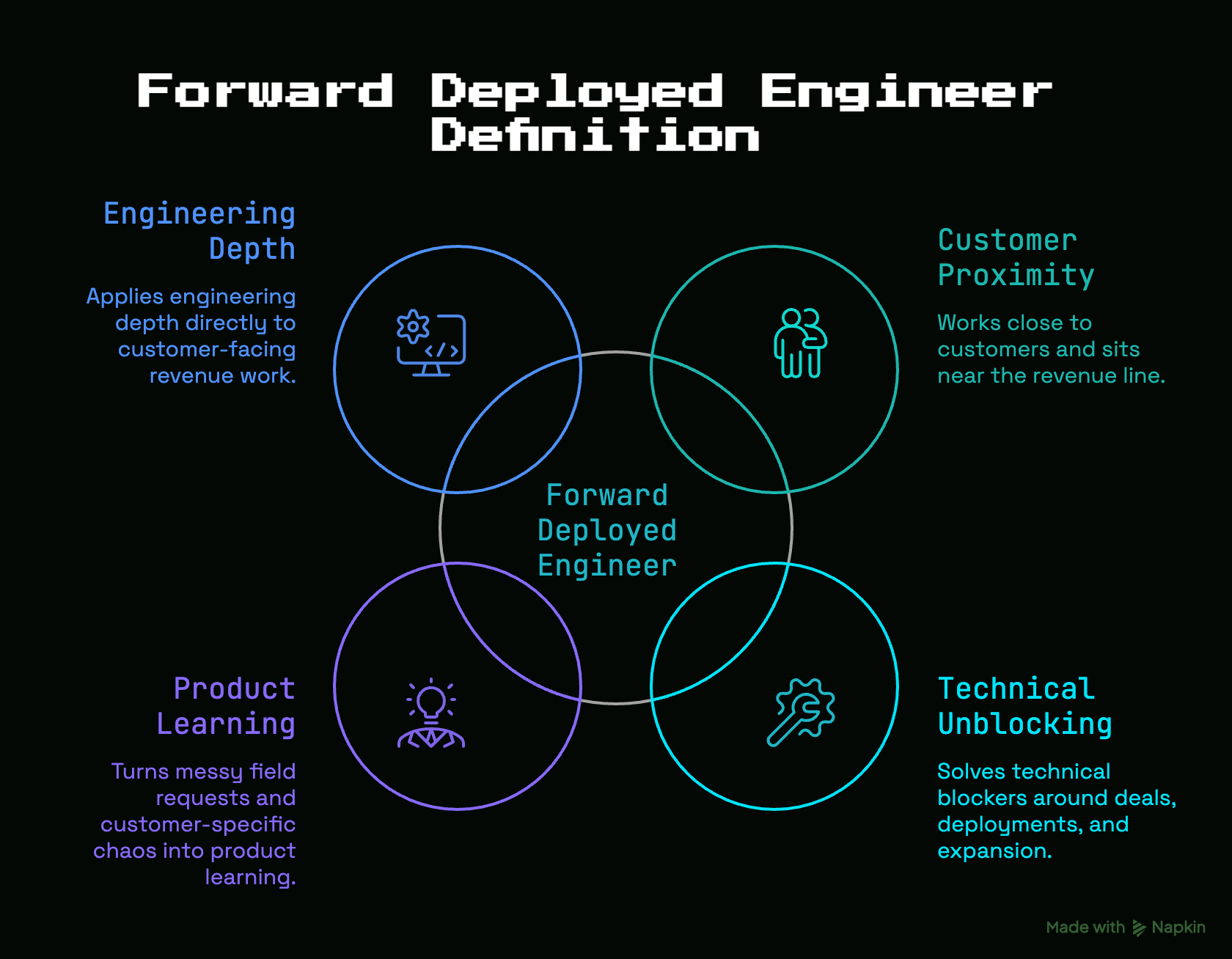
If you’re asking do I need a forward deployed engineer, you’re usually not asking about a job title. You’re asking why deals keep getting stuck on technical details, why founders keep joining late-stage calls, and why revenue now depends on someone who can both build and unblock. A forward deployed engineer is an engineer who works close to customers, solves technical blockers around deals and deployments, and turns messy field requests into product learning.
What a Forward Deployed Engineer Actually Is
A forward deployed engineer sits near the revenue line, not buried deep in the roadmap. The job is simple to describe and hard to fake: get close to customers, handle technical friction that blocks deals or expansion, and convert customer-specific chaos into something your product team can actually use.
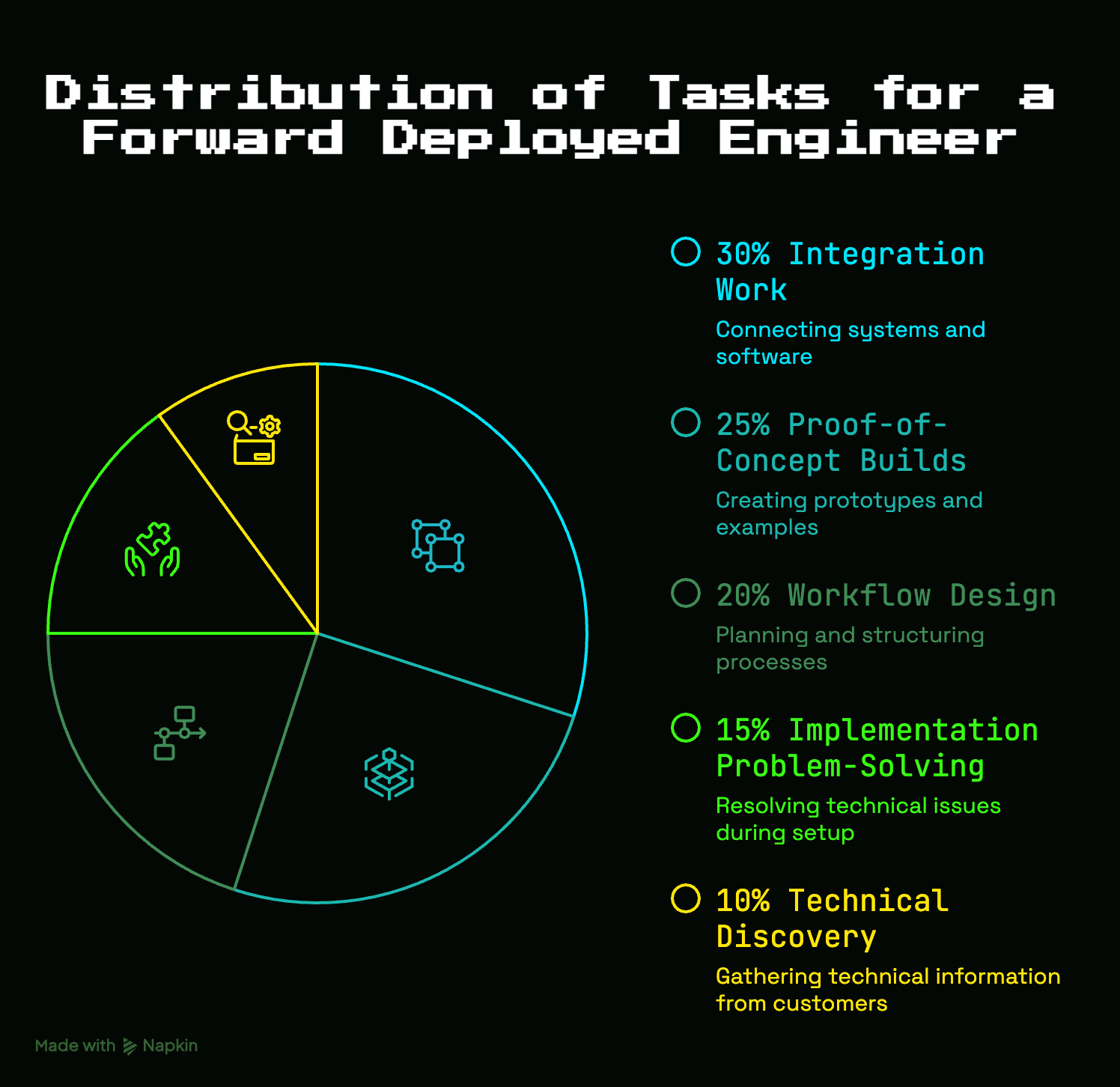
That means integration work, proof-of-concept builds, workflow design, implementation problem-solving, and technical discovery. Not generic coding. Not just demos. Not support tickets. The role exists because your clean product story collides with the real world, where every buyer has a different stack, weird data, security rules, and one legacy process nobody warned you about.
A standard software engineer focuses on building the product. A sales engineer focuses on technical pre-sales support and product explanation. A solutions engineer usually scopes and designs solutions around customer needs, often with less hands-on product engineering. A customer success manager focuses on adoption, retention, and account health. A forward deployed engineer crosses some of those borders, but the defining trait is engineering depth applied directly to customer-facing revenue work.
Why the Role Feels Confusing at First
Early SaaS teams blur this role constantly because the work starts as “founder stuff.” You jump on the call, hack around a blocker, answer the security questionnaire at 10:40 p.m., and patch the integration just enough to get the deal moving.
That works for a while. Then the same pattern repeats across more deals, and suddenly nobody knows what to call it. Sales thinks it needs technical support. Engineering thinks it’s random interruptions. Customer success sees implementation spillover. The confusion comes from the fact that FDE work lives between org chart boxes.
Here’s the thing: the problem is not naming the role. The problem is hiring the wrong role for the work already happening.
The Real Question Behind “Do I Need a Forward Deployed Engineer?”
The real question is not whether the title sounds modern or impressive. The real question is whether your revenue motion now depends on technical problem-solving that sales, product, and support cannot absorb without slowing growth.
If deals move only when someone technical jumps in, your business has a field execution problem. If that work is frequent, repeatable, and tied to revenue, you need to treat it as a real function instead of a heroic side quest.
Early in company building, almost everything feels messy. That does not justify specialized hiring. You need a forward deployed engineer only when technical customer work stops being occasional friction and starts becoming part of the sales motion itself.
The Job-to-Be-Done an FDE Fills
An FDE fills the gap between “the product works” and “the customer can buy and use it in their environment.” That gap includes integrations, custom workflows, proofs of value, implementation design, data mapping, and edge cases that do not fit neatly into your demo path.
This is the person who can say, “Yes, your system is strange, but here’s how this can work,” then actually make that true. That matters when a qualified prospect likes your product but stalls on one technical hurdle after another.
Without this role, the work lands in the wrong places. Founders get dragged into every serious deal. Product engineers context-switch constantly. Sales overpromises. Support inherits problems created before signature. None of that scales.
The Direct Claim: Most Early SaaS Teams Do Not Need One Yet
Most early SaaS teams do not need a forward deployed engineer yet.
If you still close most deals through a founder-led, repeatable motion, your first hire is usually not an FDE. The better first hire is often a sales rep, a sharper implementation lead, or a product improvement that removes the recurring friction entirely. Hiring an FDE too early creates a dangerous habit: you start solving product and positioning weaknesses with custom work.
That feels productive because deals move. The catch is that you end up training your company to say yes to every odd request. Your product gets fuzzier, your margins get worse, and your roadmap turns into a junk drawer.
Signs You Actually Need a Forward Deployed Engineer
You need an FDE when technical complexity sits directly in the path of revenue, and that pattern keeps repeating across valuable deals. Not once. Not occasionally. Repeatedly.
This usually shows up when you move upmarket, when customers have more complex environments, or when your ICP is real but not cleanly uniform. That combination creates technical selling work that nobody owns well enough.
You Keep Losing or Delaying Deals on Technical Details
If qualified deals stall because no one can answer technical questions fast and credibly, that is a real signal. Security reviews drag. Integration questions sit unanswered for days. Prospects ask if your product works with their data warehouse, identity provider, or Salesforce setup, and the answer depends on which engineer has time to look.
Picture a Thursday-night demo. The buyer is ready, procurement is circling, and everything stops because a one-off Salesforce field mapping issue breaks the workflow that matters most. If that scene feels familiar, your problem is not “sales needs to try harder.” Your problem is missing technical ownership near the deal.
Your Product Wins Only After Hands-On Technical Work
Some products do not sell cleanly through slides, demos, and pricing pages. Revenue happens only after somebody maps data, configures a workflow, tests an API path, or builds a lightweight proof of value inside the customer’s environment.
That is FDE-shaped work, whether you named it or not.
If a prospect needs to see the product connected to real data before signing, or if buying requires technical adaptation before value becomes obvious, you need a role that can do that work systematically. Otherwise every deal becomes artisanal.
Your ICP Is Real, but Not Uniform
You can have a solid ICP and still face a lot of variation. Buyers share the same high-level pain, but one runs on HubSpot, one lives in Salesforce, one has rigid security controls, and one still exports CSVs from a tool nobody wants to admit exists.
That kind of variation creates repeated field-learning work. Not because your product is broken, but because real customer environments are messy. A forward deployed engineer notices which differences matter, which ones repeat, and which ones deserve product investment. That insight is valuable because it comes from direct contact, not secondhand notes in Slack.
Founders or Engineers Are Getting Pulled Into Every Late-Stage Deal
This is one of the clearest signals. Your calendar fills with technical discovery calls. Your CTO becomes an unofficial deal desk. Product engineers get interrupted to answer implementation questions, review mappings, or join evaluation meetings.
Once that pattern starts, revenue depends on constant context switching from your most expensive people. That is not a hustle story. That is a scaling problem.
Signs You Do Not Need a Forward Deployed Engineer
Plenty of teams talk themselves into this hire because the title sounds like a shortcut. It isn’t. If the underlying issue is basic sales execution, muddy positioning, or product gaps that should be fixed at the source, an FDE just hides the problem.
Your Sales Motion Is Still Founder-Led and Lightweight
If deals close through a clear demo, simple onboarding, and a narrow buyer profile, you do not need an FDE. Your bottleneck is usually top-of-funnel, messaging, rep ramp, or consistency in the sales process.
At $1 million to $5 million ARR, that distinction matters. A specialized technical hire before the motion is stable often adds complexity instead of leverage.
You Are Using “FDE” to Avoid Fixing Product Gaps
This trap is common. Onboarding is rough, docs are thin, integrations are half-finished, and the product boundary is unclear, so the answer becomes “hire somebody technical to smooth it out.”
No. That turns custom work into a crutch.
If the same friction appears every week, the right move is to fix the product, improve onboarding, tighten docs, or say no to bad-fit deals. An FDE should surface product patterns, not permanently absorb them.
You Really Need a Sales Engineer, Solutions Engineer, or Better Support
Sometimes the problem is simpler than it looks. If you mostly need better demos, stronger technical discovery, and cleaner objection handling, you need a sales engineer. If you need implementation planning and solution design without much custom engineering, a solutions engineer fits better. If customers are confused after purchase, the gap sits in support or customer success.
Do not hire an engineer for a non-engineering problem. That mistake gets expensive fast.
Where Forward Deployed Engineers Add the Most Value
An FDE earns the role by creating leverage in three places at once: revenue, product learning, and execution speed. That combination is why strong teams value the role so highly, especially in complex enterprise motions highlighted by operators at First Round and SVPG.
Pushing Strategic Deals Over the Line
Big deals come with technical scrutiny. Buyers want proof, not reassurance. An FDE helps you pass technical evaluation, build trust during procurement, and answer “can this work here?” with something better than a confident shrug.
That shortens deal cycles and protects your core engineering team from becoming permanent pre-sales support. It also gives sales a credible partner for the moments that actually decide the deal.
Turning Customer Chaos Into Product Insight
This is where the role gets interesting. An FDE sees recurring workflow hacks, repeated data pain, and hidden buying triggers before those patterns show up in dashboards. That kind of embedded learning is exactly why product leaders talk about using field work to build to learn, not just build to deliver.
Customer chaos is useful when someone technical is close enough to spot the pattern. Otherwise it stays noise.
Scaling Founder-Led Technical Selling
Early on, a lot of technical selling lives in your inbox, your memory, and your ability to jump into a call and fix the room. That works until volume rises.
An FDE captures that scrappy, founder-driven problem-solving and makes it repeatable. The answers get documented. The integration patterns get standardized. The line between “worth doing live” and “needs product work” gets clearer. That is how you stop relying on tribal knowledge.
Cleaning Out the Feature Garage
Every early SaaS product accumulates feature clutter. One-off requests sneak in because a deal feels important, and soon the product starts looking like a garage full of old cables and half-used tools.
A good FDE helps clean that out. The role should separate true patterns from random asks, so your team builds reusable capability instead of bespoke junk. Done right, field exposure improves product discipline.
The Catch: FDE Is a Powerful Role and an Easy One to Misuse
This role goes wrong when ownership is fuzzy. Because an FDE can talk to customers, solve problems, and write code, the job attracts every unresolved task in the company.
That is exactly why clear boundaries matter.
Do Not Shove the Role Into Core Engineering
If your FDE becomes just another engineer on roadmap tickets, you lose the whole point of the role. The value sits in field contact, customer context, and rapid problem-solving near revenue.
Keep the role close to the edge where product meets reality. Otherwise you are just paying extra for a distracted software engineer.
Do Not Turn the Role Into Post-Sales Firefighting
The opposite failure mode is just as bad. If the FDE spends every week cleaning up implementations, handling escalations, and appeasing unhappy accounts, the role becomes premium support.
That burns out strong talent and muddies your org design. Customer fires need ownership, but not all of that ownership belongs in forward deployment.
Watch the R&D vs. COGS Tension
Here’s the practical finance question discussed in operator circles such as barry.ooo: is this role creating reusable product capability, or doing customer-specific delivery work?
That matters because one improves the product and the other behaves more like cost of service. If your FDE spends most time building repeatable components, that supports product leverage. If the role is mostly custom delivery tied to specific accounts, your margins will show it.
How to Decide: A Simple Diagnostic for Your Team
You do not need a long org design memo. You need a clean diagnosis.
Ask These 5 Yes-or-No Questions
Use this quick check:
- Are technical blockers delaying qualified deals every month?
- Are engineers repeatedly pulled into pre-sales work?
- Does customer variation create repeat custom work?
- Are high-value prospects asking for integrations or workflow changes before buying?
- Can field learning feed roadmap decisions quickly?
If you answer yes to several of these, the work already exists. The title is just catching up.
If You Answered Yes to 4 or 5
You need a forward deployed engineer now. Delaying the hire keeps revenue dependent on founder heroics, engineering interruptions, and slow technical follow-up.
That setup costs more than the headcount.
If You Answered Yes to 2 or 3
You have emerging FDE work, but your first move is tighter role scoping. Define where the friction actually sits. If the pain is mostly demos and technical validation, hire narrower. If the pain is real engineering near customer workflows, prepare the FDE role before the chaos hardens into habit.
If You Answered Yes to 0 or 1
You do not need an FDE. Focus on sharpening ICP, fixing the product, improving onboarding, or hiring your first sales rep.
Specialized roles make weak systems look busy.
What the First Forward Deployed Engineer Should Actually Own
If you make this hire, the role needs clean ownership from day one. Fuzzy roles drift into nonsense.
Core Responsibilities
Your first FDE should own technical discovery for complex deals, solution scoping, proof-of-concept work, integration problem-solving, implementation design, and the feedback loop from field learning into product decisions — here’s what that looks like week to week.
The common thread is simple: direct ownership tied to revenue and reusable learning. Every project should either unblock a deal, speed up deployment, or reveal a product pattern worth acting on.
What Stays Out of Scope
Keep roadmap maintenance, generic support queue work, account management, and endless bespoke feature requests out of scope. If the role owns everything technical that feels annoying, the role is already broken.
Boundaries protect leverage. Without them, you hire one talented person and bury that person under leftovers.
Success Metrics That Make Sense
Measure outcomes that reflect leverage: deal cycle reduction, technical win rate, implementation time, reusable patterns created, and field insights that turn into roadmap decisions.
Vanity metrics miss the point. You want proof that technical customer work is becoming faster, cleaner, and more repeatable.
Who to Hire for the Role
A strong first FDE needs range. Not just coding ability. Not just customer polish. Range.
Traits to Look For
Look for strong coding ability, systems thinking, calm customer communication, commercial instinct, and pattern recognition across messy requests. In plain English, that means someone who can understand a strange setup, explain tradeoffs clearly, notice what keeps repeating, and fix the right problem instead of the loudest one.
Comfort with ambiguity matters too. The job rarely arrives packaged neatly.
Red Flags in Hiring
A pure feature engineer with no customer instinct struggles here. The person writes good code but hates messy conversations, avoids tradeoffs in real time, and loses patience the moment requirements get fuzzy.
The polished pre-sales talker with weak technical depth also fails. That person sounds great on Zoom and falls apart when the real integration issue appears. You need both judgment and execution.
How to Interview for the Job
Interview for actual problem-solving. Give a messy customer scenario. Ask for an integration approach. Test practical coding or code review. Ask for tradeoffs in plain English.
If the candidate cannot move smoothly between technical depth and customer clarity, keep looking.
Alternatives to Hiring a Full-Time FDE Right Now
A lot of bootstrapped teams feel this pain before they are ready for a dedicated hire. That does not mean you ignore it. It means you handle it deliberately.
Use Founder-Led Technical Selling More Deliberately
Document recurring objections. Standardize integration answers. Set rules for when engineering joins calls and when sales handles the issue alone. Turn your current improvisation into a repeatable system.
That buys time and exposes whether the pain is truly persistent.
Hire a Sales Engineer or Solutions Engineer First
If the work is mostly technical validation, demos, and pre-sales explanation, hire a sales engineer first. If the work leans toward implementation planning and solution design, hire a solutions engineer first.
Choose the narrower role when the engineering part is still light. That keeps your org honest.
Fix the Product Before You Add Headcount
If the same friction shows up every week, fix it in product, onboarding, docs, or integrations. A person is not a product strategy.
The simplest answer is often the right one.
Your Next Move
Review your last 10 qualified deals and mark every point where technical work changed the outcome. Notice who got pulled in, what questions repeated, and which blockers came from customer variation versus product weakness.
If the same pattern keeps showing up, stop treating it like random noise and hire for it. If the pattern does not repeat, do one boring thing instead: fix the product gap that keeps wasting your time.


Discussion