

If your sales process lives in your head, you do not have a sales playbook. You have a founder who knows how to win deals by instinct, speed, and context, right up until the day a new rep joins and asks why one demo closes in 12 days while another dies after three follow-ups. This guide shows how to turn founder sales into a real sales playbook: a documented, usable system another person can run without needing your live translation on every call.
A sales playbook is the written operating system for how your team targets accounts, qualifies interest, runs calls, handles objections, moves deals forward, and closes the right customers. In a B2B SaaS company, a real playbook is not a script folder or a CRM setup. It is the practical record of how revenue actually gets created.
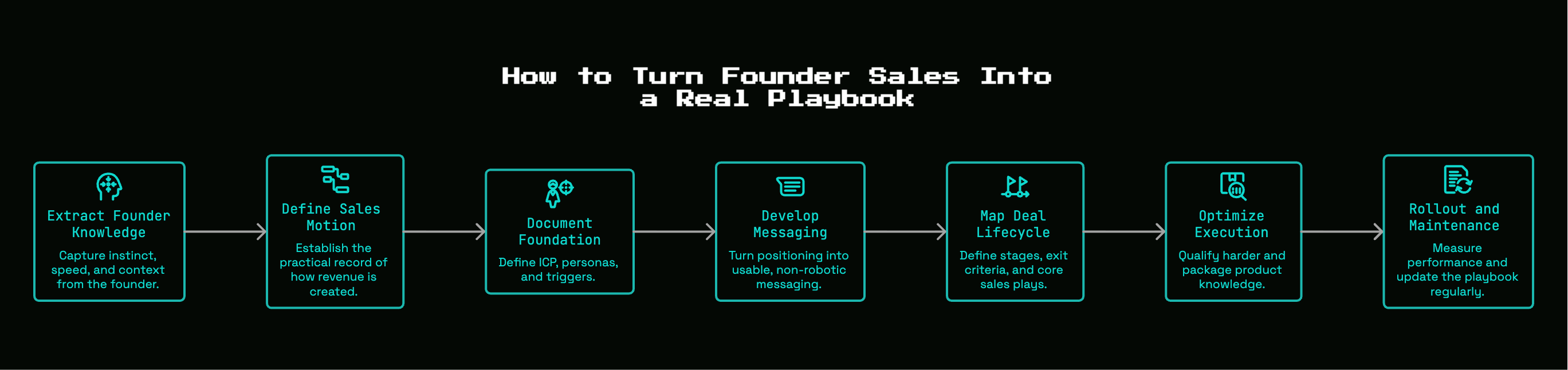
Here’s what you’ll learn:
- how to extract founder knowledge fast
- how to define your actual sales motion
- how to document ICP, personas, and triggers
- how to turn positioning into usable messaging
- how to map stages and exit criteria
- how to build core sales plays
- how to write scripts without sounding robotic
- how to qualify harder and waste less time
- how to package product knowledge for deals
- how to roll out, measure, and update the playbook
Why Founder-Led Sales Stops Working as You Start Hiring
Founder-led sales works early because you can bridge gaps in real time. You know the product better than anybody else. You can answer weird edge-case questions without blinking. You can spot a good buyer in ten minutes because you have lived through fifty versions of the same conversation.
That stops scaling the second somebody else has to do it.
A founder sale is not a process until another person can run it and get a similar result. Not identical style, not identical words, but a similar outcome with the same kind of account, the same kind of pain, and the same kind of buying journey. Until then, your “process” is just memory plus improvisation.
The real problem: your best sales moves are invisible
Most founder sales behavior is hidden in small decisions. You know when to push and when to back off. You know which objection is real and which one is polite delay. You know when a prospect says “interesting” and actually means “not urgent.” None of that sits neatly inside a CRM field.
Early on, this feels like an advantage, because it is. You can move faster than a formal team. You can skip steps. You can turn a rough discovery call into a tailored demo in the same afternoon. But speed hides structure. The pattern is there, you just have not written it down.
Here’s the thing: your first rep does not fail because of effort. That rep fails because the winning moves are invisible. If the best parts of your sales motion live in your judgment alone, every handoff turns into guesswork. Calls become inconsistent. Follow-up quality drops. Qualification gets fuzzy. The pipeline looks busy and performs badly.
What a sales playbook actually is
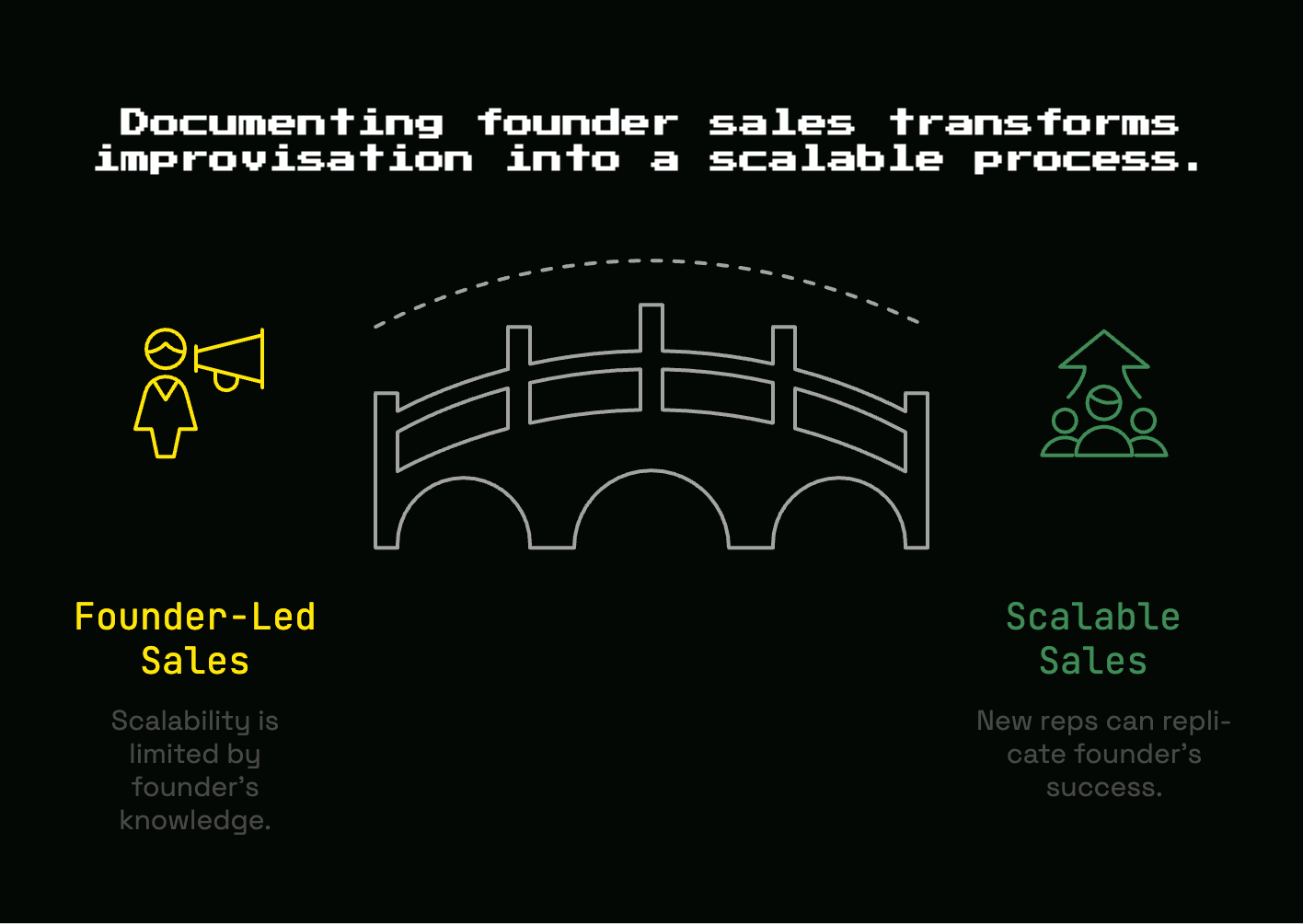
A sales playbook is the documented way your team finds, qualifies, advances, closes, and expands the right accounts. It tells a seller what good looks like at each step and gives enough context to make smart decisions without checking with you every twenty minutes.
That means it includes process, messaging, qualification, product context, competitive framing, templates, and stage rules. It does not mean a giant document full of generic sales theory. And it definitely does not mean a random pile of scripts pasted into Notion after a late-night sprint.
A script dump tells somebody what to say. A CRM field list tells somebody what to log. A generic onboarding doc tells somebody where things are. A real sales playbook tells somebody how to sell your product to your market in the way that actually works.
What “real” looks like in a B2B SaaS sales playbook
In a $1M to $5M ARR B2B SaaS company, a useful playbook is concrete. A new rep can open it before a discovery call and know which questions matter. A rep can review a stalled proposal and know what is missing. A founder can listen to a call and coach against shared standards instead of vague instinct.
That is the standard for this guide.
Your playbook needs to give a new rep enough context to run calls, handle common objections, move deals through stages, and recognize good fit without waiting for founder approval at every turn. If it cannot do that, it is not done.
Start With the Raw Material: Capture How You Sell Today
Do not start by making the document pretty. Start by getting the truth out of the places it already lives.
The first version of a playbook should feel a little messy. Good. That means it came from real deals, not from a blank page and wishful thinking. At this stage, speed beats polish. The goal is to capture patterns while they are still fresh and visible.
Audit your last 10 to 20 closed-won deals
Start with your most recent wins, ideally the last 10 to 20 deals that look like the business you want more of. Review each one and look for the recurring shape of the deal.
What triggered the conversation? Who got involved first? Which persona became the internal champion? How long did the cycle take from first meaningful conversation to signature? Which proof points landed? What objections came up? What specific next step kept the deal moving?
Patterns show up faster than expected when you review deals side by side. You start seeing the same pain language, the same stakeholder sequences, the same moments where urgency becomes real. Maybe the winning deals all started with a VP of Sales frustrated by spreadsheet forecasting. Maybe almost every deal included one finance question late in the process. Maybe the same pricing objection came up right before close and only moved after a clear ROI summary.
Document all of it. Not in perfect prose. Just get it out.
Study the deals that stalled or died
Won deals tell you what works. Lost deals tell you what to stop chasing.
A stalled or closed-lost deal often exposes the missing rule in your process. Maybe the rep demoed too early. Maybe the account loved the product but had no internal owner. Maybe the buyer said budget was approved, but procurement never had a reason to care. Maybe there was real pain, but no urgency to solve it this quarter.
Capture bad-fit signals, missing stakeholders, pricing friction, no-decision patterns, product gaps, and timing issues. Pay special attention to “great demo, no close” deals. Those usually reveal qualification failures dressed up as interest.
You want your first rep to avoid the time sink accounts that look promising, ask smart questions, and never buy. Those accounts are expensive. They consume demos, follow-ups, custom decks, and emotional energy. Your playbook should protect against that.
Pull evidence from the places you already use
The raw material is already sitting in your systems. Pull from call recordings, CRM timelines, email threads, proposal docs, demo notes, Slack messages, kickoff calls, and renewal conversations. If you use Gong, Chorus, HubSpot, Salesforce, Close, Notion, or Google Docs, you already have more than enough to start.
Focus on evidence, not recollection alone. Memory tends to smooth out details. Recordings preserve them.
A single Tuesday afternoon demo can tell you more than a polished quarterly review. Picture one where the prospect seemed interested but passive, then the CFO leaned in only after the ROI math came out and the seller tied the price to reduced manual reporting time. That is not a vague lesson. That is a repeatable moment. “Bring simple ROI math forward when finance joins late” belongs in a playbook.
Define Your Sales Motion Before You Document It
A lot of weak playbooks fail for a simple reason: the company never clearly chose its sales motion. If you are trying to document everything for every path, you get clutter fast.
Before you write detailed plays, define the motion you are actually running.
Clarify your sales model
Your sales model shapes the entire playbook. A founder-led motion needs heavy founder knowledge capture and clean handoff rules. An AE-led motion needs stage discipline, call standards, and coaching criteria. A PLG-assisted motion needs tighter rules for when product usage turns into sales engagement. An outbound-led motion needs prospecting plays that are much more detailed than an inbound-heavy business. A partner-supported motion needs joint selling guidance and channel rules.
Do not document all models just because you touch a little of each. Pick the primary motion that produces most of your revenue right now, then add secondary plays where needed.
If most revenue starts with inbound demos from operators replacing manual workflows, your playbook should reflect that. If most revenue comes from targeted outbound into sales leaders at Series A and B companies, the front half of the playbook needs far more detail on account selection, triggers, and outreach than on hand-raisers.
Decide what deal you are actually built to win
Different deal shapes require different selling behavior. That sounds obvious, but early-stage teams blur it constantly.
A $6,000 annual contract sold in two calls with one operator buyer does not need the same playbook as a $40,000 deal with three stakeholders, security review, and implementation planning. If you treat both the same, your process gets vague and your rep spends too much time overworking small deals or underworking large ones.
Define the deal you are built to win. Set the normal ACV range. Document the average sales cycle. Note how many stakeholders usually matter. Clarify implementation complexity and what creates urgency. This becomes the design constraint for the playbook.
When your first rep knows, “Most good deals close between $12,000 and $25,000 ARR, involve a manager-level champion plus one budget owner, and move in 30 to 45 days when a reporting or workflow pain is active,” selling gets sharper immediately.
Separate custom behavior from repeatable behavior
Founders routinely overestimate what is transferable. That is the catch.
Some behavior wins deals only because it comes from you. Deep product improvisation, roadmap promises, off-script technical positioning, and personal relationships that predate the sales process are not repeatable by default. Do not bake them into the standard play unless you can train, support, and govern them.
Separate the motions clearly. Mark what a rep can do solo, what needs escalation, and what stays founder-only. For example, a rep can tailor demos by use case, but custom roadmap commitments require approval. A rep can discuss known integration patterns, but architecture exceptions route to product or engineering. A rep can handle standard pricing conversations, but nonstandard terms escalate.
This one move cleans up your playbook fast. It turns founder magic into bounded systems.
Build the Foundation: ICP, Personas, and Buying Triggers
Most early sales problems are targeting problems in disguise. If your rep talks to the wrong accounts, runs discovery on weak opportunities, and demos for people with no urgency, no script in the world will save performance.
That is why every serious sales playbook starts with targeting.
Write your ideal customer profile in operational terms
Your ideal customer profile is not a marketing slogan. It is the set of companies most likely to buy, get value quickly, and stay. That means your ICP should describe operating reality, not broad identity labels.
Document company size, team structure, tech stack, current workflow, use case, maturity level, pain intensity, and budget reality. Include what the company is already doing before the sale. “Using spreadsheets and Slack to manage outbound performance across a 15 to 60 person sales team” is useful. “Mid-market SaaS company” is not enough.
The best ICP sections feel almost diagnostic. Your rep should be able to look at an account and tell within minutes whether it resembles the accounts that close well, onboard smoothly, and retain.
Also document negative ICP patterns. Accounts with the right headcount but no process owner. Teams that want analytics without consistent underlying data. Companies chasing a use case your product only partly supports. That belongs here too.
Document the buying roles you keep seeing
Most B2B SaaS deals involve a small cast of recurring roles. Your playbook should define each one in plain English and show what each role cares about.
Start with the champion, evaluator, budget owner, blocker, and end user. In some deals, one person plays two roles. That is fine. The goal is not bureaucracy. The goal is clarity.
A champion wants the problem solved and will spend political capital to get it done. An evaluator wants proof the product works in the actual workflow. A budget owner wants confidence in impact, cost, and risk. A blocker cares about disruption, implementation pain, or competing priorities. An end user wants the job to get easier.
Document the language that gets attention from each role. A founder cares about speed, leverage, visibility, and growth constraints. A sales leader cares about pipeline health, forecast confidence, rep execution, and ramp time. An ops lead cares about clean process, reliable data, admin load, and adoption. A finance contact cares about cost control, measurable return, and risk reduction.
This section gives your rep a huge advantage. Same product, different frame.
Map the trigger events that create urgency
Good sales teams do not just know who to target. They know when the pain is active enough to buy.
Document the trigger events that repeatedly open real deals. These are usually operating changes or pressure points: hiring a sales team, replacing spreadsheets, missing targets, preparing for a board meeting, entering a new market, absorbing churn, consolidating tools, launching a new motion, or cleaning up reporting after fundraising.
Triggers matter because urgency is rarely abstract. A buyer does not wake up and decide to “improve process.” A buyer reacts to friction that has become expensive, visible, or embarrassing.
Your rep should know how to connect the trigger to a business consequence. “You hired six reps in one quarter and forecasting still lives in spreadsheets” is stronger than “you may want better visibility.” Concrete beats abstract every time.
Add your disqualifiers
A strong playbook does not just say yes faster. It says no sooner.
Write down what poor-fit accounts look like. No active use case. No internal owner. Tiny pain. No realistic spend category. No implementation bandwidth. Looking for a product category you do not actually serve. Chasing custom features as a condition of starting. Treating the call as research, not evaluation.
This saves your rep from spending weeks on accounts that love the demo and never buy. Early-stage teams often mistake enthusiasm for intent. The disqualifier section fixes that.
Turn Your Value Proposition Into Messaging a Rep Can Use
Positioning documents often sound good and sell poorly. They are built for websites, decks, or internal alignment, not live conversations. Your playbook has to bridge that gap.
The rep does not need prettier words. The rep needs usable language.
State the core problem you solve in one sentence
Write the simplest accurate sentence that explains the before and after.
A good version sounds like a person talking, not a category page. “You replace manual pipeline reporting with a system that gives sales leaders a current view of performance without chasing reps for updates” is clear. It names the pain, the change, and the practical result.
That sentence becomes the anchor for calls, emails, demos, and follow-ups. It should be easy to remember and specific enough to matter. If it sounds broad enough to fit ten SaaS tools, rewrite it.
Create message variations by persona
Your product solves one core problem, but the reason it matters changes by role.
For a founder, frame it around leverage, focus, and fewer blind spots. For a sales leader, frame it around execution, visibility, and forecast trust. For an ops lead, frame it around cleaner workflows, fewer manual fixes, and consistent data. For finance, frame it around cost, efficiency, and decision confidence. For end users, frame it around time saved and fewer annoying workarounds.
Do not turn this into creative copywriting. Keep it grounded. The best persona messaging sounds like a direct reflection of the job in front of that person.
A founder does not care that your workflow is “intuitive.” A founder cares that the Monday 8:30 a.m. pipeline review stops turning into a debate about whose spreadsheet is right.
Document proof points that actually move deals
Proof points are not just logos. They are the pieces of evidence that reduce doubt at the right moment in the sales process.
Document customer stories, implementation speed, quantified outcomes, workflow improvements, risk-reduction examples, and adoption wins. Then tie each proof point to the stage or objection where it works best.
An early discovery call benefits from fast credibility. A simple peer example or relevant customer pattern works well there. A late-stage proposal conversation benefits from business impact and implementation confidence. That is where ROI examples, time-to-value stories, and rollout simplicity matter more.
Good playbooks also explain when not to use a proof point. A giant logo can backfire if your prospect is much smaller and assumes the product is overbuilt. A dramatic ROI claim can create skepticism if the deal is still early and the pain has not been fully surfaced.
Build a competitor positioning section that does not sound defensive
Competitive positioning gets awkward fast when it turns into trash talk. Avoid that.
Document the main alternatives: direct competitors, spreadsheets, internal builds, adjacent tools, and doing nothing. For each, explain why buyers choose that route, where it works, where it breaks, and how to frame the tradeoff cleanly.
If a buyer uses spreadsheets, acknowledge the appeal. Familiar, flexible, cheap, already in use. Then state the tradeoff: manual upkeep, inconsistent inputs, no shared visibility, and fragile reporting when the team grows.
If a buyer compares you to a direct competitor, define the difference in terms of fit and priorities. Maybe the competitor serves larger enterprises with more customization but heavier implementation. Maybe your product gets live faster and fits leaner teams better. Clean, factual positioning builds trust.
Map Your Actual Sales Process, Not the One You Wish You Had
A lot of CRM pipelines describe activity, not progress. Demo booked. Demo completed. Follow-up sent. Proposal viewed. None of that means the deal is actually moving.
Your sales playbook should map the process that produces revenue now, using buyer movement as the standard.
Define each sales stage with clear exit criteria
Every stage should answer one question: what must be true for this deal to earn movement to the next stage?
Typical stages include new lead, qualified, discovery complete, demo complete, evaluation, proposal, procurement, closed won, and closed lost. The stage names matter less than the definitions.
“Qualified” should not mean “good conversation.” It should mean the account fits your ICP, a real problem exists, somebody owns it, and there is agreement on a next step. “Demo complete” should not mean “the meeting happened.” It should mean the seller showed the relevant workflow, confirmed interest, and secured a committed next step tied to the buying process.
Exit criteria keep the pipeline honest. They also make coaching easier. If a deal jumps stages without the required facts, the issue is visible.
Match seller actions to buyer actions
Deals do not advance because the seller checked a box. Deals advance because the buyer did something meaningful.
At each stage, document both sides. Seller action: ran discovery, delivered tailored demo, sent proposal, answered security questions. Buyer action: confirmed pain, introduced another stakeholder, defined evaluation steps, shared timeline, reviewed pricing, engaged procurement.
This distinction matters a lot in early-stage SaaS because founders often over-credit activity. A strong call feels like progress. Sometimes it is. Sometimes it is just polite curiosity. Buyer commitments separate motion from momentum.
Set stage-specific goals, conversion rates, and timing
This is where a playbook gets teeth.
For each stage, define target conversion, average time in stage, and the threshold that signals a stuck deal. You do not need enterprise-grade analytics to do this. Start with recent history. If qualified deals that close usually move from demo to proposal in 10 days, then 24 days without movement is not neutral. It is a warning.
Document what good looks like numerically. Speed to first meeting. Discovery-to-demo conversion. Demo-to-proposal rate. Proposal-to-close rate. Average days in evaluation. Days with no meaningful buyer action.
Now your first rep is not guessing whether a deal is healthy. The playbook supplies the frame.
Define required CRM hygiene
Keep CRM rules lean and useful. A good playbook does not turn sellers into clerks.
Require the fields that support actual deal management: next step, date of next buyer commitment, stakeholder map, pain summary, target outcome, close date confidence, deal risk, and closed-lost reason. If you use a qualification framework, log the key answers there too.
Every required field should serve one of three purposes: help the seller run the deal, help you coach the deal, or help the team learn from the deal. If a field does none of those, cut it.
Document the Core Sales Plays Your First Rep Needs
This is the center of the sales playbook. A play is a repeatable sequence for a common revenue situation. It answers the practical question, “When this happens, what should you do next?”
Start with the plays your first rep will use constantly.
New logo acquisition play
A new logo acquisition play covers the standard path from target account to closed customer. It should describe the flow in simple, repeatable terms: account selection, trigger identification, outreach, first conversation, discovery, tailored demo, follow-up, stakeholder expansion, proposal, and close plan.
Document what research is enough before outreach. Define what counts as a strong first message. Clarify what the first call must accomplish. Show how to shift from problem exploration into a relevant product conversation. Set rules for when to bring in additional stakeholders and how to confirm the buying path before a proposal goes out.
The best version reads like operating guidance, not philosophy. “After a positive discovery call, send a recap within two hours with the agreed pain, target outcome, open questions, and calendar hold for the demo” is useful. “Maintain momentum through thoughtful communication” is wallpaper.
Inbound lead qualification play
Inbound leads feel easy, which is why teams mishandle them.
Document the required response time, the first qualification checks, the routing logic, and the default next step by lead type. A hand-raiser from a strong-fit account with a clear use case should get fast scheduling and tight qualification. A weak-fit inquiry should still get respectful handling, but not the same seller time.
Keep qualification light enough to preserve speed. You do not need a twenty-question gate just because somebody booked a demo. You need the few facts that predict deal quality: fit, pain, urgency, owner, and plausible buying path.
Also define what not to do. Do not turn an inbound conversation into an interrogation. Do not schedule full demos for every curious contact. Do not let calendar convenience outrun judgment.
Outbound prospecting play
Outbound needs more structure because it starts from less buyer intent.
Define list criteria first. Which accounts fit your ICP? Which titles matter? Which triggers justify outreach now? Then set the expected research depth. Most accounts do not need a custom dossier. They need enough context to tie your message to a real operating condition.
Document your cadence. How many touches, across which channels, over what time period. Clarify where personalization belongs and where standardization is better. A good rule: personalize the reason for outreach, standardize the structure.
Also define what counts as a real response. “Looks interesting, send info” is not the same as “we’re replacing our manual workflow this quarter.” Your playbook should teach the rep to distinguish signal from politeness.
Discovery call play
Discovery is where founder intuition often looks hardest to transfer, but it becomes teachable once you break down the job.
A strong discovery call covers context, goals, current workflow, pain, business impact, urgency, stakeholders, decision process, and next step. That does not mean asking robotic questions in a fixed order. It means getting enough truth to decide whether the account deserves a tailored demo and a real sales effort.
Document the opening. Set the agenda. Create permission for a conversation, not a pitch. Move from current state into friction. Ask what is breaking, where time is wasted, where visibility is weak, what happens if nothing changes, and who feels the pain most directly.
Most weak discovery calls fail because the seller starts demoing too early. The moment the buyer mentions a problem, the seller rushes to show a feature. Resist that. Discovery is not the prelude to a product tour. It is the diagnostic work that earns the right to show the right workflow.
Demo play
The purpose of a demo is not to prove your product has features. The purpose is to help the buyer see a better way to run a meaningful workflow.
Document the structure. Start by recapping the pain and the outcome in the buyer’s own terms. Show the workflow in the order the buyer experiences value. Keep each section tied to a job the buyer needs done. Pause to confirm relevance before moving on.
Tailor by use case and audience. A manager-focused demo should emphasize visibility, control, reporting, and team consistency. An end-user-heavy demo should emphasize speed, simplicity, and day-to-day friction reduction. A finance-inclusive demo should include cost logic and rollout clarity before the end.
And cut the feature parade. If a feature does not support the diagnosed pain, it stays out.
Trial or proof-of-concept play
If your product uses trials or a proof of concept, document strict entry criteria. Nothing burns time faster than a trial with no owner, no setup discipline, and no shared definition of success.
State what must be true before a trial starts. There must be a live use case, an internal owner, access to the right users or data, and a scheduled end-of-trial review. Define setup steps, timeline, mutual commitments, success metrics, and the decision process at the end.
A trial is not a delay tactic if it is structured. It is a buying event with checkpoints.
Proposal and closing play
A proposal should not feel like the start of a mystery. By the time pricing goes out, the seller should know who approves, what matters, what objection is likely, and what process follows.
Document how to present pricing, recap value, confirm package fit, align on timing, handle procurement, and drive to signature. Include what the proposal email or call should cover: business problem, agreed value, recommended package, terms, implementation summary, and exact next steps.
Also write the anti-pattern clearly. Do not send a proposal and wait. Passive waiting is not deal management. Every proposal needs a close plan tied to named stakeholders and dated next actions.
Expansion and upsell play
Expansion belongs in the playbook if existing customers create meaningful growth. For many B2B SaaS companies, that starts earlier than expected.
Document the triggers: usage milestones, additional teams showing interest, new workflows opening up, feature adoption reaching a threshold, leadership asking for broader visibility, or the customer hiring into adjacent functions.
Tie the conversation to value already proven. Expansion works when it feels like the next logical step, not a fresh pitch. If the customer has hit a usage or outcome milestone, show how broader adoption solves the next bottleneck.
Done well, expansion selling feels helpful. Done badly, it sounds like opportunism.
Create Scripts, Templates, and Talk Tracks Without Sounding Scripted
Templates are useful because selling is repetitive. Templates become harmful when they flatten judgment and personality. Your playbook should give structure without forcing stiff language.
Cold email templates
A good cold email template starts with a real reason for outreach, points to a concrete pain or trigger, and asks for a simple next step. Build a few patterns around the situations that show up most often.
One pattern can lead with a trigger: recent hiring, a systems change, or new market push. Another can lead with a known workflow pain. Another can use a role-based hook tied to a repeated responsibility, like forecasting, reporting, onboarding, or workflow cleanup.
Document what stays standard and what changes. Keep the structure, call to action, and core value statement stable. Personalize the trigger, the pain framing, and one line that proves the message belongs to that account. That balance keeps quality high without slowing reps to a crawl.
Call openers and voicemail talk tracks
Call openers should sound like a person with a reason to call, not a script trying to sneak past resistance.
For a cold call, open with relevance and permission. Name the reason, tie it to a likely operating problem, and ask a direct question. For a follow-up call, reference the prior interaction and make the next step easy. For a post-demo check-in, reconnect the product to the business issue, not just the meeting itself.
Voicemails work best when they are short and specific. State why you called, what pattern you keep seeing, and how to respond if the problem is active. Leave one clean path forward.
Discovery questions that uncover real pain
Do not dump fifty questions into the playbook and call it guidance. Organize discovery by question type so the rep knows what job each question is doing.
Workflow questions reveal how the work happens today. Impact questions show what the friction costs in time, revenue, quality, or control. Urgency questions test whether the pain is active now. Stakeholder questions expose who cares and who decides. Alternative questions show what the buyer already uses. Decision process questions clarify how buying actually happens.
This structure makes the rep more adaptive. The goal is not to ask every question. The goal is to leave the call with the facts required to qualify, tailor, and advance.
Objection-handling talk tracks
Early-stage SaaS objections repeat more than founders expect. Price, timing, bandwidth, internal inertia, current alternatives, and vague delay language show up constantly. Your playbook should cover the common ones and define the goal of each response.
For “too expensive,” the goal is to reconnect price to the cost of the current problem, test package fit, and expose whether price is real or just easy to say. For “bad timing,” the goal is to understand what is actually crowding it out and whether the trigger still creates urgency. For “send info,” the goal is to avoid replacing a conversation with a PDF graveyard. For “using something else,” the goal is to learn what works, what does not, and why change is even on the table.
For “need to think,” the goal is clarity. What exactly needs thought? Value, timing, internal buy-in, budget, or trust? For “no bandwidth,” the goal is to separate implementation fear from true lack of priority.
The point of objection handling is not to “overcome” resistance through pressure. It is to diagnose what stands between interest and decision.
Follow-up email templates by stage
Your playbook should include stage-based follow-up templates because sellers waste a surprising amount of time rewriting the same message.
Cover post-discovery recap, no-show follow-up, trial kickoff, proposal recap, stalled deal revival, and closed-lost nurture. Each template should have a defined purpose.
A post-discovery recap should confirm the pain, the goals, the use case, and the agreed next step. A no-show follow-up should be brief, low-drama, and easy to reschedule. A trial kickoff should lock commitments, timeline, and success measures. A proposal recap should summarize value and buyer process, not just restate pricing. A stalled deal revival should reconnect the account to the trigger or cost of inaction. A closed-lost nurture should preserve relevance without pretending the deal is still live.
Build Qualification Rules That Protect Focus
Qualification is where founder instinct becomes a usable filter. Without it, the playbook turns into a manual for talking to everybody and closing almost nobody.
Choose a qualification framework and simplify it
Use a framework if it helps, not because the internet told you to. MEDDICC, BANT, and SPICED all work when simplified and applied honestly. In an early-stage B2B SaaS motion, lighter is better.
Take the core ideas and strip out enterprise theater. You need pain, fit, urgency, ownership, buying path, and budget reality. That is enough to manage most deals between $10,000 and $50,000 without turning every opportunity into a procurement seminar.
The framework exists to sharpen judgment and coaching. If your rep cannot explain the account’s real problem and who feels it, no acronym will rescue the deal.
Define your must-have qualification signals
Before a deal advances, certain facts must be known. Write them down clearly.
You need a real pain, not generic interest. You need ICP fit, not just title match. You need urgency tied to a business event or operating problem. You need an owner on the buyer side. You need a plausible buying path. You need a realistic spend category, even if formal budget is not fully approved yet.
These are your must-haves. If one is missing, the deal does not deserve full-cycle treatment. It may stay in nurture, product-led follow-up, or future pipeline. But it does not earn heavy sales time.
Write red flags and stop signs into the playbook
A strong qualification section also teaches restraint.
Write down the red flags that mean slow down, recycle, or disqualify. No clear use case. No owner. Endless “just exploring.” Product gaps disguised as curiosity. Repeated next-step slippage. Pricing conversations with no business case. Demo excitement with no process movement. Requests for custom work before commitment.
Stop signs protect your rep from optimism. They also protect your forecast from fantasy.
Package Product Knowledge for Sales, Not for Internal Pride
Sales does not need a museum tour of your product. Sales needs practical product knowledge that helps in live deals.
This section should answer three questions fast: what problem does each part of the product solve, how is it packaged and priced, and where are the usual technical concerns.
Product overview by use case
Explain the product in the order a buyer experiences value. Group capabilities by the jobs they get done, not by the way the navigation menu happens to be organized.
If your platform covers reporting, workflow automation, and team visibility, describe those as outcomes tied to the buyer’s current pain. Show how the workflow changes after adoption. Keep the language concrete and buyer-facing.
This helps the rep demo better, position cleaner, and avoid feature dumping.
Pricing and packaging guidance
Your playbook should document how pricing works in plain English. Include package boundaries, minimums, contract terms, billing expectations, renewal rules, and discount authority. A rep should know what can be approved directly and what needs escalation.
Also document how to explain pricing. Good sellers do not just quote numbers. They connect packaging to use case, team size, value scope, and rollout path. If a lower package often fits better as a starting point, say so. If discounting is rare and strategic, say that too.
Clarity here prevents awkward deal friction late in the cycle.
Integrations, security, and implementation basics
Technical questions slow deals when sellers answer vaguely. Fix that by documenting the recurring questions in short, plain English.
Which systems do you integrate with? What does setup usually involve? How long until first value? What security materials are available? What permissions are typically needed? What implementation work falls on the customer?
Also include escalation paths. The rep does not need to become a solutions engineer. The rep needs enough confidence to answer the common questions and enough clarity to know when to pull in support.
Known limitations and how to handle them
Every product has weak spots. Pretending otherwise just creates late-stage trust damage.
Document known limitations, honest workarounds, and the point where the deal should be disqualified instead of forced. If a feature gap is acceptable in the short term, explain how to frame it clearly. If a gap breaks the use case, say that directly.
This section saves rep credibility. It also prevents the founder habit of rescuing deals with overpromises.
Add Competitive Intelligence and “Why Change” Material
Most deals do not die because a competitor was better. Many die because the buyer never felt enough urgency to change.
Your playbook needs material for both battles: competitor choice and status quo inertia.
Competing against the status quo
The most common competitor in B2B SaaS is “good enough for now.” Usually that means spreadsheets, manual workflows, disconnected tools, or a patchwork of habits nobody loves but everybody tolerates.
Your rep has to make inaction feel costly and concrete. That means tying the current workflow to wasted time, missed visibility, slower decisions, unreliable reporting, rep frustration, customer risk, or revenue drag. Not in a dramatic way. In a specific way.
A spreadsheet is fine until the weekly numbers break the night before the board update. A manual workflow is manageable until hiring doubles and nobody trusts the data. “Why change” becomes real when the cost of staying put is visible in the buyer’s own operation.
Direct competitor battlecards
Battlecards should be practical, not bloated. For each major competitor, document why buyers consider the product, where it is strong, where it tends to win, where your product is stronger, where your product is weaker, and how to position the difference without sounding insecure.
This section should help a rep avoid two mistakes: pretending the competitor has no value, and collapsing into generic “better service” claims. Buyers see through both.
Better language sounds like this: “If your team wants heavy customization and you already have admin capacity, that option fits well. If you want faster rollout and cleaner day-to-day use for a lean team, your product tends to fit better.” Clear tradeoffs build trust.
Build a simple ROI and business-case framework
A buyer often needs help justifying the purchase internally. Your playbook should make that easy.
Create a simple ROI framework using the levers that matter in your deals: time saved, error reduction, faster ramp, cleaner reporting, reduced admin work, better forecast confidence, increased rep productivity, lower churn risk, or faster execution. Keep the math simple enough to use live.
For example, if a manager spends six hours a week cleaning pipeline data and another four hours rebuilding reports, that is ten hours of management time every week. Multiply by loaded cost, then add the downstream cost of delayed or low-confidence decisions. Suddenly the price conversation becomes easier.
Business cases win deals because they translate software into operating economics.
Turn Founder Calls Into Repeatable Discovery and Demo Standards
This is usually the hardest transfer point. Founders know how to run good calls without always knowing why the calls work. Your playbook needs to make the mechanics visible.
What you say in the first five minutes of a call
The first five minutes set the tone for everything that follows. A good opener lowers friction, creates clarity, and establishes that this will be a useful conversation, not a disguised pitch ambush.
Document the opener in a flexible structure: brief context, shared agenda, permission to ask questions, and a promise to keep the conversation relevant. Then explain the tone. Calm, direct, low-theater. No over-selling. No fake excitement. No need to sound like a training video.
A clean opening sounds ordinary, and that is why it works.
How you diagnose before you prescribe
The best founders do this naturally. They learn enough before showing enough.
Document the sequence. Start with the current state. Move into friction and consequences. Clarify what has already been tried. Identify the trigger that makes the problem worth fixing now. Surface who else cares. Then, and only then, show the workflow that addresses those pains.
The trick is earning the right to demo specific workflows. If you skip that diagnostic work, the product risks looking interesting but generic. If you do it well, each part of the demo lands like an answer to a known problem.
How you run a demo that sells the workflow
A workflow-based demo follows the buyer’s reality, not your interface map.
Start with the job to be done. Show how the current messy process gets replaced. Move in a logical sequence from input to action to visibility to outcome. Use short transitions to connect each step back to the pain surfaced in discovery. Check in during the demo, not just at the end. Ask whether the workflow matches how the team operates. Confirm where it would save time or reduce confusion. Address friction as it appears.
This turns the demo into a collaborative evaluation instead of a lecture.
What great call notes look like
Great call notes are not long. They are useful.
Document a consistent format: pain, current workflow, impact, desired outcome, urgency, stakeholders, risks, objections, and next step. Every note should be readable by another person in under a minute.
That matters because deals are team sports even in small companies. If a founder, manager, or second rep jumps in, the notes must preserve context instantly. A vague line like “good call, interested in features and pricing” is worthless. A sharp note like “sales ops lead owns reporting pain, current workflow is spreadsheet plus CRM export every Friday, leadership lacks current pipeline view, VP Sales joins next call, wants rollout this month before board review” is actionable.
Make the Playbook Usable Inside Your CRM and Tools
A playbook nobody sees during the workday does not get used. It turns into a nice document that decays quietly.
Your playbook has to show up where selling happens.
Connect each play to CRM stages and fields
Embed the playbook inside the workflow. Add stage definitions directly into CRM guidance. Tie required fields to stage exits. Link discovery checklists, proposal templates, and qualification prompts where the rep needs them.
For example, when a deal enters “qualified,” the CRM should prompt for pain, owner, urgency, and next step. When a rep opens a demo stage, the system should surface the demo prep template and call note structure. This reduces context switching and makes good behavior easier than bad behavior.
Store assets where reps can find them fast
Do not create a maze. Give sales assets one home and a clean structure.
Scripts, battlecards, recordings, objections, templates, onboarding modules, and product notes should be organized by use case and stage, not by whichever person uploaded them first. The goal is speed. A rep preparing for a pricing call should find the package explanation, common finance objections, proposal recap template, and ROI worksheet in under thirty seconds.
Fancy knowledge systems are optional. Fast retrieval is not.
Use call recordings and AI summaries the smart way
Call recordings are one of the fastest ways to improve a playbook because they capture reality without extra admin. AI summaries help if used with judgment.
Use recordings to identify repeated objections, stalled moments, effective language, and strong demo patterns. Save short clips that show a good opener, a clean qualification turn, or a pricing conversation that stayed grounded. Use AI-generated notes to accelerate pattern spotting, but do not outsource judgment to them. Summaries often miss tone, buyer hesitation, and the difference between polite interest and real commitment.
The smart use of AI is speed plus review, not blind trust.
Roll Out the Playbook So a New Rep Actually Uses It
A playbook fails at rollout more often than at writing. The common mistake is dumping the whole thing on a new rep and calling that onboarding.
Adoption is an operating habit, not a launch event.
Introduce the playbook in layers
Start with week one essentials: ICP, qualification basics, stage definitions, discovery structure, demo expectations, and CRM hygiene. In month one, add outbound, inbound, proposal, and objection material. In month two, add deeper competitive positioning, ROI building, expansion plays, and edge-case handling.
Layering works because new reps do not need every possible answer on day one. They need the pieces required to survive live calls and build confidence. Everything else lands better once real deal context exists.
Pair documentation with live practice
Reading does not change selling behavior. Practice does.
Pair each section of the playbook with role-plays, call reviews, shadowing, mock objections, and demo practice. If your rep learns the discovery framework, listen to two real discovery calls and score them. If the rep learns the pricing play, run a mock close conversation with budget pressure and timing friction.
This turns the playbook into muscle memory instead of shelfware.
Give sales managers or founders a coaching scorecard
Coaching gets better when feedback has a shared frame. Build a simple scorecard around the behaviors that matter most: qualification quality, next-step strength, demo relevance, objection handling, stakeholder mapping, and CRM discipline.
Use the scorecard in 1:1s and call reviews. Keep it focused. You do not need twenty categories. You need a consistent way to judge whether the rep is following the playbook and where execution breaks down.
This is how a playbook becomes a management tool, not just a training asset.
Measure Whether the Sales Playbook Is Working
The success of a playbook is not measured by page count, design quality, or how proud you feel after finishing it. It is measured by usage and outcomes.
Track adoption signals
Look for signs that the playbook is actually shaping behavior. Are reps using the templates? Are call scorecards being completed? Are required CRM fields filled with useful detail? Is onboarding ramp getting faster? Are the core assets being opened and reused?
Adoption signals matter because a playbook can fail before revenue numbers tell you anything. If nobody is using the materials, the problem is visible early.
Track revenue impact metrics
Then tie the playbook to performance. Watch speed to first meeting, meeting-to-opportunity conversion, opportunity-to-close rate, average days in stage, overall sales cycle length, win rate, average deal size, and ramp time for new reps.
You are looking for movement, not perfection. A better playbook tightens qualification, raises call quality, improves stage progression, and reduces random deal handling. Over time, that shows up in cleaner conversion and shorter ramp.
Look for failure patterns by section
When metrics slip, diagnose by playbook section.
If meetings are up but opportunities stay weak, the issue is usually targeting or discovery. If demos are strong but close rates lag, the issue is often qualification, ROI, stakeholder management, or proposal discipline. If many deals enter pipeline and then rot in one stage, your exit criteria are probably too loose or your seller actions are not producing buyer commitments.
This section-by-section view keeps your updates precise.
Update the Playbook Without Turning It Into a Junk Drawer
A playbook should evolve, but not sprawl. The fastest way to ruin one is to keep adding disconnected advice until nobody knows what is current.
Set a monthly review rhythm
Use a fixed monthly cadence. Review recent wins, losses, objections, pricing friction, stage bottlenecks, and onboarding feedback. Compare call patterns. Note which templates get used and which ones get ignored. Tie every update to field evidence.
Monthly is frequent enough to stay sharp and slow enough to avoid chaotic churn.
Assign owners for each section
Ownership prevents rot. Someone should own ICP, someone should own messaging, someone should own process, someone should own product notes, and someone should own competitive material and templates. In a small company, one person may own several sections. That is fine. What matters is clarity.
Without an owner, outdated guidance lingers. Reps keep using old pricing language, old objection responses, or old competitor framing because nobody officially retired them.
Version the playbook and retire old guidance
Version control sounds boring until a rep sends last quarter’s pricing note to an active prospect.
Use clear version labels, short change logs, and an archive for retired templates. Mark one current source of truth. If an asset changes, update the linked version in the CRM or knowledge base at the same time.
This keeps the playbook tight and trustworthy.
Common Mistakes That Make Sales Playbooks Useless
Bad playbooks usually fail in predictable ways. The mistakes are common, and the fix is usually straightforward.
Writing for completeness instead of action
A giant document feels productive. It often is not.
If a rep cannot find what to say before the next discovery call or what to do after a stalled proposal, the playbook is too bloated or too abstract. Write for live use. Optimize for action, retrieval, and decision support.
Completeness is not the goal. Usefulness is.
Copying enterprise frameworks too early
Early-stage teams love borrowing complex systems from bigger companies. It looks mature. It usually creates drag.
Heavy process before motion stability turns into theater. Extra stages, long qualification forms, and formal governance create the appearance of discipline while hiding the absence of clear selling patterns. Keep the framework proportionate to your actual deals.
Confusing founder charisma with repeatable process
Charm is not a play. Speed is not a play. Deep context is not a play.
If your best deals close because you riff well, answer everything live, and make prospects feel personally handled, admit that honestly. Then extract the repeatable parts: the questions you ask, the proof points you use, the moments where urgency sharpens, the stakeholders who matter, and the follow-up that moves things forward.
A real playbook survives without your constant presence.
Letting product and sales language drift apart
When product and sales describe the same thing differently, deals get sloppy. Demos feel disconnected from discovery. Follow-ups sound vague. Buyers hear one promise on a call and another in the app or the docs.
Your playbook should keep product explanation and sales messaging aligned. Not identical in style, but consistent in meaning and scope. This reduces confusion and improves trust.
A Practical 30-Day Plan to Build Your First Real Sales Playbook
You do not need six months and a consultant to do this. You need a focused month and a bias for real evidence over perfect formatting.
Days 1, 7: capture the raw material
Spend the first week reviewing recent wins and losses. Pull recordings, email threads, CRM notes, proposal docs, and kickoff calls. Write down repeated pains, buyer roles, trigger events, proof points, objections, and next steps that consistently moved deals forward.
Do not organize everything beautifully yet. Your job is extraction.
Days 8, 14: define process, ICP, and qualification
In week two, turn the patterns into structure. Write your ICP in operational terms. Define personas and buyer roles. Document trigger events and disqualifiers. Set your sales stages with exit criteria. Choose a lightweight qualification framework and define the must-have signals for progression.
This is the backbone. Lock it before polishing templates.
Days 15, 21: build the first plays and assets
In week three, create the plays your first rep will use most: discovery, demo, inbound qualification, outbound prospecting, proposal, and closing. Add the minimum supporting assets: cold email patterns, follow-up templates, objection talk tracks, call note format, pricing guidance, and top competitor framing.
Keep each section lean. If it does not help with a live deal, cut it.
Days 22, 30: test with live deals and revise
The final stretch is where the playbook becomes real. Use it in active opportunities. Run discovery from the documented structure. Prep demos with the use-case framework. Send the recap templates. Score calls with the coaching criteria. Watch where the guidance feels thin, awkward, or missing.
Then revise based on what broke.
Start this week with one simple move: review your last five won deals and write down the exact steps that showed up every time. That list is the beginning of your real sales playbook.
Frequently Asked Questions
What is the difference between a sales playbook and a sales process?
A sales process is the sequence of stages a deal moves through. A sales playbook is broader. It includes the process, plus messaging, qualification rules, call structure, templates, product guidance, objection handling, and competitive positioning. The process is one part of the playbook.
How long should a sales playbook be for an early-stage SaaS company?
It should be as short as possible while still helping a rep run real deals well. For most early-stage SaaS teams, the first strong version is often 15 to 30 practical pages or the equivalent in a well-organized wiki. Length is not the target. Usability is.
Who should own the sales playbook?
Ownership should sit with the person accountable for sales execution, usually the founder, first sales leader, or head of revenue. Section ownership can be distributed across product, sales, and customer-facing roles, but one person needs final responsibility for keeping the playbook current and used.
How often should you update a sales playbook?
Review it monthly and update it when field evidence justifies a change. New objections, pricing friction, competitor patterns, stage bottlenecks, and product changes all deserve updates. Random edits without evidence create noise.
What should be in a sales playbook first?
Start with ICP, qualification rules, stage definitions, discovery guidance, demo structure, pricing basics, and follow-up templates. Those sections shape daily selling behavior fastest. Fancy extras can wait.
Can AI create a sales playbook from call recordings?
AI can speed up extraction by summarizing calls, spotting repeated themes, and organizing raw material. It cannot replace judgment. You still need to decide which patterns are real, which behaviors are repeatable, and which guidance belongs in the final playbook.


Discussion