

A sales process audit sounds like a big, slow project right up until your pipeline looks busy, your calendar is full, and closed deals still feel weirdly hard to get. The good version is much simpler: a sales process audit helps you find exactly where momentum breaks, so you can fix the right thing instead of guessing.
What a sales process audit actually checks
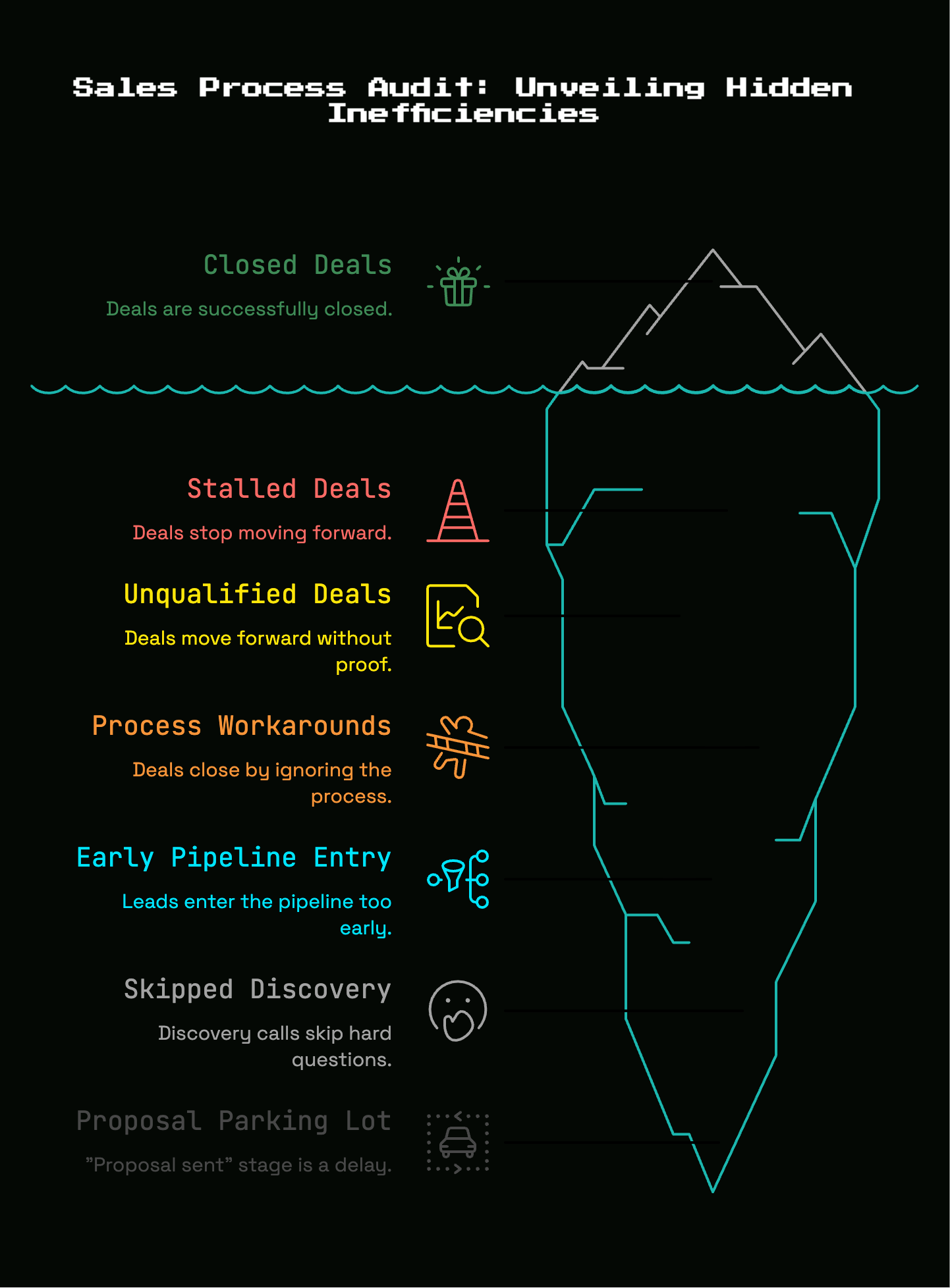
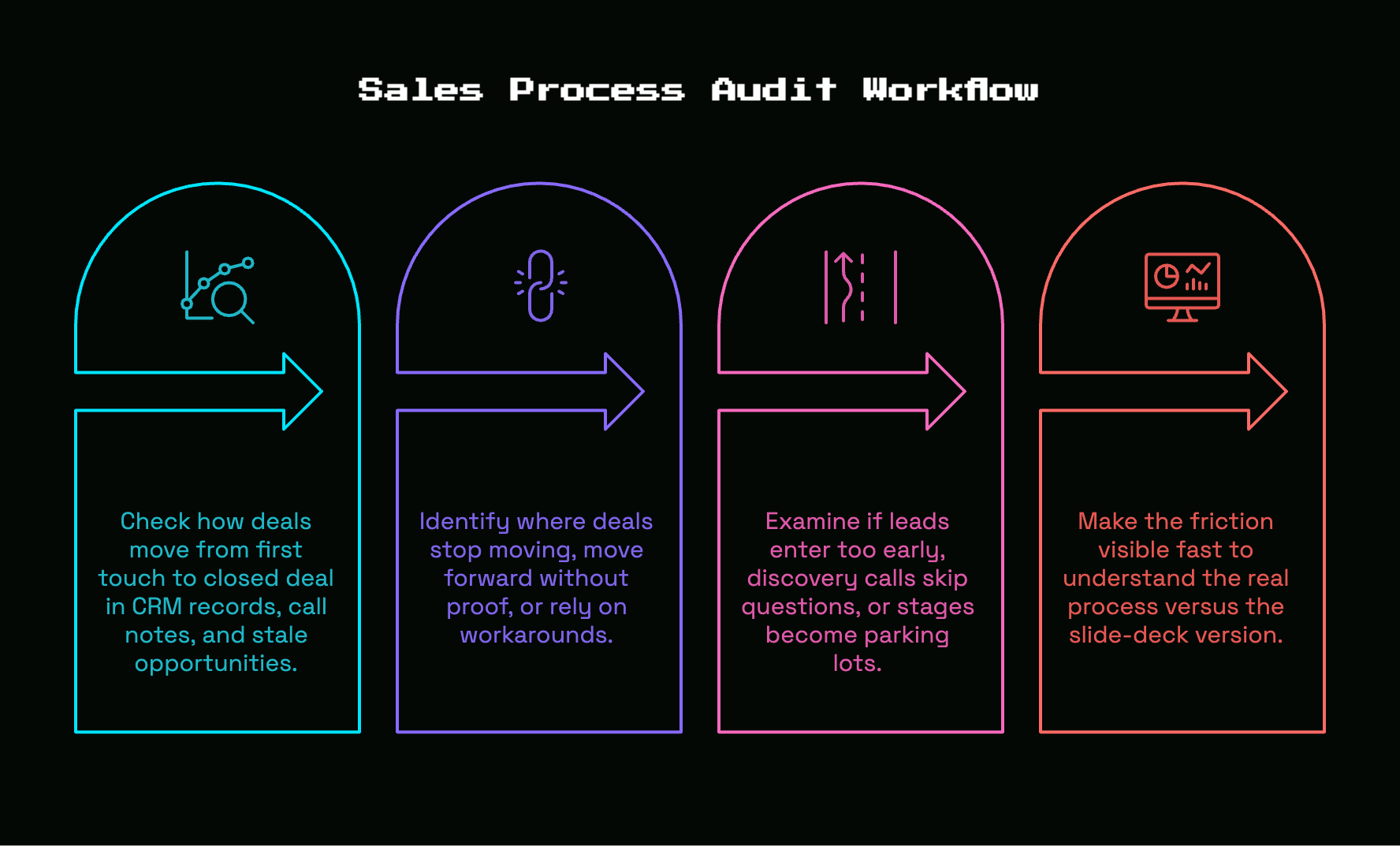
A sales process audit is a checkup on how deals move from first touch to closed deal. Not the slide-deck version of your process, the real one. The one hiding in CRM records, call notes, stale opportunities, and that awkward follow-up gap after a demo.
When people talk about “breaks,” they usually mean one of three things. Deals stop moving. Deals move forward without enough proof and then die later. Or deals close, but only when somebody works around the process by force of personality. That last one shows up a lot in founder-led sales.
The point is not to grade your team. It is to see where friction lives. If a lead enters the pipeline too early, if discovery calls skip the hard questions, or if your “proposal sent” stage is really a parking lot, the audit should make that visible fast.
When to run a sales process audit
Run an audit when something feels off for more than a couple of weeks. Maybe pipeline coverage looks fine but wins are thin. Maybe sales cycles got longer. Maybe your CRM has become a junk drawer. Or maybe you are hiring your first rep and need to turn founder instinct into something repeatable.
This is especially useful around a few moments. After two missed months in a row. Right before adding headcount. After changing pricing or packaging. After a push into outbound. And after hearing the same objection five times in ten days.
Here’s the thing: not every rough patch is a process problem. Some months are noisy. But if the same stall points keep showing up, or if different deals keep dying in the same stage, that is not bad luck. That is a process signal.
What you’ll need before you start
Keep the prep light. If you turn this into a six-tab strategy doc, it will sit there untouched. The best audit usually fits into one focused working block, plus a short cleanup pass after.
Before Step 1, gather four things: CRM access, a recent deal sample, call and handoff notes, and a simple audit sheet. That is enough to get to the truth surprisingly quickly.
Access to your CRM and pipeline data
Start with the records that show what actually happened. Pull deal stages, created dates, close dates, owner, activity history, lead source, amount, and loss reason if you track it.
Do not rely on memory here. Memory is generous with progress and fuzzy on delays. CRM timestamps are less flattering, but much more useful.
Checkpoint: if you can see when deals entered each stage and when activity last happened, you have enough data to begin.
A recent sample of won and lost deals
You do not need every deal from the last year. Pull a clean sample from the last 60 to 90 days. Ten won deals and ten to fifteen lost deals is often plenty for an early-stage SaaS team.
The trick is to choose deals that reflect your real motion. Include founder-led and rep-led if both exist. Include a mix of deal sizes if your ACV varies. Skip weird one-off edge cases unless those are becoming common.
Notes from calls, demos, and handoffs
Now grab the messy human layer. Call notes. Demo recordings. Follow-up emails. Proposal threads. Onboarding handoff notes. Anything that shows what got said, promised, skipped, or misunderstood.
This matters because your official process and your Tuesday-at-4:17-p.m. process are rarely identical. And honestly, that gap is where the best findings usually live.
A simple audit sheet or scorecard
Use a spreadsheet, doc, or simple scorecard. Keep columns for stage, observed issue, evidence, likely cause, impact, ease to fix, and proposed change.
Do not invent a fancy scoring model. A plain sheet you actually finish beats a perfect framework you abandon halfway through.
Step 1: Map your current sales process as it really works
Before you analyze anything, write down the process as it exists today. Not how you want it to work, and not how your CRM stages were originally named. Just the live path a deal actually takes.
- Open your CRM and list the current stages in order.
- Compare those stages with a few recent won and lost deals.
- Note any off-path steps, side conversations, or hidden approvals.
- Rewrite the flow in plain English from first touch to closed deal.
Success looks like a simple sequence you could hand to a new hire without apologizing for it.
List every stage from first touch to closed deal
Use names that describe reality. “Inbound lead,” “qualified opportunity,” “discovery complete,” “demo delivered,” “proposal sent,” “verbal yes,” “closed won,” “closed lost.” Simple beats clever.
- Write each stage in the order a deal usually moves.
- For each one, add one sentence describing what happens there.
- Flag any stage that exists mostly because “it has always been there.”
If a stage has no clear job, it usually causes one of two problems: reporting noise or fake progress.
Write the entry and exit criteria for each stage
A stage should have a door in and a door out. Otherwise deals drift around like socks in a dryer.
- For each stage, write what must be true for a deal to enter.
- Write what must be true for a deal to exit.
- Keep criteria observable, not emotional.
For example, “good conversation” is weak. “Confirmed business pain, timeline, and next meeting scheduled” is usable. After this step, you should be able to look at any opportunity and tell whether it belongs where it sits.
Note where the process changes by segment or deal type
Early-stage SaaS teams often have more than one motion hiding under one pipeline. Founder-led inbound may move one way. Outbound to larger accounts may move another. Product-led upgrades may skip stages entirely.
- Mark where the process differs by source, segment, or ACV.
- Note which differences are intentional and which are accidental.
- Flag any variation that breaks reporting.
The catch is that hidden forks create confusion fast. If you are comparing unlike deals in one stage report, your audit will point at the wrong problem.
Step 2: Pull the numbers that show where deals slow down
Now move from the map to the evidence. You are looking for friction, not building a board deck.
- Pull stage-to-stage conversion rates.
- Measure time spent in each stage.
- Compare win rate, sales cycle, and deal size.
- Split founder-led and rep-led motion if needed.
Check conversion rates between stages
A healthy process does not need perfect conversion. It needs understandable conversion. Sharp drop-offs usually mean something specific is broken.
- Count how many deals enter each stage.
- Count how many move to the next stage.
- Calculate the percentage at each handoff.
- Highlight the biggest drop.
If 70 percent of qualified opportunities book discovery but only 18 percent move from demo to proposal, that stage deserves attention first. Something in messaging, qualification, or follow-up is probably off.
Measure time spent in each stage
Some stages kill deals slowly. They look active in the CRM, but nothing is really happening.
- Calculate average days spent in each stage.
- Look for outliers and aging deals.
- Separate active progress from idle waiting.
A long stage duration usually means one of two things. The stage combines too many jobs, or there is no clear next action. If “proposal sent” averages 19 days, that is probably not a proposal stage. It is a decision fog stage.
Compare win rate, sales cycle length, and average deal size
This keeps you grounded. Messy stages are annoying, but not every annoyance is a revenue problem.
- Compare win rate across recent periods.
- Compare average days to close.
- Compare average deal size by segment or source.
- Check which process issues line up with weaker outcomes.
A stage that feels chaotic but still converts quickly may not be first on the list. A stage that quietly adds 12 days to every deal probably should be.
Separate founder-led deals from rep-led deals if needed
This filter is gold for early teams. Founder sales often include invisible advantages: product context, authority, speed, and trust.
- Tag deals by owner type.
- Compare conversion, cycle time, and average deal size.
- Look for stages where performance splits sharply.
If your founder closes after one clean discovery and one tailored demo, while your first rep needs three calls and loses in procurement, the break may not be rep skill alone. It may be missing process, missing materials, or missing context transfer.
Step 3: Audit lead quality and qualification rules
Bad-fit leads make every later stage harder. If qualification is fuzzy, pipeline fills up with hope instead of real opportunities.
- Review pipeline sources.
- Check qualification questions.
- Look for stage inflation and weak opportunities.
Review your sources of pipeline
Not all pipeline is equal. Some sources feel productive because volume is high, but very little converts.
- Group recent opportunities by source.
- Compare source volume to win rate and cycle length.
- Flag sources that create activity without progress.
Inbound demo requests may close well. Cold outbound may need more touches and tighter targeting. Referral deals may skip friction entirely. You want to know which sources deserve more attention and which just eat time.
Check how opportunities get qualified
Qualification sounds formal, but it just means deciding whether a deal deserves time. That is all.
- Review the questions used in discovery or before opportunity creation.
- Check whether you confirm fit, pain, urgency, and buying process.
- Compare qualified deals with closed-lost notes.
If opportunities are created before real pain or urgency is confirmed, later stages will carry too much weight. Demos become entertainment. Proposals become placeholders.
Look for stage inflation and unqualified opportunities
This is where pipelines get flattering and dangerous.
- Scan active opportunities for missing proof.
- Look for deals advanced without a next step, confirmed need, or buying path.
- Mark opportunities that should be pushed back or closed out.
A bloated pipeline feels nice until the quarter ends. Better to have 14 real deals than 32 half-deals with vibes.
Step 4: Review messaging at the moments that matter
A lot of process problems are actually messaging problems in disguise. The stage itself is fine. The conversation inside the stage is not.
- Audit first-touch outreach.
- Review discovery calls.
- Check demos, proposals, and follow-ups.
Audit first-touch outreach and response handling
Early momentum is fragile. Slow response or weak framing can kill a good lead before the real process even starts.
- Read a sample of first-touch emails and reply threads.
- Check response time on inbound leads.
- Review call intros and demo-booking language.
- Note where interest goes cold.
If your first response sounds generic or takes a day and a half, you are making the next stage work harder than it should.
Review discovery questions and call structure
Discovery should answer whether the deal is worth pursuing and what the buyer actually needs to decide.
- Listen to a few discovery calls or read notes.
- Check whether pain, urgency, current workflow, and decision path were covered.
- Look for calls that jumped to pitching too early.
If discovery is shallow, every demo becomes guesswork. You end up showing features instead of connecting the product to a real problem.
Check demos, proposals, and follow-up language
This is where many deals stall. Buyers get more information, but not more clarity.
- Review demos for relevance to the use case discussed in discovery.
- Read proposals and next-step emails.
- Check whether each follow-up asks for a concrete decision or action.
The trick is to help buyers move, not just hand over materials. “Let me know what you think” is soft. “If pricing works, the next step is security review by Friday” is movement.
Step 5: Inspect CRM hygiene and stage discipline
If your CRM is messy, your audit gets blurry. You do not need perfect data, but you do need data you can trust enough to act on.
- Check for missing fields and stale deals.
- Review stage consistency.
- Inspect required fields and automation.
Look for missing fields, stale deals, and duplicate records
Start with the boring stuff. Boring stuff causes expensive confusion.
- Scan for blank source, amount, close date, or loss reason fields.
- Find deals with no recent activity.
- Check for duplicate companies or contacts.
A small pile of bad records can make your pipeline look healthier than it is. It also wastes follow-up time because nobody knows which record is current.
Check whether reps use stages consistently
Stage names only help if everybody uses them the same way.
- Compare a few deals from different owners in the same stage.
- Check what evidence exists for each stage move.
- Note where stage meanings drift.
If one person moves a deal to “proposal sent” after mentioning ballpark pricing on a call, and another only uses it after a formal quote goes out, your reporting is already crooked.
Review required fields and automation
Good CRM setup nudges good behavior.
- Check which fields are required before stage changes.
- Review reminders, task creation, and stale-deal alerts.
- Add lightweight rules where context keeps going missing.
Simple automation can prevent a lot of sloppiness. A required next step date before moving to proposal is not glamorous, but it works.
Step 6: Examine handoffs and ownership gaps
Deals often lose momentum between people, not inside meetings. In a small team, that can hide in plain sight.
- Review lead-to-sales handoff.
- Check ownership during the deal.
- Audit the post-sale handoff.
Check the lead-to-sales handoff
- Trace what happens when a lead becomes an opportunity.
- Check who owns the next response and how quickly it happens.
- Review what context gets passed along.
If handoff notes are thin or slow, the first live sales conversation starts colder than it should.
Review internal ownership during the deal cycle
- List who handles discovery, demos, pricing, security, legal, and procurement.
- Mark where ownership shifts.
- Flag any step with no clear owner.
When ownership changes midstream without rules, deals drift. Buyers feel it too. Repeating context is frustrating, and frustration slows decisions.
Audit the closed-won handoff to onboarding or customer success
- Review what gets transferred after signature.
- Check whether promised outcomes, use cases, and timing are documented.
- Look for churn risk created by a rough handoff.
A sloppy handoff does more than annoy onboarding. It exposes promises that were never clearly qualified during the sale.
Step 7: Listen to what lost deals are telling you
Closed-lost deals are not just losses. They are clues.
- Group loss reasons.
- Compare CRM reasons with actual notes.
- Separate process issues from market issues.
Categorize loss reasons in plain English
- Create a short set of useful buckets.
- Reclassify recent losses into those buckets.
- Keep labels simple: no decision, bad fit, timing, pricing, competitor, missing urgency.
Plain categories make patterns easier to trust. “Other” is where learning goes to die.
Compare recorded loss reasons with real call notes
- Pick a sample of lost deals.
- Read the notes and emails beside the logged reason.
- Mark mismatches.
“Budget” is often the junk drawer answer. Sometimes the real issue was weak urgency, unclear value, or qualification that should have happened earlier.
Spot the difference between process problems and market problems
- Ask whether the loss came from the wrong buyer, weak offer fit, or a broken step.
- Group losses accordingly.
- Avoid fixing process when the real issue is segment or positioning.
That distinction matters. You do not want to tighten follow-up emails when the actual problem is chasing customers who were never a fit.
Step 8: Interview the people closest to the process
Data shows the shape of the problem. Short conversations explain why it keeps happening.
- Ask the same core questions across roles.
- Look for repeated workarounds.
- Capture buyer-side friction.
Ask founders, reps, and customer-facing teammates the same core questions
Use the same prompts each time: where deals most often stall, what objections repeat, where handoffs get messy, and what part of the process feels fake.
- Keep interviews short.
- Write answers in one place.
- Compare patterns, not personalities.
Look for repeated workarounds
- Note any unofficial steps people use to push deals through.
- Check where templates, extra calls, or side chats fill a gap.
- Treat repeated workarounds as process clues.
If the same workaround shows up three times, the process is asking too much somewhere.
Capture friction buyers notice
- Review feedback about slow replies, repeated questions, confusing pricing, or unclear next steps.
- Match that feedback to stages in your process.
- Highlight friction buyers feel directly.
Buyer friction is like a shopping cart with a sticky wheel. Progress is still possible, but it gets harder every aisle.
Step 9: Score the biggest breaks by impact and ease
Now turn notes into priorities. Otherwise the audit becomes an interesting document and nothing more.
- Rank issues by impact.
- Rank issues by effort.
- Choose one quick win and one deeper fix.
Rank issues by revenue impact
Score each issue based on how often it happens and how much damage it causes. Use conversion loss, delay, deal volume affected, or forecast distortion.
- Assign a simple high, medium, or low impact score.
- Start with the issue hurting the most deals most often.
Rank issues by effort to fix
Some fixes take one afternoon. Some need training, automation, and a process reset.
- Estimate effort in plain terms: low, medium, high.
- Include systems, training, and behavior change.
- Avoid falling in love with the most strategic-sounding fix.
Pick one quick win and one deeper fix
- Choose one low-effort, high-value cleanup.
- Choose one larger fix tied to the root cause.
- Ignore the rest for now.
This balance matters. A quick win builds confidence. A deeper fix changes outcomes.
Step 10: Turn findings into a 30-day fix plan
An audit only matters if behavior changes after it.
- Write each priority as a clear action.
- assign an owner and due date.
- Set checkpoints and success measures.
Write the problem, fix, owner, and due date for each priority
Use a simple four-column plan.
- Name the problem.
- State the fix in one sentence.
- Assign one owner.
- Add a due date.
If an item has three owners, it has no owner.
Update stage definitions, qualification rules, or templates
Most early-stage SaaS teams end up fixing the same kinds of things: stage criteria, discovery rules, demo structure, follow-up templates, CRM fields, and handoff notes.
- Rewrite unclear stage definitions.
- Tighten qualification standards.
- Update templates that create vague next steps.
- Adjust CRM rules to support the new behavior.
Set review checkpoints and success metrics
You need a way to tell if the change worked.
- Pick one or two metrics per fix.
- Review them after two weeks and again after 30 days.
- Watch for conversion, speed, cleanliness, and consistency.
A process is healthier when fewer deals sit still for fuzzy reasons and more stage movement actually means progress.
Troubleshooting: Common problems during a sales process audit
A few issues show up almost every time. None of them should stop the audit.
“Your CRM data is a mess”
Use a smaller clean sample and cross-check with notes, recordings, and email threads.
- Pull the cleanest recent deals.
- Ignore the urge to fix every record before starting.
- Get signal first, cleanup second.
Perfect data is nice. Directionally useful data is enough to find most breaks.
“Nobody agrees on what the stages mean”
Reset stages with entry and exit criteria in plain English.
- Pick the current active stages.
- Write one clear definition for each.
- Share examples of what belongs and what does not.
Once stage language sharpens up, your reports get more believable almost immediately.
“Your pipeline looks full, but deals aren’t closing”
That usually means false momentum.
- Check qualification standards.
- Find stale opportunities.
- Review stage jumps without evidence.
- Reclassify or close weak deals.
This is common, and it is absolutely fixable.
“Your first rep is doing something different from the founder”
Compare patterns without assuming the founder is automatically right.
- Review both motions side by side.
- Note where founder context changes the conversation.
- Turn hidden context into a repeatable step or asset.
A lot of “rep underperformance” is really undocumented founder behavior.
“You found too many problems at once”
Narrow the list.
- Pick the issue affecting the most deals.
- Pick the easiest fix with visible impact.
- Leave the rest in a parking lot.
Trying to fix ten things at once is how audits disappear into Slack.
What good looks like after the audit
A good outcome is not a prettier spreadsheet. It is a cleaner sales motion. Stages mean what they say. Opportunities enter the pipeline later and better qualified. Follow-up gets tighter. Ownership gets clearer. Handoffs stop dropping context.
You should also feel less fog. When a deal stalls, the reason is easier to name. When a forecast looks shaky, you can see why. And when you hire or train somebody, your process is no longer trapped inside your head.
Your next move: run a lightweight audit every quarter
You do not need to turn this into a quarterly ritual with slides, status colors, and dramatic language. Keep it light. Pull a recent deal sample, review the numbers, listen to a few calls, and check whether your stages still match reality.
Try one thing today: audit the last ten closed-lost deals and mark the stage where momentum actually broke. That single pass can tell you more than another month of guessing.


Discussion