

A forward deployed engineer is an engineer who works directly with customers to make complex software actually work in the real world. If your sales call keeps ending with some version of “looks great, but can your product handle our setup?”, this is the role that turns that awkward pause into a real answer.
What a Forward Deployed Engineer Is
At a basic level, a forward deployed engineer sits at the messy edge where product, implementation, and customer reality collide. Not in theory. In the actual environment, with actual data, security requirements, broken APIs, and the strange workflow somebody built six years ago and never documented.
This role exists because some software is easy to demo but harder to deploy. Especially in B2B SaaS, the difference between “the product can do this” and “your team can use this next month” is often the whole deal.
The simple version
The simple version is this: a forward deployed engineer helps customers get from interest to working outcome when the path is not clean or repeatable.
If your product needs integration work, technical validation, custom setup, or hands-on problem solving before a customer feels safe buying, this person becomes the bridge. Your sales rep can create momentum. Your product can show promise. But when somebody asks, “Can this work with our stack?” the forward deployed engineer is the person close enough to both the code and the customer to make that “yes” real.
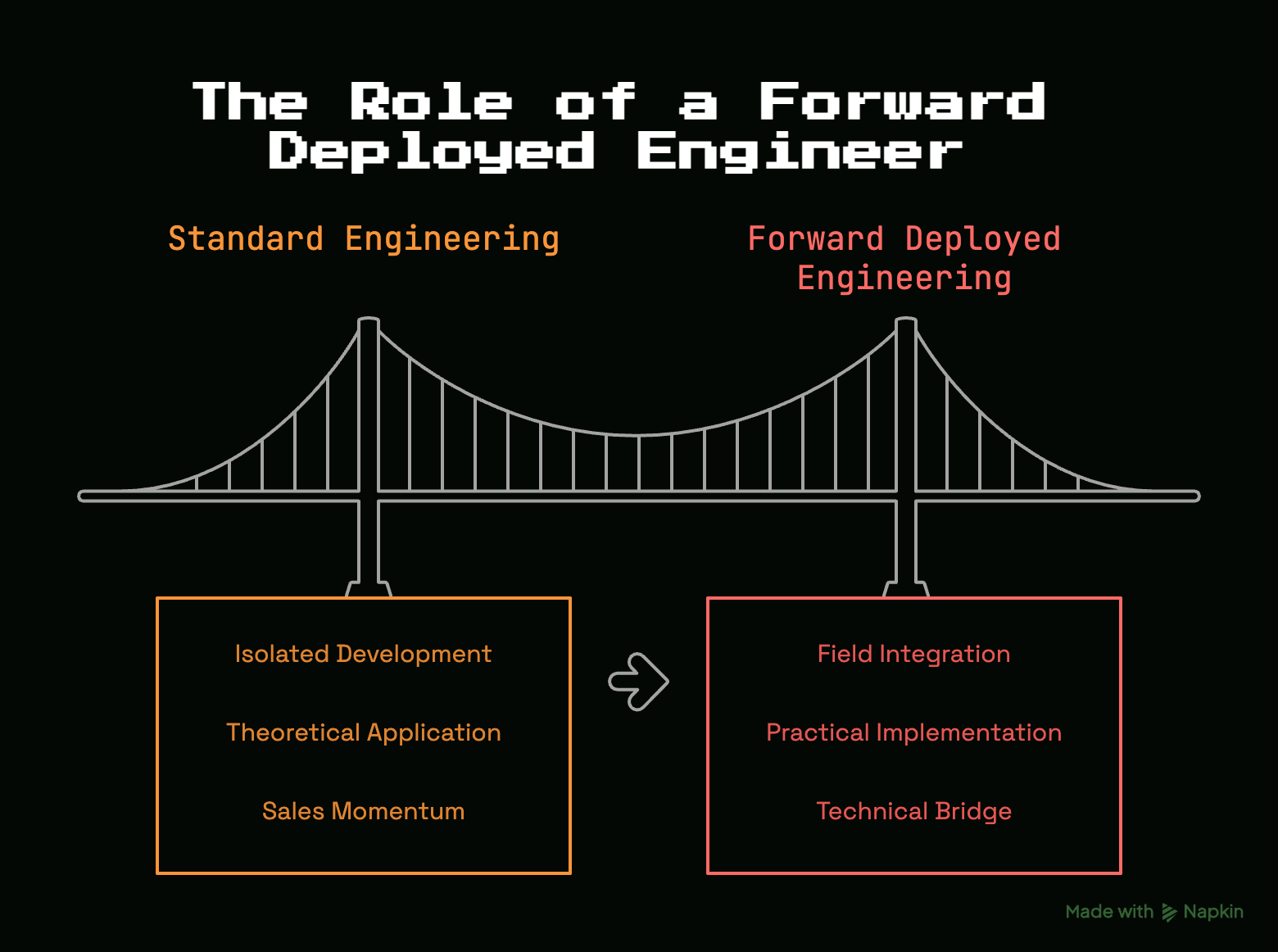
Why the title sounds unusual
“Forward deployed” sounds military because that language got borrowed from being placed close to where the action is. In software, the action is not in a war zone, obviously. It is in the field, close to customers, close to live environments, and close to the problems that never show up in a polished demo.
That unusual title is actually useful. It signals that this is not an engineer tucked away from users. It is an engineer placed near real usage, where things break, stall, or need adaptation.
Why this role exists in the first place
Here’s the thing: this role exists because the gap between product promise and customer reality is real, and somebody has to close it.
For simple products, a clean demo and a standard onboarding flow might be enough. For technical, flexible, or still-maturing products, it usually is not. The more your product depends on a customer’s existing systems, data quality, security constraints, or internal process, the less likely it is that sales and support handoffs alone will get the job done.
Enterprise software gets messy fast
Enterprise environments get weird fast. A prospect may have a legacy warehouse, unusual permissioning rules, internal review gates, and naming conventions that make no sense outside that building.
Picture a Thursday afternoon call where somebody asks whether your tool can connect to a warehouse database nobody on your team has touched before. That moment is where this role earns its keep. Not by waving it away, but by getting specific about what it would take, what is possible now, and what needs to change.
Early product teams learn fastest in the field
There is another reason this role matters: your team learns faster in the field than in a planning doc.
When an engineer keeps seeing the same blockers across implementations, patterns become obvious. Maybe the API is too thin. Maybe setup breaks the moment data arrives in an unexpected format. Maybe a feature works beautifully in ideal conditions and falls apart under normal ones. Field work exposes the difference between what your product claims and what your customers can consistently use. That learning is expensive to ignore.
What a forward deployed engineer actually does
The day-to-day work is usually a mix of technical depth, customer contact, and product feedback. That mix is the whole point.
Pre-sales technical work
Before a contract is signed, a forward deployed engineer often handles technical discovery, solution design, proof of concepts, custom demos, and implementation questions that go beyond a standard pitch.
This matters a lot when you are hiring your first sales rep. That person may be great at opening doors and moving conversations forward. But technical doubt kills deals quietly. A forward deployed engineer helps remove that doubt with credible, concrete answers.
Post-sale implementation and unblock work
After the deal closes, the same person often stays involved to help the customer get to first value faster. That can mean integrating systems, shaping workflows, debugging setup issues, or building the small connective tissue your core product does not yet cover.
The catch is that this is often hands-on work, not just advice on a Zoom call. If the customer needs a working setup, somebody has to get into the details.
Product feedback from the front lines
A good forward deployed engineer does not just solve the problem and move on. Patterns get brought back to the product team.
Repeated requests, weak documentation, onboarding friction, missing APIs, and features that only work in happy-path conditions all show up here first. That makes the role useful beyond any single customer. It helps your team decide what should stay custom and what deserves to become standard product.
How this role is different from nearby roles
This is where a lot of confusion starts, because the job overlaps with several familiar roles.
Forward deployed engineer vs. solutions engineer
A solutions engineer is also technical and customer-facing. The difference is depth and ownership. A forward deployed engineer usually goes further into implementation and may build custom components, scripts, or product changes to make the customer successful.
In a smaller company, the line can blur. Same calls, same problems, different title. But the forward deployed version usually sits closer to code and messier delivery work.
Forward deployed engineer vs. sales engineer
A sales engineer usually focuses on helping the deal move forward. Demo support, technical validation, objection handling.
A forward deployed engineer often stays involved after signature and owns more of the “make it work in the wild” layer. Less theater, more wrench-turning.
Forward deployed engineer vs. customer success or implementation
Customer success focuses on adoption, retention, and outcomes. Implementation teams often follow a repeatable playbook.
A forward deployed engineer steps in when the playbook does not exist yet, or keeps failing in edge cases. This is the role for the parts that are still too custom, too technical, or too new to operationalize cleanly.
Forward deployed engineer vs. product engineer
A product engineer usually builds for the many. A forward deployed engineer often starts with one customer’s problem.
But that one customer problem can reveal what many future customers will need. That is why the role matters. It can turn field pain into product direction.
When hiring a forward deployed engineer makes sense
You do not hire this role because the title sounds impressive. You hire it because your business keeps generating the same kind of friction — the real question is whether you actually need one yet.
Signs your team has hit the need
The signs are usually obvious once you name them. Deals stall on technical trust. You keep joining implementation calls yourself. Onboarding depends on one engineer doing heroics. Custom asks repeat across prospects. Your first sales rep keeps surfacing technical questions that nobody clearly owns.
If that sounds familiar, the role probably already exists in your business. It is just scattered across people.
When it is probably too early
If your product is simple, onboarding is repeatable, and technical objections are rare, hiring a forward deployed engineer may add complexity before it adds leverage.
Not every SaaS company needs this. Some teams just need better documentation, clearer demos, or a tighter implementation process.
What kinds of companies use this role most
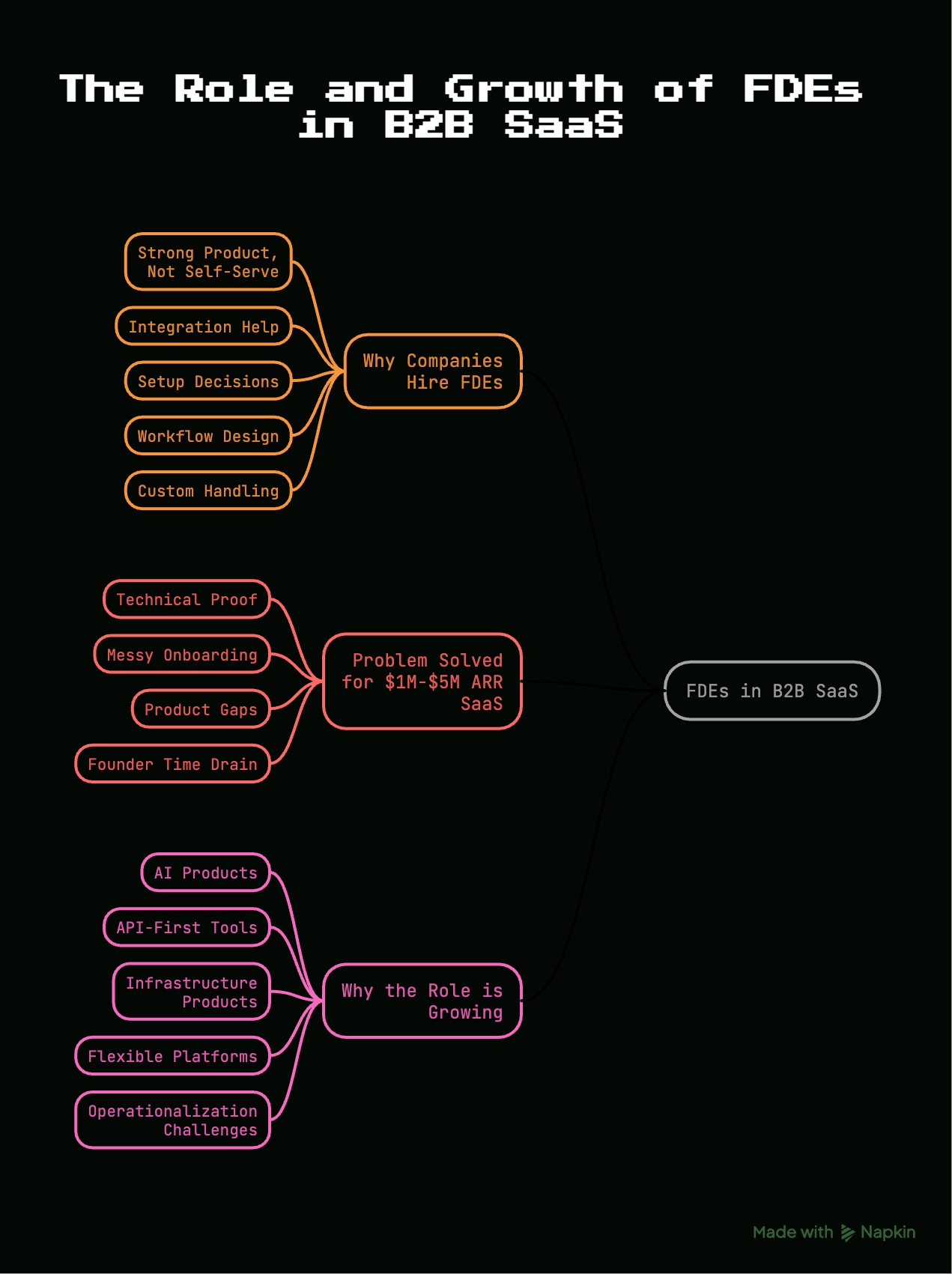
This role shows up most often in AI products, developer tools, data infrastructure, security software, and highly configurable enterprise SaaS.
The common thread is simple: products that need adaptation before they feel easy.
The tradeoffs and common misconceptions
This role can be incredibly useful. It can also go sideways if you are not careful.
“Is this just expensive custom work?”
Sometimes, yes. If the job turns into endless one-off services with no feedback loop into product, you are basically funding bespoke delivery with engineering salaries.
Useful forward deployed work teaches your product what to standardize next. Bad forward deployed work traps you in custom requests forever.
The R&D vs. COGS tension
Some of this work is really product learning. Some of it is just delivery effort required to serve a customer.
Mix those together without clarity and you get bad decisions. Product work looks overpriced. Delivery work looks strategic when it is not. The role gets much easier to manage when you separate learning that improves the core product from work that is simply the cost of serving a complex account. That R&D versus COGS tension shows up often in discussions of forward deployed engineering (SVPG).
Why the role can be a force multiplier
In the right company, this role speeds up sales, sharpens the roadmap, and shortens time to value at the same time.
Think of it like having somebody who can both spot the leak and grab the wrench, instead of sending three people down the hall to debate whose job it is.
How to think about the role if your team is small
At $1M to $5M ARR, this often feels less exotic than the title suggests.
What this often looks like before the official hire
Before the formal hire, the “forward deployed engineer” is often just you, a founding engineer, or a product-minded technical teammate doing the work without the label.
That is useful to notice. The role usually appears in practice before it appears on an org chart.
What to look for in a first hire
The best first hire has strong technical range, comfort with customers, calm under ambiguity, and good judgment about what to custom-build versus what to push into the product.
Plain-English communication matters just as much as technical skill. If somebody can solve the problem but cannot explain tradeoffs simply, the role gets harder than it needs to be.
One thing to try before hiring
Track every technical blocker that shows up in sales and onboarding for the next 30 days. Group them by pattern, not by account.
If the same handful keeps coming back, your signal is clear. The forward deployed engineer role already exists in your business. It just does not have a name yet.
Frequently Asked Questions
Is a forward deployed engineer an engineer or a go-to-market role?
It is both technical and customer-facing, but it leans engineering. The role exists to solve real implementation and product-fit problems, not just support the sales process.
Do early-stage SaaS companies need this role?
Some do, especially if the product is technical, flexible, or hard to deploy. If your founders or engineers keep getting pulled into deals and onboarding, that is usually the hint.
Can a solutions engineer cover the same job?
Sometimes. In smaller companies, one person may wear both hats. The difference is that a forward deployed engineer usually goes deeper into implementation and product change.
Does this role always involve custom code?
Not always, but often some hands-on technical work is involved. The job is less about presenting possibilities and more about making a real customer environment work.
What is the biggest risk with this role?
The biggest risk is turning it into permanent bespoke services. If field work never feeds back into the product, you end up solving the same problem account by account.
How do you know the role is working?
You should see faster technical validation in deals, smoother onboarding, clearer product feedback, and fewer founder-led rescue missions. If all four improve, the role is doing its job.


Discussion