

A GTM Engineer is the person who makes your go-to-market machine actually run. If your CRM is full, your reps are still building lists by hand, and inbound leads somehow vanish between form fill and follow-up, this role starts to make a lot of sense fast.
What a GTM Engineer Is
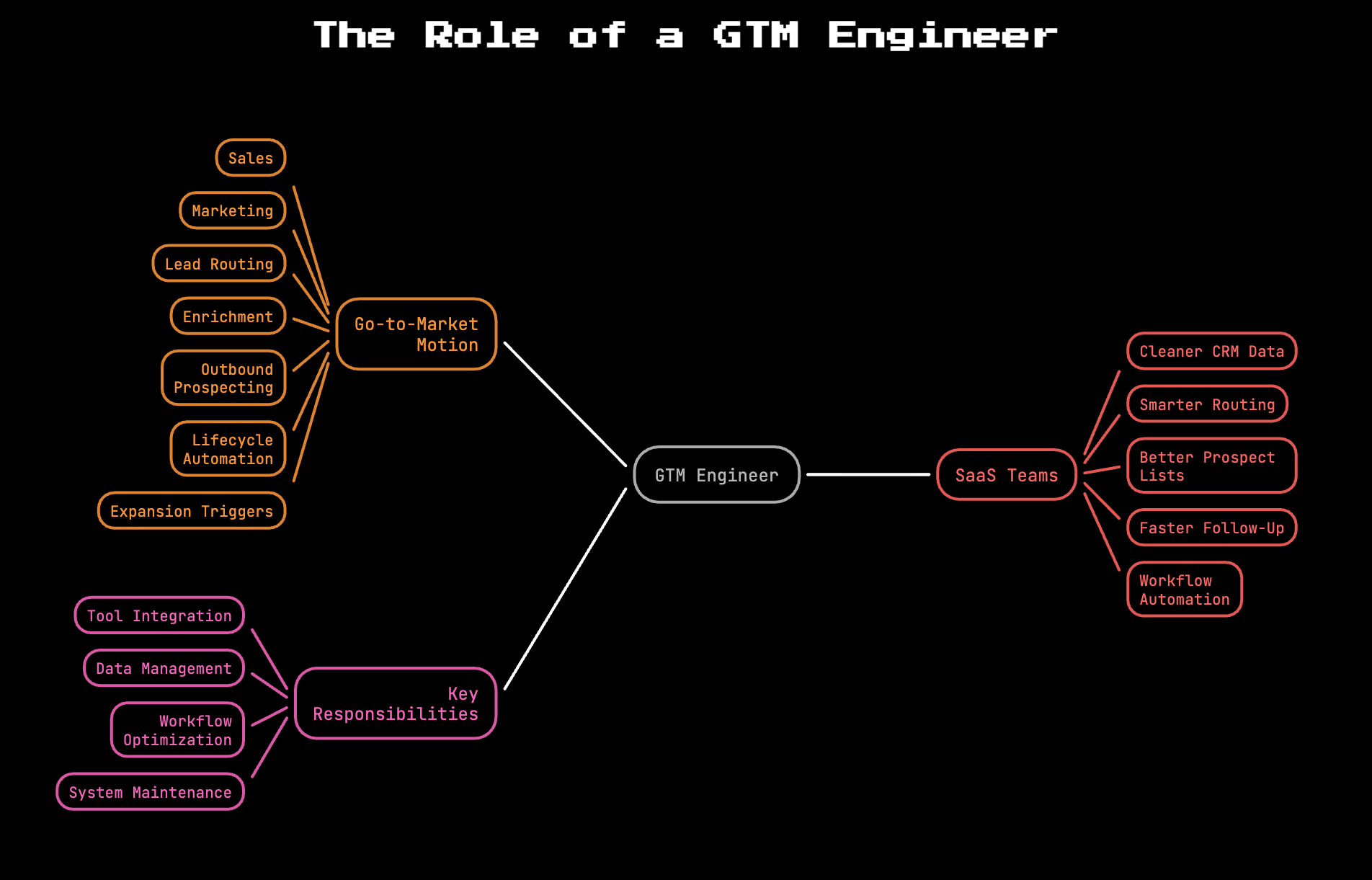
“GTM” means go-to-market, which is the part of your business that turns attention into pipeline and customers. Sales, marketing, lead routing, enrichment, outbound prospecting, lifecycle automation, expansion triggers, all of that lives inside the GTM motion.
A GTM Engineer sits in the middle of those moving parts and connects them into a usable system. The job is not just to own tools. The job is to make tools, data, and workflows work together so your team can move faster without adding chaos.
A simple definition for SaaS teams
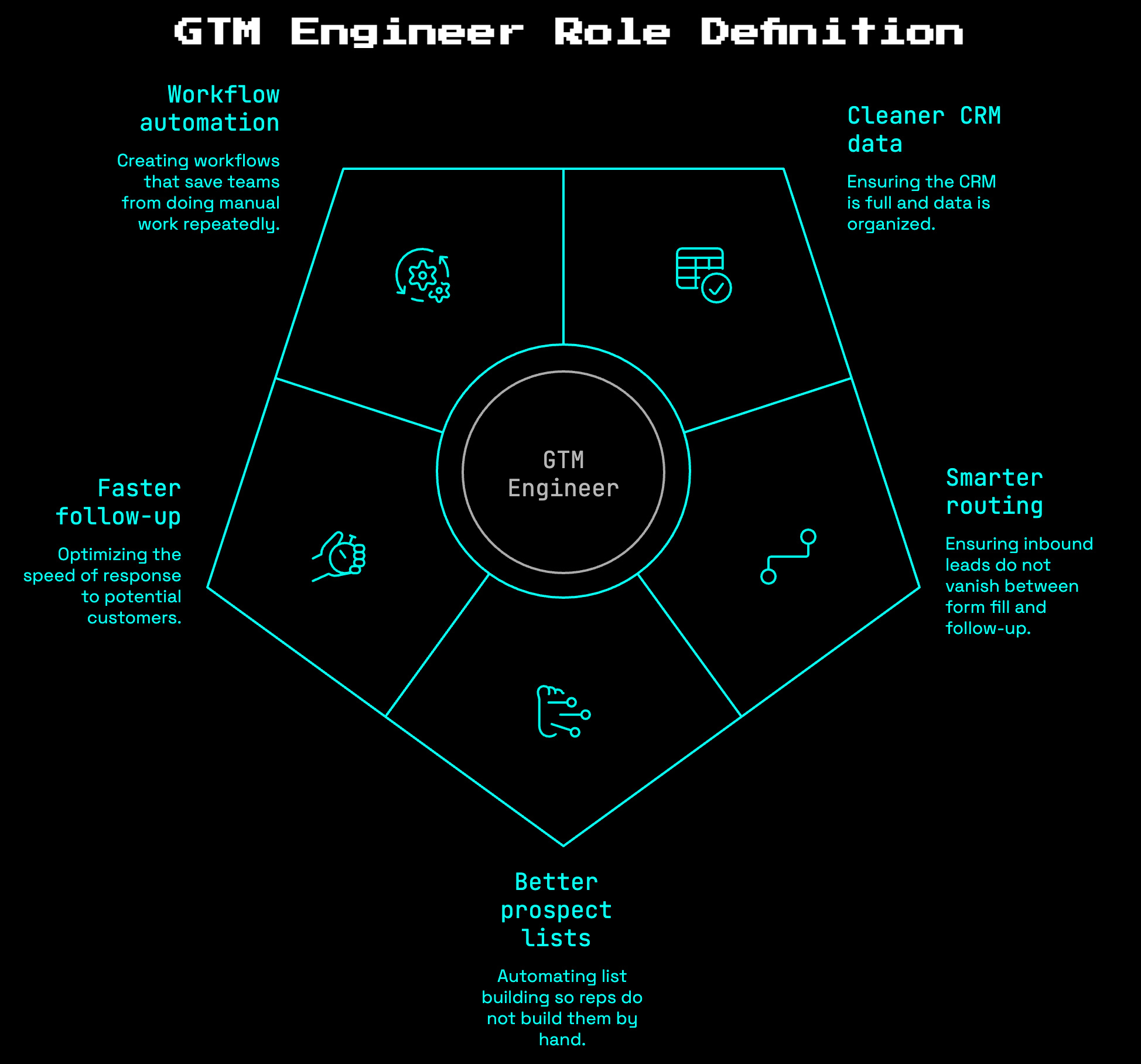
For a SaaS team, a GTM Engineer is the person who builds and fixes the systems behind revenue execution. That means cleaner CRM data, smarter routing, better prospect lists, faster follow-up, and workflows that save your team from doing the same manual work over and over.
Put more simply: if your go-to-market motion is the engine, a GTM Engineer handles a lot of the wiring, timing, and maintenance so the car actually moves when you hit the gas.
Why this role suddenly shows up everywhere
This title did not appear out of nowhere. Small SaaS teams now run on a bigger stack than much larger companies used a few years ago. You might have a CRM, sales engagement tool, enrichment provider, scheduling app, form tool, product analytics platform, support tool, billing system, ad platforms, and a few AI tools layered on top. Each tool promises speed. Together, unmanaged, they usually create mess.
That mess used to get absorbed by founders, early operators, or a very patient first sales hire. Somebody exported CSVs at 10:30 p.m. Somebody fixed duplicates on a Sunday. Somebody manually checked whether a lead already existed before assigning it. That worked for a while.
But once your team grows past founder-led improvisation, the cracks get expensive. Leads sit untouched. Reps lose trust in data. Marketing sends volume into a funnel that does not route correctly. Customer teams miss expansion moments because nobody connected product usage to account workflows.
That is why the role has become real. SaaS growth is more systems-driven now. A GTM Engineer exists because the plumbing became too important to leave half-built.
Why SaaS Growth Teams Start Looking for a GTM Engineer
Most teams do not wake up and decide to hire a GTM Engineer because the title sounds modern. The role usually shows up after a stretch of avoidable friction.
You notice leads sitting in HubSpot with no owner. A rep spends an hour building a list that should take ten minutes. Somebody uploads contacts twice and now the sequence tool is a mess. Enrichment covers some records but not others. Nobody is fully sure which fields matter, which workflows are active, or why one form routes instantly while another disappears into limbo.
At the $1M to $5M ARR stage, this pain gets sharper. You have enough volume for bad systems to hurt, but not enough headcount to hide the damage.
The moment your team outgrows spreadsheets and duct tape
Early on, duct tape is normal. A spreadsheet can absolutely run a lot of your motion when deals are few, the founder owns most calls, and every lead feels memorable.
That stops working when handoffs multiply.
The first rep joins. Then maybe a marketer. Then a customer success lead. Suddenly a lead is no longer just “someone you talked to.” It has a source, owner, score, lifecycle stage, follow-up rule, and maybe a few enrichment fields that determine whether it should go to sales at all. Every extra person adds a dependency. Every dependency creates another place where information can get lost.
Here’s the thing: most operational leaks do not look dramatic. They look small. A missing phone number. A duplicate company record. A demo request assigned the next morning instead of right away. A rep using an old ICP filter because nobody updated the list logic after you changed markets. One leak is survivable. Fifty leaks become your growth ceiling.
The cost of not having one
Without someone owning GTM systems, your team pays in slow motion.
Outreach takes longer because list building is manual. Prioritization gets weak because good accounts and random accounts look the same in the CRM. Reps duplicate research because signals are scattered across tools. Inbound follow-up becomes inconsistent because routing logic breaks quietly. Marketing struggles to target well because the audience data is unreliable. Customer teams miss expansion or churn signals because product usage never makes it into the workflows that matter.
The cost is not just admin pain. It is missed pipeline.
If a rep spends five hours a week cleaning records and building lists, that is time not spent talking to accounts. If your best-fit inbound leads wait six hours for a response, some of that demand is gone. If your closed-lost deals never get revisited when conditions change, that pipeline does not magically come back on its own.
A GTM Engineer solves for those invisible losses.
What a GTM Engineer Actually Does Day to Day
The title can sound vague until you look at the day-to-day work. Then it becomes pretty concrete, pretty fast.
A GTM Engineer usually spends time inside your CRM, enrichment tools, automation platforms, spreadsheets, sequencing systems, and data sources. Not to admire the stack, but to make useful workflows ship.
Builds and fixes GTM systems
A lot of the job is systems work. That includes cleaning up CRM structure, setting ownership rules, fixing lifecycle stages, and making sure lead routing follows logic you can actually defend.
Maybe a demo request from a U.S. mid-market company should go to one rep, while a student request from outside your target region should go into a nurture flow instead. Maybe contact enrichment should happen right after form submit, and deduplication should run before assignment, not after. Maybe an account entering a sequence should also create a task in the CRM and update a status field so marketing does not keep treating it like net-new demand.
These are small design choices, but they shape how your team works every day.
A GTM Engineer also makes tools talk to each other. If HubSpot holds the account record, Apollo handles sequencing, Clearbit or a similar provider fills in company details, and product usage sits somewhere else entirely, somebody has to decide how those systems sync, when fields update, and what counts as source of truth.
Turns messy data into usable signals
Raw data is rarely useful by itself. A GTM Engineer turns it into signals.
Signals are clues that tell your team who to contact, when to contact them, or how to prioritize them. A company hiring its first security engineer can be a signal. A target account raising a Series A can be a signal. A product-qualified user inviting five new teammates can be a signal. A closed-lost prospect changing leadership can be a signal too.
The trick is not gathering every possible clue. The trick is deciding which clues actually matter for your motion.
Good GTM engineering filters noise. If a field gets populated but never changes a decision, it is probably clutter. If a signal correlates with meetings booked or expansion conversations started, it deserves a workflow. That judgment matters more than having giant piles of data.
Launches repeatable plays
Useful GTM work becomes repeatable. That is where this role starts paying for itself.
Instead of asking a rep to manually check LinkedIn, recent funding, tech stack, and hiring activity before every outreach batch, a GTM Engineer can build a repeatable outbound play that combines those filters into a list and pushes qualified accounts into the right sequence path.
Instead of letting inbound leads sit until somebody notices them, a GTM Engineer can build a workflow that enriches, scores, routes, and alerts instantly.
Instead of leaving expansion entirely to memory and gut feel, a GTM Engineer can trigger account reviews when seat count jumps, usage spikes, or executive contacts change.
A repeatable play is just a system your team can trust to run more than once without heroic effort.
Supports reps, marketers, and customer teams
This role is rarely just for sales.
Reps get cleaner lists, better timing, and less admin drag. Marketing gets better audience targeting, clearer funnel handoffs, and more confidence that demand gets worked properly. Customer teams get alerts for expansion risk or opportunity instead of discovering everything late.
That cross-functional value is one reason the title sticks. A GTM Engineer works close to execution, but across the whole path from lead to revenue.
The Core Skills Behind the Role
A GTM Engineer is unusual because the role sits between commercial judgment and technical execution. That blend is the whole point.
Systems thinking
Systems thinking means seeing the full path instead of one isolated task. A lead source is not just a source. It connects to enrichment, routing, scoring, ownership, response time, sequence entry, meeting creation, and pipeline reporting.
If something feels off in your funnel, a strong GTM Engineer can trace it backward. Maybe reply rates dropped because targeting changed. Maybe targeting changed because a firmographic filter broke. Firmographic means basic company attributes like industry, size, or location. Maybe that filter broke because a source field started syncing differently after a tool update.
That mindset is rare. It is less about individual tasks and more about understanding how small changes ripple through the system.
Tool fluency and automation instincts
Tool fluency does not mean collecting logins. It means knowing how to make tools useful together.
A strong GTM Engineer understands how CRMs, enrichment providers, sequencing tools, automation platforms, spreadsheets, APIs, and AI tools can combine into a working process. More importantly, your GTM Engineer knows when not to add another tool.
That instinct matters because early-stage teams often overbuy software when the real problem is logic. A broken routing rule does not need a new platform. A messy lifecycle stage setup does not get fixed by buying another dashboard.
Automation instincts matter too. Some work deserves automation. Some does not. If a task happens often, follows clear rules, and affects speed or quality, it is a good automation candidate. If it happens rarely and needs judgment every time, forcing automation can create more trouble than it saves.
Data judgment
A lot of GTM work looks technical from the outside, but the real leverage comes from judgment.
Which fields actually matter in the CRM? Which enrichment source is most trustworthy for employee count? Which score should affect routing, and which one is just interesting? Which signal deserves a daily alert, and which one belongs in a weekly review?
Bad data judgment creates bloated systems. Suddenly your team has 140 fields, seven scores, and no idea which ones drive action. Good data judgment keeps the stack sharp. Fewer fields. Cleaner logic. Better action.
That simplicity is not basic. It is disciplined.
Copy and workflow empathy
Here is one part people miss: good GTM Engineers understand how work feels on the receiving end.
If an automation drops a giant list into a rep queue with no context, it gets ignored. If an alert fires ten times a day with weak relevance, trust disappears. If an AI-generated outbound snippet sounds robotic, nobody wants to send it.
Workflow empathy means building systems that fit real behavior. The alert should be useful enough to act on. The list should be filtered enough to trust. The enrichment should add context that helps somebody write or prioritize, not just decorate the record.
That is why this role is not just technical. It has to understand human use.
Do GTM Engineers Need to Know How to Code?
Short answer: no, but technical comfort helps a lot.
What “technical” really means in this job
A GTM Engineer is not necessarily writing production software for your product team. Technical in this context usually means understanding data structure, logic, workflows, field mapping, integrations, APIs, and how to debug a process when something breaks.
That is different from traditional software engineering.
If somebody can reason through inputs and outputs, understand how records sync, work with filters and formulas, and troubleshoot why a webhook failed, that is already useful technical ability for this role. A webhook is just a message one tool sends to another when something happens, like a form submit triggering an enrichment step.
No-code, low-code, and code-based work
A surprising amount of GTM engineering can happen without heavy coding. Zapier, Make, HubSpot workflows, Salesforce automation, Clay, Airtable, Google Sheets, and SQL can cover a lot of ground. Low-code tools can handle routing, enrichment waterfalls, data syncs, qualification rules, and lead processing for many early-stage teams.
Light scripting can extend that. A little JavaScript or Python can help clean fields, transform messy inputs, call APIs, or process data at scale. SQL is especially useful when product usage data, marketing data, and CRM data need to be analyzed together.
The spectrum matters. Some teams need a builder who can stay mostly inside no-code tools. Others need someone who can comfortably write scripts and work directly with APIs. Both can be GTM Engineers if the outcome is the same: shipping systems that improve revenue execution.
The practical answer for early-stage teams
For an early-stage SaaS company, shipping useful systems matters more than formal engineering credentials. A person who can diagnose a broken lead flow on Tuesday, rebuild it on Wednesday, and cut response time by Thursday is more valuable than somebody with stronger code skills but no GTM instincts.
Coding helps. Resourcefulness matters more.
If your stack is messy but still fairly standard, a GTM Engineer who is strong in no-code, low-code, CRM logic, and light scripting is often enough. If your motion depends heavily on product data, custom scoring, or unusual integrations, deeper technical skill becomes more valuable.
But the test is simple: can your GTM Engineer turn a painful manual process into a reliable working system? That is the bar.
How a GTM Engineer Differs From Similar Roles
https://www.youtube.com/watch?v=paF4J941uqg
This is where hiring confusion usually starts. Several adjacent roles overlap with GTM engineering, but the overlap is not the same thing as the role.
GTM engineer vs RevOps
RevOps, or revenue operations, usually owns process, reporting, governance, forecasting support, and shared infrastructure across sales, marketing, and customer success. The focus is often consistency, visibility, and operational health.
A GTM Engineer tends to work closer to execution. Instead of mainly defining process, the role often builds workflows that power prospecting, lead qualification, signal routing, lifecycle automation, and expansion triggers.
The line can blur, especially in small companies. But here’s the clean distinction: RevOps often asks, “How should the system be structured?” A GTM Engineer often asks, “How do you make this motion actually run better next week?”
GTM engineer vs sales ops
Sales ops usually centers on the sales team itself. Forecasting, territories, rep workflows, compensation support, pipeline hygiene, and internal process design often sit here.
GTM engineering reaches further. It touches sales, but also inbound flow, enrichment layers, account signals, marketing handoffs, and customer expansion workflows. The work is broader, more experimental, and often more automation-heavy.
If sales ops keeps the sales floor organized, GTM engineering builds extra doors, better lighting, and a faster conveyor belt into the room.
GTM engineer vs growth marketer
There is real overlap with growth. Both roles care about funnels, experimentation, conversion, and speed.
The difference is where the center of gravity sits. A growth marketer usually owns campaigns, channels, messaging experiments, landing pages, paid acquisition, or demand generation programs. A GTM Engineer usually owns the systems that move data and actions through those programs.
One role creates and tests market-facing motion. The other makes sure the motion is operationally sharp, connected, and repeatable.
GTM engineer vs SDR manager or first sales hire
A strong first sales hire often understands the pain better than anyone. That matters. But knowing the pain is not the same as designing the system that removes it.
A seller might know that lists are bad, routing is slow, and signals are missing. A GTM Engineer knows how to fix the routing logic, connect enrichment, define field rules, create filtered list generation, and build workflows that keep those issues from coming back.
Sometimes one person can do both for a while. But assuming every strong seller should architect GTM systems is how teams end up with clever workarounds instead of durable infrastructure.
Where a GTM Engineer Should Sit in Your Org
The best reporting line depends less on title fashion and more on where your biggest bottleneck lives.
Inside RevOps
This is the most common home because GTM engineering naturally sits close to CRM ownership, data governance, lifecycle definitions, and cross-functional workflows.
If your biggest issues involve lead routing, field logic, attribution cleanliness, handoffs across functions, and overall funnel plumbing, RevOps is a strong fit. The role gets access to the core systems and enough authority to shape how records and workflows behave.
This setup works especially well when your company already has some operational structure and needs somebody to build on top of it.
Inside Growth or Marketing
Sometimes your biggest challenge is pipeline generation, not backend reporting. Maybe outbound experimentation matters most. Maybe paid and inbound systems need better qualification and audience syncing. Maybe website intent, visitor identification, and enrichment are the main opportunities.
In that case, housing the role in growth or marketing can work well. The GTM Engineer stays close to experimentation and volume creation while still building the data and workflow systems behind it.
This model often shows up when the company is trying to create more demand from a relatively lean team.
Embedded with sales leadership
For a smaller SaaS team, especially one hiring early sales talent, the role may sit closest to the founder or head of sales. That can be the right move when the immediate job is building a repeatable pipeline engine fast.
This setup keeps the role close to frontline pain. Reps complain about bad lists, founder-led follow-up is inconsistent, and the company needs fast fixes more than formal structure. If the GTM Engineer can act quickly with direct access to the decision-maker, a lot of useful work gets done faster.
The catch is that sales-only embedding can sometimes narrow the scope too much. Inbound, lifecycle, and customer workflows still matter.
The best setup for a small SaaS team
For a bootstrapped or early-scaling SaaS team, the best setup is usually the one that gives this role three things: access to the CRM and stack, direct visibility into pipeline problems, and clear ownership over workflow changes.
Org-chart purity does not matter much yet. Speed does.
If your company spends two months debating whether the role belongs in sales, ops, or growth, but nobody fixes the broken inbound router, you have missed the point. Put the role where painful systems can get fixed quickly and where the owner can work across functions without political friction.
The Problems a GTM Engineer Solves Across the Funnel
A GTM Engineer is not only a back-office builder. The role improves how your team works across the full funnel.
Outbound prospecting and account research
Outbound gets much better when account selection stops being a generic export.
A GTM Engineer can combine ICP filters with signals like hiring patterns, technology usage, funding events, website changes, product usage, partner overlap, or leadership movement to create more focused account lists. ICP means ideal customer profile, your best-fit customer shape.
That means reps start with accounts that have a reason to care now, not just accounts that exist.
The same role can also clean the handoff into sequencing tools so list generation, enrichment, personalization inputs, and campaign entry all happen in a more controlled way. Fewer junk records. Better timing. Less list chaos.
Inbound lead routing and follow-up
Inbound is where plumbing problems get painfully obvious.
A good GTM Engineer sets up form routing, enriches records on submit, checks for duplicates, applies qualification logic, assigns ownership, and makes sure the right person gets notified fast. That can turn a slow, error-prone handoff into something nearly instant.
For a small team, speed-to-lead matters a lot because you do not have endless volume to waste. If somebody asks for a demo, intent is high right then, not tomorrow morning after three Slack pings and a manual assignment.
Pipeline prioritization
Small teams do not lose because they lack tasks. Small teams lose because everything starts to look equally urgent.
A GTM Engineer helps create scoring and prioritization systems so effort goes where it counts. That might include lead scoring, account scoring, territory logic, intent signals, product-qualified lead triggers, or reactivation lists based on changed circumstances.
When done well, prioritization does not just produce a prettier dashboard. It changes rep behavior. The team focuses on better accounts, acts faster on warmer signals, and wastes less time on low-yield work.
Customer expansion and retention signals
Post-sale workflows are often neglected until churn forces attention. That is a mistake.
A GTM Engineer can connect product usage, seat growth, support patterns, billing status, executive changes, or renewal timing into workflows that help customer teams act sooner. Maybe heavy usage without an enterprise plan triggers an expansion review. Maybe a drop in usage plus a support escalation creates a save play. Maybe a new executive contact at the account prompts relationship-building before renewal season.
This is one reason the role matters beyond new logo acquisition. Revenue systems do not stop at closed-won.
The core building blocks behind revenue systems
Good GTM systems are not magic. Most of the time, they come down to four building blocks: data, logic, workflows, and interfaces.
Miss one, and the whole thing gets shaky.
Data: the raw material
Data is the input layer. That includes firmographic data like company size and industry, technographic data about tools in use, intent signals, product usage events, CRM history, and enrichment from outside providers.
The catch is that more data is not automatically better. Ten trusted fields beat 70 flaky ones every time. If account owner, segment, lifecycle stage, last activity, product usage, and buying signal are all clean and current, your team can do real work. If your database is huge but unreliable, your system turns into decoration.
For early scaling SaaS teams, the smartest move is usually to define which data points actually change decisions. Not every field deserves to exist.
Logic: the rules that decide what happens next
Logic is the “if this, then that” layer. If a lead comes from a demo form and the company is in your target segment, route it to the assigned rep within minutes. If a trial account hits a product threshold, create an alert. If an account already exists, merge or associate instead of creating a duplicate.
This layer includes routing rules, lifecycle stages, scoring models, qualification criteria, deduplication logic, territory assignment, and trigger conditions. It sounds dry, but it is where a lot of revenue quality lives.
When logic is sloppy, teams compensate with guesswork. When logic is clean, your system quietly makes a hundred small decisions correctly every day.
Workflows: the automations that move work forward
Workflows are where logic becomes action. A form submission triggers enrichment. Enrichment updates fields. Fields determine routing. Routing creates tasks and alerts. Alerts drive follow-up. Product usage triggers a sales touch or success play. Renewal dates kick off prep.
A strong workflow reduces dropped balls. A weak workflow creates hidden failure points.
That matters because dropped balls are rarely dramatic. They are small. A contact record without a title. An opportunity that never changed stage. An account that should have gone to a named rep but hit the round-robin queue instead. GTM engineering exists to make those misses much rarer.
Interfaces: where your team actually uses the system
A system is only real if your team can use it at the moment work happens.
That means CRM views that make sense, dashboards that answer actual questions, Slack alerts that arrive with enough context, forms that collect the right information, sequences connected to current data, playbooks that fit the workflow, and AI copilots that support work instead of interrupting it.
Think of interfaces as the handles on the machine. If your team cannot grab the system easily, the engineering behind it does not matter much.
A Typical GTM Engineering Stack
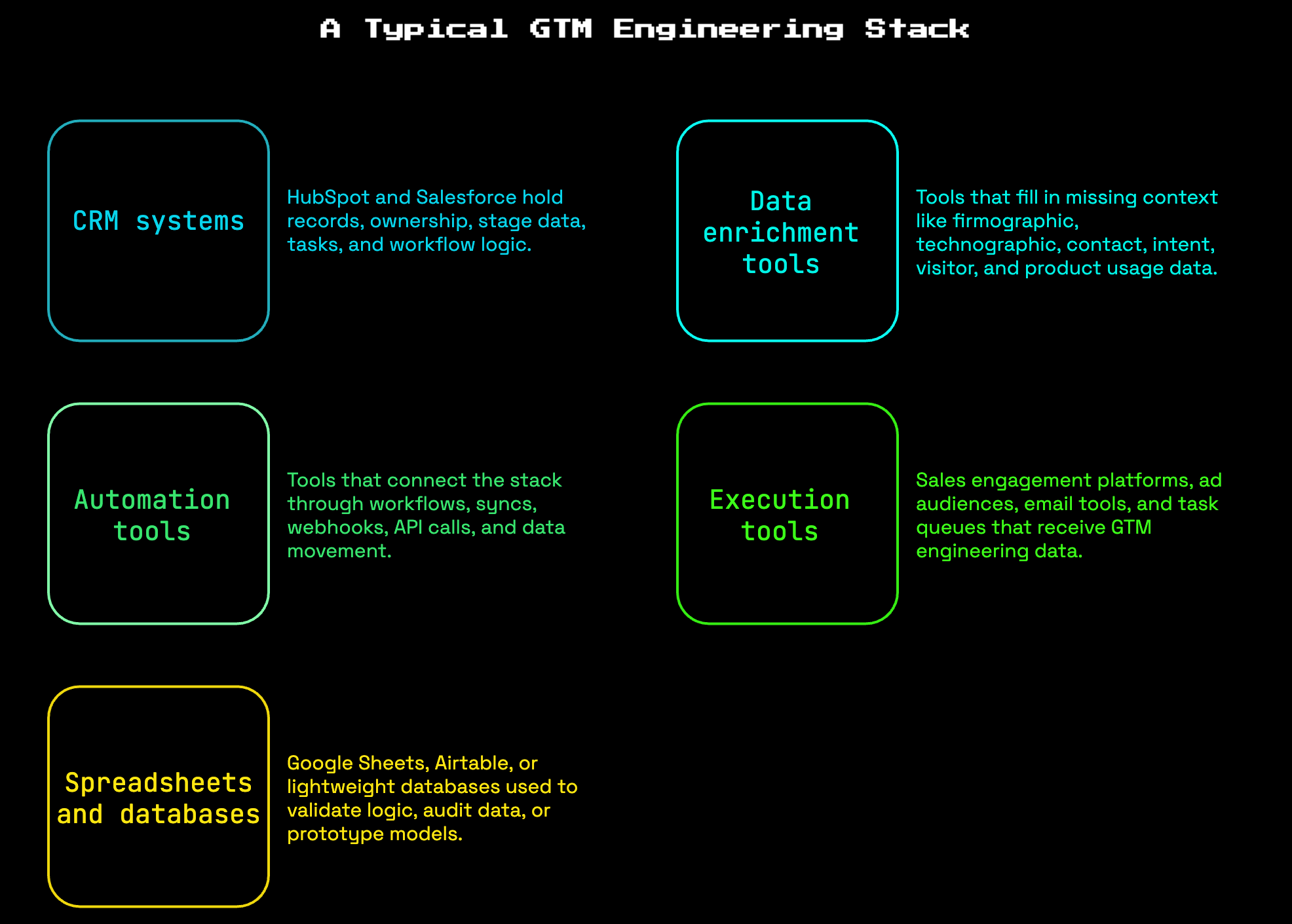
The stack matters, but only because of what it enables.
CRM and source-of-truth systems
Your CRM is usually the center. HubSpot and Salesforce are the most common examples because they hold records, ownership, stage data, tasks, and workflow logic.
A GTM Engineer treats the CRM as operational infrastructure, not just a place to log deals. If record structure is messy, everything downstream gets weaker. Clean lifecycle stages, consistent property usage, reliable ownership rules, and usable automation inside the CRM are the foundation.
Data enrichment and signal tools
Enrichment tools fill in missing context. That can include firmographic data, which describes the company itself, like size and industry. Technographic data tells you what software or systems a company uses. Contact data gives direct people information like email, title, or phone. Intent data tries to show buying interest. Visitor data identifies website visitors. Product usage data shows what users do inside your product.
A GTM Engineer usually works across several of these data types and decides which ones deserve action.
The key is not collecting everything. It is choosing data your team can trust enough to use.
Automation and integration tools
Automation tools connect the stack. This is where workflows, syncs, webhooks, API calls, and data movement come together.
If a form fills, something should happen. If a target account gets enriched with a strong signal, something should happen. If a product-qualified lead crosses a threshold, something should happen.
That “something” is usually built in automation tools, CRM logic, or light custom scripts. The goal is to reduce manual handoffs and keep actions consistent.
Outreach, sequencing, and execution tools
GTM engineering often feeds execution systems like sales engagement platforms, ad audiences, email tools, and task queues.
A rep usually does not want raw data. A rep wants a good list, relevant context, and a workflow that makes next steps obvious. A marketer wants clean audience segments and dependable sync behavior. A customer team wants useful alerts, not a spreadsheet graveyard.
Execution tools are where upstream design either pays off or falls apart.
Spreadsheets and lightweight databases
Honestly, a lot of excellent GTM engineering starts in a spreadsheet.
Before a workflow becomes formal, somebody usually tests logic in Google Sheets, Airtable, or a lightweight database. That is normal. A spreadsheet is often the fastest way to validate a scoring rule, compare enrichment coverage, audit duplicates, or prototype a target account model.
The mistake is not starting there. The mistake is staying there too long when the process becomes mission-critical.
Where AI actually helps
AI can be genuinely useful here, just not in the magical “run your whole GTM team” way.
The best use cases are practical: account research summaries, call notes, message drafts, enrichment support, lead categorization, field normalization, and workflow assistance. AI is great at speeding up repetitive interpretation work. It is much worse at replacing judgment about account fit, deal nuance, or whether an alert actually matters.
The trick is simple: automate the prep, not the thinking.
What Good GTM Engineering Looks Like in Practice
This role gets easier to understand once you picture actual workflows.
Example: fixing inbound in one afternoon
Imagine a demo request comes in at 4:47 p.m. on a Thursday. Before the form submit is even cold, the workflow checks whether the person already exists in the CRM, enriches the company record, confirms territory and company size, scores the lead, assigns the right owner, creates a task, and sends an alert to the rep.
Instead of a lead sitting overnight because somebody has to check the company manually, the system does the boring part instantly.
That is GTM engineering in practice. Not a giant transformation deck. Just a better path between interest and action.
Example: building a smarter outbound list
Now picture outbound list building. Instead of exporting every company in a broad SaaS segment, your system filters for accounts that fit your ICP, recently hired a role tied to your use case, use a compatible tool in the stack, and showed some kind of timing signal like a pricing page visit or a new product launch.
Suddenly the list is not just “software companies with 50 to 200 employees.” It is “software companies with a real reason to care right now.”
That changes messaging quality and rep confidence at the same time.
Example: turning closed-lost records into pipeline
Closed-lost deals are often left to die quietly, which is wasteful.
A GTM Engineer can build a reactivation workflow that checks old opportunities for fresh signals. Maybe the account raised funding. Maybe a new leader joined. Maybe hiring reopened. Maybe the product category got more urgent. Maybe a contract with a competitor is likely reaching expiration.
Those triggers can push the record back into a review queue with updated context. Instead of cold prospecting from scratch, your team re-engages accounts that already know your name.
Example: surfacing expansion opportunities
Expansion can be systematized too.
Say an account suddenly adds users, starts using a feature tied to a higher plan, logs more support tickets from a second team, or sees an executive change that opens a buying conversation. A GTM Engineer can connect those signals to alerts or account review queues for customer success or account management.
That gives your post-sale team a reason to act before the opportunity becomes obvious to everyone else.
How to design GTM systems without creating a mess
Plenty of teams build some automation and accidentally create a haunted house. Mysterious fields. Duplicate records. Workflows nobody understands. Alerts everybody mutes. Avoiding that is half the job.
Start with one revenue bottleneck, not ten tools
The best first move is not stack shopping. It is picking one painful bottleneck.
Maybe inbound lead response is slow. Maybe outbound targeting is poor. Maybe trial users hit activation milestones and nobody follows up. Start there. Define the workflow around the problem, then decide what tools are required.
Tool-first GTM engineering is how teams end up paying for six platforms and still managing pipeline in Slack.
Keep lifecycle stages and field architecture simple
Simple beats clever here. Your lifecycle stages should be easy to explain. Your fields should have a purpose. Ownership rules should be obvious. Naming conventions should stop future confusion, not create it.
Every extra field is like another kitchen drawer full of random cables. If nobody knows what it is for, nobody will trust what comes out of it. Early scaling teams do not need 19 nuanced lifecycle states. You need enough structure to guide action and reporting, nothing more.
Build for trust before sophistication
A basic routing rule your team trusts is better than a fancy AI score nobody believes.
Trust comes from visibility and logic. People need to understand why the system made a decision. If an account gets assigned, the reason should be explainable. If a lead score goes up, the driver should be clear. Hidden sophistication looks impressive in a demo and fragile in daily use.
Adoption follows trust. Without trust, even accurate systems get ignored.
Document the logic so the system survives turnover
Every workflow needs a plain-English explanation: what triggers it, what it changes, who owns it, what can break, and how to tell if it broke.
This matters more than most teams think. Once your first ops hire leaves, or your first rep joins, undocumented logic turns into archaeology. Nobody wants to spend Thursday afternoon deciphering why leads from one webinar source skip enrichment unless a checkbox happens to be true.
Documentation is not bureaucracy. It is maintenance for future sanity.
When You Actually Need a GTM Engineer
Not every SaaS company needs this role right away. But many wait too long.
Signs your team is ready
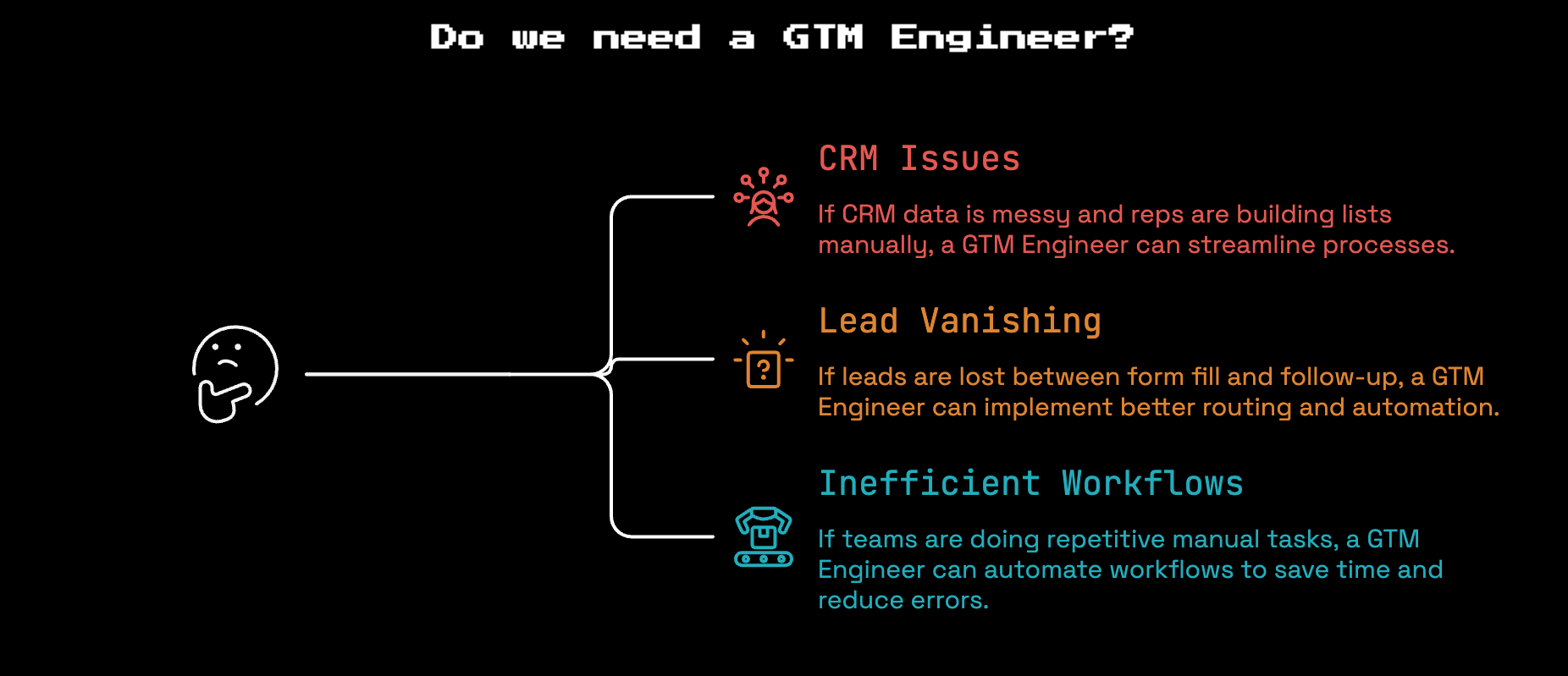
You are probably ready when your tools are multiplying, manual work is eating selling time, and operational issues show up in daily complaints. Reps do not trust lists. Inbound follow-up is inconsistent. Marketing and sales disagree on lead quality because the underlying data is sloppy. Founder time keeps disappearing into CRM cleanup, routing logic, and one-off fixes.
Another signal is repetition. If the same manual task keeps happening every week, and it clearly affects speed or quality, that is GTM engineering territory.
Signs it is too early
It is too early if your GTM motion is still undefined.
If you are still figuring out basic messaging, your ICP is unstable, lead volume is tiny, or founder-led selling is so custom that there is nothing repeatable yet, hiring a GTM Engineer may be premature. A system cannot save a motion that has not been shaped.
The role is best when there is enough repetition to improve and enough pain to justify ownership.
The direct claim: this role matters before your team feels “big enough”
Here is the direct claim: early-stage SaaS teams often wait too long to solve GTM systems.
Instead of fixing the plumbing once, you keep hiring around the mess. One more rep compensates for bad list quality. One more marketer compensates for leaky follow-up. One more ops contractor patches another sync issue. It looks like growth, but some of it is just expensive tolerance for broken systems.
A GTM Engineer often pays off before your org chart looks ready for one.
Your First GTM Engineer Hire: What to Look For
Hiring the first one matters because this role can either create momentum fast or disappear into tool tinkering.
The traits that matter most
Curiosity matters because the role starts with investigation. Speed matters because useful fixes should ship quickly. Ownership matters because broken workflows rarely come wrapped in neat job descriptions. Tool fluency matters because the stack is messy. Commercial judgment matters because not every operational improvement affects revenue.
Above all, you want somebody who ships. Not somebody who only audits. Not somebody who only ideates. Somebody who can see a problem, design a better workflow, build it, test it, and improve it after real use.
Backgrounds that often produce strong GTM engineers
Several backgrounds can work well.
An SDR or BDR background often brings frontline pain awareness. That path is usually strong on prospecting workflows, list quality, sequencing friction, and what reps actually need in context.
A RevOps or sales ops background often brings CRM structure, reporting logic, lifecycle thinking, and cross-functional process design.
A growth background can be strong on funnel thinking, experimentation, paid and inbound systems, and conversion-focused workflows.
A startup generalist often brings speed, resourcefulness, and a habit of solving whatever is broken with the tools available.
A technical ops background can be great for integrations, APIs, scripting, and data transformation, especially when product signals matter.
The best candidates usually combine parts of more than one path.
Interview questions that reveal real ability
Ask practical questions, not abstract ones.
Give a scenario where inbound demo requests are taking six hours to reach the right rep. Ask how the candidate would diagnose the flow, what would get checked first, and what changes would likely ship in the first week.
Describe an outbound team complaining about bad lists and weak reply rates. Ask how list quality, signals, enrichment, and sequence entry would get redesigned.
Ask how the candidate would judge whether an enrichment source is good enough to trust. Ask what fields belong in the CRM and which ones should stay out. Ask for examples of workflows built end to end, including what broke after launch and how it got fixed.
Good answers sound specific. Vague strategy talk is a bad sign.
Red flags when hiring
Be careful with candidates who only speak in frameworks and never in live workflow detail. Be careful with tool specialists who know one platform deeply but cannot reason across a system. Be careful with candidates who worship automation and never mention adoption, trust, or user behavior.
Another red flag: somebody who cannot explain tradeoffs. Every GTM system has tradeoffs between speed, accuracy, flexibility, and maintenance. If a candidate talks as if every workflow has a perfect answer, that usually means not enough time spent owning messy reality.
What to Hand a GTM Engineer in the First 90 Days
A good hire still needs a sensible target. Without one, the role can get buried in random requests.
First 30 days: audit the leaks
The first month should focus on seeing the system clearly.
That means reviewing the stack, walking through the funnel from source to pipeline, checking data quality, mapping handoffs, and identifying the few workflow failures that are costing the most right now. Look at forms, routing, ownership, enrichment, deduplication, sequence handoffs, lifecycle stages, and reporting blind spots.
The goal is not to document everything for its own sake. The goal is to find the leaks that are causing visible revenue drag.
Days 31, 60: fix the obvious bottlenecks
Next comes the boring but valuable work.
Fix routing. Improve enrichment coverage. Clean duplicate logic. Tighten rep workflows. Establish basic scoring or prioritization rules. Remove manual steps that happen constantly. Ship one or two wins that save time immediately.
This stage matters because it builds trust. When reps see lists improve or demo requests route correctly, the role stops feeling abstract.
Days 61, 90: build one repeatable growth system
By this point, the role should move beyond cleanup and into leverage.
Pick one meaningful repeatable system. Signal-based outbound is a strong option. Inbound qualification automation is another. Closed-lost reactivation can work well if you already have a decent historical pipeline. Expansion alerts can be powerful if your product usage data is clean enough.
One good repeatable system is better than five half-finished experiments.
Metrics That Show a GTM Engineer Is Working
This role should be judged by business impact, not by the number of tools connected or automations named.
Efficiency metrics
Start with time and throughput. How much manual list building went away? How long does routine CRM cleanup take now versus before? How fast can a rep get a usable target list? How quickly can ops requests ship?
If the same headcount can execute more cleanly with less admin drag, that is real progress.
Funnel metrics
Then look at funnel movement. Speed-to-lead should improve. Routing accuracy should improve. Reply rates can improve if targeting gets sharper. Meeting conversion can improve if inbound is handled faster and outbound lists fit better. Pipeline creation should rise if more good opportunities reach the team at the right time.
These are the numbers that connect systems work to revenue reality.
Data quality metrics
Data quality sounds dull until bad data starts costing pipeline.
Track field completeness for the properties that actually matter. Watch duplication rate. Check accuracy on ownership and lifecycle stage. Measure contact coverage where relevant. Pay attention to signal freshness, because stale signals create false confidence.
If your GTM Engineer is working well, trust in core records should rise.
Adoption metrics
Even a beautifully designed workflow fails if nobody uses it.
Are reps actually working the lists? Are alerts being acted on? Are marketers using the segments? Do customer teams trust the expansion flags enough to follow up?
Adoption is where theory meets behavior. If usage is weak, the system probably is too.
Common Misconceptions About GTM Engineers
Because the title is new, the misunderstandings are predictable.
“It is just a new name for sales ops”
No. There is overlap, but the center of gravity is different.
Sales ops usually supports the sales organization with structure, reporting, forecasting help, and process consistency. GTM engineering leans more into building executional workflows, signal-driven systems, and experiments that improve how pipeline gets created and worked.
That difference matters when hiring.
“This is only for large, venture-backed teams”
Actually, smaller SaaS teams often get more from the role.
When you do not have layers of staff to absorb operational friction, one better system can replace a surprising amount of headcount pain. A clean inbound process or a smarter outbound engine can change the output of a lean team more than another generic hire can.
Bootstrapped teams, in particular, feel the upside because efficiency matters more.
“A GTM engineer only works on outbound”
Outbound gets most of the attention because it is easy to picture list building and sequencing. But the role often improves inbound, lifecycle automation, customer expansion, and post-sale signal design just as much.
If your view of GTM engineering stops at cold email, you are seeing maybe half the picture.
“If you buy the right tools, you do not need one”
Tools do not design logic for you. Tools do not decide which signals matter. Tools do not clean fields, define ownership rules, or create trustworthy workflows automatically.
Buying software without owning the system is like buying shelves without deciding what belongs where. The room still ends up messy.
FAQs About GTM Engineers
What does GTM stand for?
GTM stands for go-to-market. In practice, that means the systems and activities you use to attract leads, qualify demand, create pipeline, close customers, and grow accounts.
What does a GTM engineer do all day?
A GTM Engineer usually works on CRM logic, enrichment, routing, automation, list building, signal design, workflow fixes, and experiments that help sales, marketing, and customer teams move faster.
Is a GTM engineer the same as RevOps?
No. RevOps usually owns broader revenue process and infrastructure. A GTM Engineer tends to build executional workflows and growth systems closer to daily pipeline creation and follow-up.
Does a GTM engineer need SQL or Python?
Not always, but both can help. Many useful systems can be built with no-code and low-code tools, while SQL, Python, or light scripting become more useful when your workflows depend on custom data work or deeper integrations.
What tools does a GTM engineer use?
Usually a CRM, enrichment tools, automation platforms, sequencing tools, spreadsheets, and sometimes product data tools, APIs, or lightweight scripts. The exact stack matters less than how well the pieces work together.
Who should a GTM engineer report to?
The short answer is: wherever your biggest bottleneck sits. That is often RevOps, growth, or sales leadership. For a small SaaS company, access and speed matter more than perfect org design.
What kind of company should hire one first?
A B2B SaaS company is usually a strong fit once tool sprawl, manual workflows, inconsistent follow-up, and data quality issues start slowing growth. This often shows up around early scale, especially after the first sales hires join.
If You Are Not Ready to Hire One Yet
You do not need the title to start doing the work.
Start with one workflow, not a full rebuild
Do not try to fix your entire GTM stack at once. Pick one painful workflow and improve it fully.
Inbound routing is a great candidate. Outbound list building is another. Closed-lost reactivation works well if you already have a healthy set of old opportunities. Start small enough to finish, but meaningful enough to matter.
One working system teaches more than a giant backlog ever will.
Assign temporary ownership clearly
If nobody owns GTM plumbing, the mess drifts.
Even before you hire a GTM Engineer, somebody should own lead flow quality, routing logic, key field definitions, and workflow reliability. Maybe that is a founder for now. Maybe it is an ops-minded marketer. Maybe it is a sales leader who actually cares about system quality. Maybe it’s a fractional head of growth if none of those people have the bandwidth.
What matters is clarity. Shared ownership usually means neglected ownership.
The first thing to try this week
Trace one lead from the moment it enters your world to the moment somebody follows up. If it comes through a form, follow that path. If it starts as an outbound list source, follow that one instead.
Write down every manual step, every delay, every field somebody has to check by hand, and every point where the process could quietly break. That quick audit will tell you more than a dozen software demos.
And if the list gets embarrassingly long, you probably already know what role you need.


Discussion