

A GTM process is the repeatable way your company turns a product into revenue, and if it feels fuzzy inside your business, buyers feel that fuzziness too. That is why so many B2B SaaS teams keep working harder while deals get slower, handoffs get messier, and pipeline starts to look busy without actually becoming reliable.
What the GTM Process Actually Is
The GTM process is the coordinated motion that connects market insight, positioning, sales, marketing, operations, and customer success to the way people actually buy. In plain English, it is the system that helps somebody go from “I might have a problem” to “I bought this, got value from it, and would buy more.”
That sounds broad because it is broad. A GTM process is not a launch checklist, and it is not just a marketing campaign with a sales follow-up. It covers how you choose your market, how you explain your product, how you reach the right accounts, how deals move, how handoffs happen, and how you learn what is working.
For a B2B SaaS company in the $1M to $5M ARR range, this matters more than most teams expect. At this stage, there is usually enough traction to prove the product is real, but not enough structure to make revenue predictable. You feel it when a founder closes deals one way, marketing talks about the product another way, and the first sales hire is left trying to connect the dots.
Why “buyers accept” matters more than “teams execute”
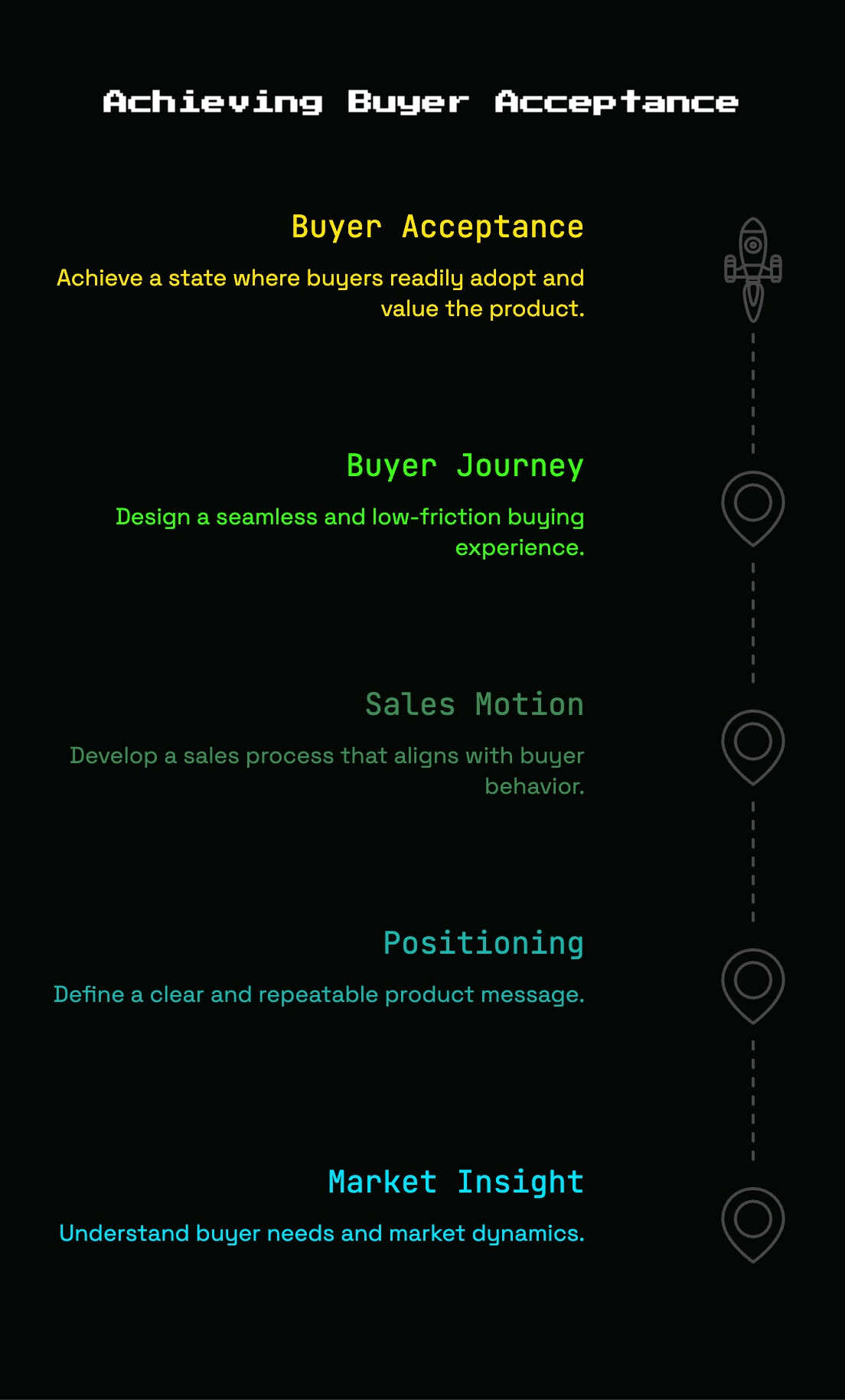
A GTM process only works if it fits real buying behavior. Internal execution matters, of course, but the motion fails when it asks buyers to do unnatural things.
Maybe your site asks for a demo before anybody understands the problem you solve. Maybe your sales call jumps into features before the buyer can explain the pain internally. Maybe your proposal lands before security, budget, or the manager of the day-to-day user has been looped in. On paper, your team executed the plan. In practice, the buyer had to do too much work.
Here’s the thing: buyers do not reward effort. Buyers reward clarity, trust, timing, and low friction.
That is why “buyers accept” is the better standard. A strong GTM process meets buyers where they are. It gives the right proof at the right moment. It makes the next step feel obvious instead of demanding. Half of B2B deals stall because of no decision, not because a competitor won. That usually means the motion made buying feel harder than staying put.
GTM process vs. GTM strategy vs. marketing strategy
These terms get mashed together all the time, and that creates confusion fast.
GTM strategy is the set of choices. Which market you target, which segment you start with, how you position the product, what route to market you use, what price point you aim for, and what success looks like. Think of strategy as deciding where to play and how to win.
GTM process is the operating system that turns those choices into repeatable execution. It defines who owns what, how leads or accounts move, how opportunities are created, how feedback gets captured, and how teams stay aligned over time. If strategy is the blueprint, process is the plumbing, wiring, and habits that make the house livable.
Marketing strategy is narrower. It covers demand creation, channels, campaigns, content, brand, and message distribution. That matters a lot, but it is still one part of the larger motion. As GTM scope gets broader in modern B2B, the companies that win tend to treat revenue as one coordinated system rather than separate department projects.
Why early-stage B2B SaaS teams get GTM wrong
This is the familiar sequence. You get some early customers. You hire a first rep. You try outbound. You add content. You tweak pricing. Somebody updates the homepage. Somebody else changes the deck. Three months later, activity is up and confidence is down.
Most GTM problems at this stage are not caused by laziness or lack of ideas. The problem is fragmentation. Decisions get made in different corners of the business without a shared model of who the best buyer is, why that buyer moves now, and what the buying path is supposed to feel like.
That is why you can have smart people doing real work and still end up with a GTM motion that feels stitched together.
The “random acts of growth” trap
Random acts of growth look productive from the outside. More campaigns. More outbound sequences. More webinars. More feature launches. More demos.
But if the underlying system is weak, all that motion just creates noise. Marketing pulls in leads sales does not want. Sales pursues accounts that onboarding struggles to retain. Product builds for one segment while the site speaks to another. The funnel gets wider, but not healthier.
The result is familiar: noisy pipeline, long sales cycles, and deals that drift into “we’ll revisit this next quarter.” Research keeps pointing to the same pressure points. In one 2026 survey, 87% of B2B companies said creating qualified opportunities is difficult, and 88% said generating enough pipeline is hard. That does not mean everybody needs more activity. Usually it means activity is disconnected from a coherent motion.
Why a decent product still struggles without a clear motion
A good product does not automatically produce traction. Plenty of tools solve real problems and still struggle to grow because buyers do not understand the problem clearly, cannot explain the value internally, or hit too much friction on the way to purchase.
There is a big gap between “this works” and “this gets bought consistently.”
You can see it in the details. The homepage says one thing, the deck says another, and the demo shows features that only make sense after somebody already believes the problem matters. Or the product is genuinely useful, but the path to value feels vague, so buyers hesitate. If implementation looks uncertain, if pricing seems hard to evaluate, or if handoffs feel awkward, even a strong product starts to feel risky.
That gap is exactly what the GTM process is supposed to close.
The core pieces of a GTM process
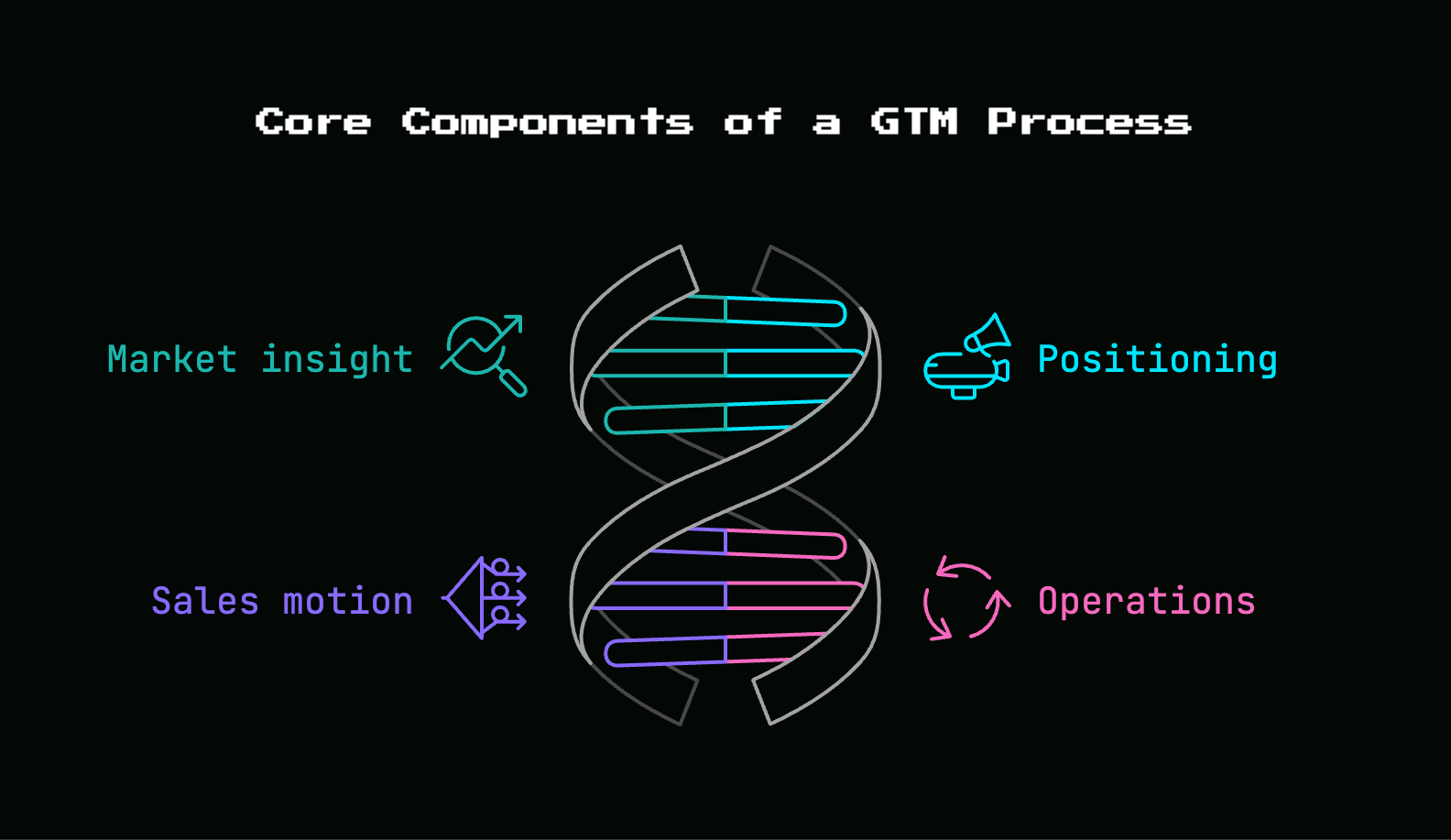
Before getting into how to build one, it helps to know what the system actually contains. A modern GTM process is not one document. It is a set of connected parts that reinforce each other.
If one part is weak, the whole motion starts leaking. Great messaging cannot rescue a bad target market. Strong demand generation cannot fix broken handoffs. A talented rep cannot invent a sales motion from scratch if your market choice and positioning are still muddy.
Market insight and customer understanding
This starts with your ideal customer profile, or ICP. That means the kind of company most likely to get real value from your product and buy it in a reasonable timeframe. It also includes segmentation, buyer pains, trigger events, and the reasons somebody decides to act now instead of someday.
The catch is that “everyone with this problem” is not an ICP. It is just a hopeful sentence.
Usable market understanding has edges. It tells you which accounts tend to convert faster, which ones churn less, which use cases pull deals forward, and which triggers create urgency. Without that clarity, targeting gets sloppy. And when ICP targeting drifts, win rates can drop hard. Some research puts the damage from misaligned ICP targeting at up to 75% dilution in win rates. That sounds dramatic, but honestly, it matches what early-stage teams feel when every deal starts looking custom.
Positioning, messaging, and value proposition
These terms overlap, but they are not the same.
Positioning is the context you set in the buyer’s mind. It answers what category you belong in, who you are for, and why your approach is meaningfully different. Messaging is how you communicate that clearly in conversations, on your site, in emails, and in demos. Value proposition is the sharp answer to “why should I switch now?”
Put another way, positioning is the frame, messaging is the language, and value proposition is the reason to move.
When these get blurred together, copy starts sounding polished but weak. You end up with lines that describe software without making anybody care. Buyers do not need more claims. Buyers need a clear problem, a believable outcome, and a reason your product is a better fit than sticking with the status quo.
Sales motion, channel mix, and distribution
Your GTM process also needs a route to market, the actual path you use to reach buyers and convert demand into revenue.
That might be direct sales, product-led growth, founder-led selling, partner-led distribution, inbound, outbound, or some mix. Different routes fit different products, price points, and buying habits. A low-ACV self-serve tool can often lean product-led. A higher-ACV multi-stakeholder platform usually needs a more guided motion.
Copying the motion of a bigger SaaS company is a fast way to waste six months. Your buyers only care about the route that feels natural to them.
Operations, handoffs, and feedback loops
Operations is the plumbing. Not glamorous, but if it breaks, everything backs up.
This includes CRM hygiene, lead and account routing, stage definitions, reporting, enablement, and customer feedback loops. RevOps sits here too, even if nobody on your team has that title yet. Somebody still needs to make sure data is clean, ownership is clear, and the system is producing useful signals instead of dashboard theater.
A lot of GTM execution breaks because teams run in silos or lack unified data. That is not abstract. It shows up as duplicate accounts, vague pipeline stages, missed follow-ups, confused ownership, and reps working deals from memory instead of from a real system.
Start with the market: pick a narrow wedge you can actually win
Most early-stage SaaS teams start too broad. That makes the story weaker, the outreach blander, and the pipeline less qualified. Focus feels scary because it means excluding possible buyers, but broadness is usually what slows growth.
You do not need the perfect market. You need a wedge you can actually win.
Think of it like opening a small door before trying to move a couch through the house. If the first opening is too wide, you lose all leverage. A narrow wedge gives you pattern recognition. You learn faster which pains convert, which objections matter, and which use cases create expansion later.
Define your ICP without making it uselessly broad
A practical ICP combines firmographic, technographic, and behavioral criteria.
Firmographic means company traits like industry, size, revenue band, geography, and team structure. Technographic means the tools already in the stack, which matters more than many teams realize. Behavioral means what the account is doing: hiring, adding systems, expanding teams, dealing with compliance, changing leadership, or showing intent around the problem you solve.
That mix gives you something sales and marketing can actually use. “Mid-market B2B SaaS companies” is too broad. “U.S.-based B2B SaaS companies with 50 to 250 employees, a sales team of at least five, HubSpot in place, and a recent push into outbound” is the start of a workable target.
If your first sales hire is guessing who is a fit, your ICP is not defined. A tighter definition also makes it easier to build a repeatable way for your first rep to sell, because consistency starts with knowing which deals deserve effort.
Segment by urgency, not just by industry
Industry matters, but urgency matters more.
Two companies in the same vertical can look identical in a spreadsheet and behave completely differently in a sales cycle. One feels real pain, has budget, and needs change now. The other agrees the problem exists but can live with it for nine more months.
That is why smart segmentation looks at pain intensity, trigger events, and willingness to change. A company that just hired a VP of Revenue, missed a board target, or inherited a messy handoff process is usually more ready to act than another company in the same vertical with no active pressure.
This is also where a lot of buyer understanding gets sharper. If you want a better motion, spend time studying how purchase timing actually shifts. Behavior tells you more than static persona labels.
Map the buying group, not just the champion
Lead-centric thinking breaks down fast in B2B SaaS. One person might start the conversation, but that almost never means one person decides.
In many B2B purchases, a buying group forms around the opportunity. The user cares about workflow pain. The manager cares about team adoption. The budget owner cares about ROI. Security wants answers. Procurement wants process. An executive sponsor wants risk reduction and confidence.
If your GTM process only supports the champion, the deal gets fragile. Research cited in one GTM guide notes the average B2B purchase involves 10 stakeholders. Even if your deals are smaller than that, the point stands: more people show up than your CRM lead view suggests.
Build positioning buyers can repeat back to someone else
Strong GTM depends on a message simple enough to travel inside the account.
That matters because your champion is not just evaluating your product. Your champion is also translating it for somebody else, usually after your call ends. If the explanation falls apart in the hallway, in Slack, or during a Tuesday 4:30 p.m. budget meeting, the deal loses momentum.
A useful test is simple: after one call, could somebody explain your product to a VP in two or three clear sentences? If not, your motion is too hard to buy from.
Clarify the problem you solve before the features you ship
Most early-stage SaaS messaging leans too feature-first. It lists what the product does without anchoring why the buyer should care right now.
Features matter later. The problem comes first.
Buyers need to recognize the pain almost instantly. Not in abstract terms, but in a way that feels like their Tuesday morning. Missed handoffs. Slow approvals. Manual reporting that eats three hours every Friday. Pipeline that looks full until the board asks what is actually closeable.
Once that pain is clear, features make sense as proof. Without the problem, features are just a pile of buttons.
Create a point of view, not a pile of claims
A point of view is your angle on why the old way is broken, why that matters now, and why your approach fits better.
That is different from a list of positive adjectives. “Fast, powerful, flexible, easy-to-use” is not a point of view. It is wallpaper.
A point of view gives buyers language for change. Maybe the old lead routing logic no longer fits multi-stakeholder buying. Maybe manual onboarding creates hidden churn before anybody notices it. Maybe your category has trained teams to track activity instead of actual opportunity health.
A clear point of view is useful because buyers can repeat it internally. It helps the product travel.
Test your message in live conversations
Messaging is not something you finish in a doc and admire forever. It gets tested in the field.
Sales calls are message tests. Demo reactions are message tests. Reply rates, onboarding calls, lost deal notes, and even awkward silences are message tests. If buyers nod at your opening line but get confused during the demo, the story is incomplete. If prospects ask the same clarifying question every week, the message is doing extra work somewhere.
That is one reason founder involvement in early selling matters so much. Before handing the motion off, you need firsthand pattern recognition around objections, timing, value perception, and who really drives the decision.
Choose a sales motion that matches your price, product, and buyer
A sales motion is the shape your revenue engine takes in practice. Who sells, how demand gets created, how much guidance the buyer needs, and what the path to revenue looks like.
At this stage, the biggest mistake is copying what impressive companies do at scale. Your motion should match your actual product, average contract value, buying complexity, and current resources.
Founder-led sales before team-led sales
This point deserves a direct answer: if you have not personally closed enough deals to understand why buyers say yes, why they stall, what objections repeat, and how the buying path really works, you are probably early to hand sales off.
A first rep cannot invent clarity for you.
Founder-led sales matters because it exposes the reality underneath assumptions. You hear the language buyers use, not the language you hoped they used. You notice which use cases pull urgency forward. You learn which buyers smile on the demo and disappear anyway.
Then, and only then, can you start building a process somebody else can run. Otherwise you are hiring a rep into ambiguity and calling it a growth plan.
When to use inbound, outbound, or a hybrid motion
Inbound works well when buyers already know the category, can describe the problem, and are willing to raise a hand. It tends to produce warmer conversations, but it also depends on demand existing in the first place.
Outbound is useful when the problem is real but timing is uneven, category awareness is lower, or your best buyers are not searching actively yet. Outbound can create opportunities that would not show up on their own, but it only works when targeting and messaging are sharp.
Hybrid is often the best fit for early B2B SaaS. Inbound warms the market and catches active demand. Outbound creates focus and speeds learning. The catch is that hybrid only works if both sides use the same ICP, the same core story, and one shared definition of a qualified opportunity.
Motion should also reflect price. Lower ACV products can support more product-led or inbound-heavy paths. Higher ACV, multi-stakeholder deals usually need a more guided approach.
The first sales hire: what the process must already have
Before your first rep starts, the GTM process should already provide a few basics: a clear ICP, usable messaging, stage definitions, a working CRM, example calls, a realistic offer, and enough pattern recognition to know what a healthy deal looks like.
That is not perfection. It is enough structure to learn without chaos.
A rep cannot create product-market fit, and a rep cannot fix muddy positioning by sheer activity. If you want the hire to work, hand over a motion, not a wish.
Design the buyer journey so it feels easy to buy
The GTM process becomes real at the buyer journey level. Not in your org chart. Not in your planning doc. In the moments where somebody decides whether to keep moving.
Buyer acceptance comes from reducing friction at each step. If the path feels confusing, slow, or risky, buyers pause. And once a B2B deal pauses, it often stays paused.
Match touchpoints to buyer questions
Buyers have different questions at different points. Early on, the question is usually, “Is this problem worth fixing?” Then it becomes, “Why this approach?” Later it turns into, “Will this work for a company like ours?” and “How hard is this to implement?”
A simple journey helps. Awareness needs problem clarity. Consideration needs framing and differentiation. Evaluation needs proof, examples, and confidence. Decision needs answers around stakeholders, security, pricing, and rollout. Onboarding needs momentum and a clear first win.
If your content, calls, and demos do not match those questions, your process is asking buyers to bridge the gap alone.
Remove friction from handoffs
Handoffs are where good motions quietly die.
The lead fills out a form and gets a generic email. Sales runs a decent demo but onboarding has no context. A champion is interested but procurement enters late with basic unanswered questions. Each handoff becomes a fresh point of confusion.
That is why GTM is cross-functional by nature. Marketing to sales, sales to onboarding, onboarding back to product, none of these are side details. They are part of the buying experience.
Even simple fixes matter. Shared notes. Clear ownership. One place for deal context. Preemptive security material. A short internal handoff template. A buyer should not have to repeat the same explanation three times just because your teams are split across tools.
Make the next step obvious every time
One of the easiest ways to improve a GTM process is to get ruthless about the next step.
Every call, email, demo, proposal, and follow-up should point to one clear action. Book the technical review. Invite the manager. Confirm implementation timing. Review security docs. Start a pilot. Whatever it is, make it visible.
Many deals die from inaction, not active rejection. If the next step is vague, buyers default to waiting. And waiting is the silent killer of pipeline.
Build your GTM process around opportunities, not just leads
This shift matters more now than it did a few years ago.
A lead-centric GTM process treats individual people as the unit of progress. That can work in simpler sales motions, but it breaks down in B2B SaaS deals where multiple contacts, multiple conversations, and multiple approval steps shape the outcome.
An opportunity-based process treats the account and buying group as the real object you are trying to move forward.
What lead-centric GTM misses
Lead-centric reporting often makes the top of funnel look healthy while hiding the actual state of deals.
You can generate form fills, sequence replies, demo requests, and meetings while still failing to advance accounts. One contact may be engaged while the budget owner has never heard of you. A lead might be marked qualified even though no buying group exists, no timeline is clear, and no internal urgency is real.
That is why a purely lead-based view can overvalue activity and undervalue deal health. It gives you volume without context.
How opportunity-based GTM changes execution
When your GTM process becomes opportunity-aware, execution gets more realistic. You attach multiple contacts to the same deal. You note stakeholder roles. You coordinate outreach around one shared account context. You define progress by movement in the buying group, not just by a single lead taking a meeting.
This is where modern GTM is heading. Research from LeanData points to a move toward opportunity-based execution and dynamic buying groups because that better reflects how B2B deals actually move.
In practical terms, it changes your questions. Instead of asking, “Did the lead respond?” you ask, “Do you have coverage across the people needed for a decision?” That is a better question.
A simple version early-stage teams can run today
You do not need an enterprise stack to adopt this thinking.
A lightweight version works fine. Track accounts, not just people. Attach contacts to opportunities. Note who is the user, who manages the team, who signs, who handles security, and who could act as executive cover. Review deal health every week with that context in view.
Simple is good here. The goal is not complexity. The goal is to stop mistaking contact activity for buying progress.
Put the right operating rhythm behind the motion
Even a smart GTM design falls apart without cadence. You cannot run this system on memory, heroics, or whatever feels urgent on Thursday afternoon.
A repeatable GTM process needs an operating rhythm. Not endless meetings, just a few useful ones that force learning back into the system.
Weekly deal reviews that improve the motion
Weekly deal reviews should focus less on rep theater and more on pattern recognition.
Look for where deals stall, which objections repeat, which segments convert, which channels source stronger opportunities, and where the buyer journey gets sticky. If three deals from a similar segment all slow down at security review, that is not random. If the same objection appears in four demos, your messaging needs work.
Short is better. Useful is better. The meeting should improve the motion, not just inspect the forecast.
Monthly funnel and conversion reviews
Once a month, step back from individual deals and look at the system.
How are stage conversions changing? Which sources create qualified opportunities versus just names? How fast is pipeline moving? Do you have enough coverage for the next quarter? Where are leads, accounts, or opportunities leaking out?
This is where numbers help you see friction. A CRM can make a real difference here. Some reporting has found sales cycle gains from CRM implementation around 14%, which makes sense because clean process usually speeds decisions.
Quarterly GTM resets
Quarterly resets keep drift from becoming strategy.
Markets shift. Segments change. Messaging gets stale. A once-good channel starts underperforming. Your GTM process should be revisited regularly, especially once your team grows past a few people and informal alignment stops working.
If you have a RevOps owner, this is a natural place for that role. If not, somebody still needs to own the revenue system, pull learnings together, and make sure the process keeps matching real buyer behavior.
The metrics that tell you if the motion is working
Metrics are not there to make dashboards look official. The point is to spot friction, waste, and false confidence early enough to fix them.
If the GTM process is working, the numbers should tell a story that makes operational sense.
Demand and pipeline metrics
Start with pipeline growth, qualified opportunities, source mix, account engagement, and pipeline coverage.
Pipeline growth tells you whether enough future revenue is being created. Qualified opportunities tell you whether that pipeline is real or just inflated. Source mix shows where strong deals originate. Account engagement helps you see whether interest is spreading through the buying group or resting on one contact. Pipeline coverage tells you how much room for error you actually have.
A lot of teams feel pipeline pressure right now, and for good reason. Acquisition is getting more expensive, and volume alone is not saving anybody.
Sales efficiency metrics
Then look at win rate, sales cycle length, customer acquisition cost, CAC payback, time to first revenue, and average deal size.
These are decision metrics. A falling win rate may signal ICP drift or weak qualification. A long sales cycle may signal friction in the journey or missing stakeholders. Rising CAC with flat deal size is a warning. Slow time to first revenue can mean onboarding is dragging, which hurts both cash flow and trust.
Keep these tied to action. If you track 30 metrics and change nothing, the system is not getting smarter.
A useful benchmark still shows up here: maintaining an LTV:CAC above 3:1 is a healthy sign that your acquisition motion is efficient enough to support growth.
Retention and expansion metrics
GTM does not stop at acquisition. If your process brings in customers that stall in onboarding, churn early, or never expand, the motion is incomplete.
That is why retention and expansion metrics belong in the GTM view. Net retention, expansion revenue, churn signals, product adoption milestones, and customer handoff quality all show whether you are acquiring the right customers and setting them up properly.
A sloppy handoff to customer success can erase months of sales effort. A clean one can turn a good acquisition motion into a compounding revenue motion.
Where AI actually helps in a GTM process
AI can help a lot, but not in the magical way tool vendors like to imply.
In a GTM process, AI is most useful when it speeds work, improves routing, sharpens personalization, summarizes context, or helps surface signals that a small team would otherwise miss. It is an operating layer, not a substitute for clarity.
Fast wins for small GTM teams
The best early use cases are boring in a good way.
Enrichment can fill in missing account details. Note summaries can reduce admin work after calls. Call analysis can spot repeated objections or missing talk tracks. Outbound drafts can speed personalization. Routing rules can help assign the right follow-up faster. Prompted follow-ups can stop simple tasks from slipping.
These are practical wins because they save time without changing your whole motion. And that matters, especially for lean teams trying to do real selling without building a tool museum.
What AI cannot fix
AI will not rescue a vague ICP. It will not clarify muddy positioning. It will not repair a broken handoff between sales and onboarding. And it will absolutely not make poor targeting less poor.
Bad inputs still produce noisy outputs.
If your message is generic, AI helps you generate generic content faster. If your account data is messy, AI helps you scale confusion. So the order matters. Get the fundamentals straight, then use AI to reduce drag.
How to add AI without making your stack messier
Pick a few workflows with measurable value and start there.
Maybe it is call summaries, enrichment, and follow-up prompts. Maybe it is routing and account research. The trick is to choose workflows that save time or improve conversion in a way you can actually notice.
A lot of teams are moving this direction. One 2026 survey found 58.4% expect AI-first GTM models to outperform traditional ones within 12 to 24 months. But the winners will not be the teams with the most AI tools. It will be the teams with the cleanest process and the clearest use cases.
Common GTM process mistakes that make buyers hesitate
Most GTM mistakes do not look dramatic from the inside. They look normal. That is part of the problem.
The damage shows up later, in stalled deals, weak conversion, confused handoffs, and customers who seemed right until renewal time.
Confusing activity with traction
More emails, more demos, and more campaigns do not mean the motion is working.
If the wrong accounts are entering the funnel, activity only increases waste. You end up celebrating motion while qualified pipeline stays flat. This is one reason documented systems matter. Companies with documented GTM strategies are significantly more likely to hit revenue targets, mostly because documentation forces sharper choices and cleaner execution.
Selling to one contact in a multi-person decision
A deal can look healthy and still be fragile if everything depends on one enthusiastic contact.
As soon as that person gets busy, changes jobs, loses confidence, or struggles to explain your value internally, momentum disappears. Multi-person decisions need stakeholder coverage. If your process does not support that, your pipeline will look better than it is.
Letting each team define the customer differently
When product, marketing, and sales all use different definitions of the customer, the GTM process becomes self-defeating.
Marketing targets one segment, sales pursues another, and product prioritizes a third. Language drifts. Promises drift. Success criteria drift. The buyer feels that inconsistency immediately, even if nobody on your team names it out loud.
Shared understanding of ICP and messaging is not a nice-to-have. It is the base layer of coordination.
Scaling before the motion is repeatable
Hiring ahead of clarity is one of the most expensive mistakes an early-stage SaaS company can make.
Adding reps to a shaky process is like adding lanes to a road with the wrong exit signs. Cars move faster, but more of them go the wrong way. Before scaling headcount, fix the motion. If you are not sure where the process is breaking, run a quick look at where deals actually get stuck. That usually reveals more than another month of hoping.
A practical GTM process for a $1M, $5M ARR SaaS company
At this stage, the best GTM process is not fancy. It is clear, documented, and calm enough for a small team to actually run every week.
You do not need a giant rollout. You need a working model.
Step 1: Document your best-fit customer and buying trigger
Start with your best current customers. Not all customers, your best ones.
Look for what they share: company size, team shape, tool stack, urgency, use case, buying path, and how long it took to close. Then identify the trigger that pushed action. Maybe a new leader joined. Maybe reporting broke under growth. Maybe a handoff issue started costing deals.
Write this down in one place. If possible, validate it with direct conversations. A good rule from GTM research is at least 20 customer or prospect conversations before locking in assumptions.
Step 2: Write a simple positioning and message house
Keep this to one page.
State the audience, the painful problem, the core value, the proof behind that value, and the most common objections. Add one short point of view on why the old way is failing. That is enough to align your homepage, deck, outreach, and demo narrative.
If you cannot fit the story on one page, it is probably still too blurry.
Step 3: Pick one primary route to market
Choose the channel most likely to produce both learning and revenue, then commit to it long enough to see patterns.
That might be founder-led outbound into a narrow segment. It might be inbound plus demo-led conversion. It might be a hybrid motion with light outbound around a content engine. What matters is that one route gets priority.
Spreading effort across five channels too early feels safer. It is usually slower.
Step 4: Define stages, owners, and handoffs
Map the path from first touch to onboarding.
Define what counts as an account, a qualified opportunity, a real evaluation, a closed-won deal, and a successful handoff. Name the owner at each step. Spell out what information must be captured before the next handoff happens.
Even a few shared pages can do the job. Fancy documentation is optional. Clear ownership is not.
Step 5: Review, refine, and tighten every quarter
A GTM process is a living system.
The point is not to reinvent it every quarter. The point is to tighten it. Adjust the ICP if the wrong deals keep entering. Refine the message if one objection keeps repeating. Simplify a handoff if onboarding starts cold. Drop a weak channel. Double down on a strong one.
Small fixes, repeated consistently, usually beat dramatic reinventions.
FAQs about the GTM process
Is a GTM process only for launches?
No. Launches are one use case, but the GTM process should support ongoing acquisition, expansion, and adaptation. In B2B SaaS, the real value comes after launch, when the company needs a repeatable motion for creating opportunities, closing deals, onboarding customers, and expanding accounts over time.
What is the difference between GTM process and sales process?
A sales process covers how an opportunity moves through a deal, from discovery to close. A GTM process is broader. It includes market choice, positioning, messaging, channels, routing, handoffs, metrics, and post-sale alignment. Sales process sits inside GTM, not the other way around.
Who should own the GTM process?
One person should drive coordination, even though the process spans multiple functions. In a smaller SaaS company, that owner is often the founder, a head of revenue, an operator with a RevOps mindset, or part-time growth leadership brought in before that role becomes full-time. The key is clear accountability. Without it, GTM becomes everybody’s job and nobody’s system.
How documented does your GTM process need to be?
It does not need to be fancy. A few shared pages can be enough if they define the ICP, buying triggers, positioning, stage definitions, ownership, handoffs, and core KPIs. Documentation matters because it removes guesswork and makes the motion teachable.
The one thing to try this week
Take one recent won deal and one stalled deal, then compare them side by side.
Look at the segment, the trigger, the stakeholders involved, the message that landed, the objections that showed up, the handoffs, and the next steps. You will usually spot the truth fast. One deal fit the motion buyers were ready to accept. The other asked for too much trust, too much translation, or too much effort.
That one exercise can do more for your GTM process than another batch of random activity. Once you see the difference clearly, fixing the motion gets much easier.


Discussion