

A fractional head of growth is a senior growth leader you bring in part-time to turn scattered go-to-market work into a system that actually drives revenue. If your team is busy, your founder is still holding too much of sales in their head, and every meeting ends with “we need more pipeline,” this role starts to make a lot of sense fast.
What a Fractional Head of Growth Actually Is
A fractional head of growth is not a junior freelancer with a nicer title. It is a senior operator who steps into your business with enough experience to spot what is broken, decide what matters most, and help your team improve the full path from demand to revenue.
The phrase “head of growth” can sound fuzzy, mostly because different companies use it differently. In a B2B SaaS company, the job usually sits across marketing, sales, product, and lifecycle work. The point is not to own every task. The point is to make sure your growth motion works as one connected system instead of four disconnected functions.
The word “fractional” matters here, but not in the way many founders first assume. It does not mean watered down. It means you get a slice of senior leadership time instead of paying for full-time executive coverage before your business actually needs it.
Just as important, this is not automatically a temporary patch. Some engagements last a few months to reset direction. Others continue for a year or longer because the fit keeps working.
A quick note on how I work with B2B SaaS teams
I work with post-PMF B2B SaaS companies at $1M–$5M ARR facing the same transition: demand exists, but too much of GTM still depends on the founder. I find the bottleneck and build the first working system that removes it. If you are pre-PMF or only need extra hands, I am probably not the right fit.
Case StudyFrom €1M to €2.5M ARR Fully Bootstrapped.
Solid product, real demand. The fix wasn't more leads. It wasn't a bigger team either. The change that unlocked growth wasn't what most founders expect.
Read the full story →What “fractional” really means in day-to-day work
In practice, fractional means your company buys a defined amount of high-level leadership each month. That might be a few hours a week, one or two days a week, or a retainer tied to specific outcomes and operating rhythms.
So what do you actually get during that time? Usually a mix of diagnosis, strategy, prioritization, team coaching, decision support, and weekly accountability. The role is close enough to your business to influence real decisions, not just hand over a slide deck and disappear.
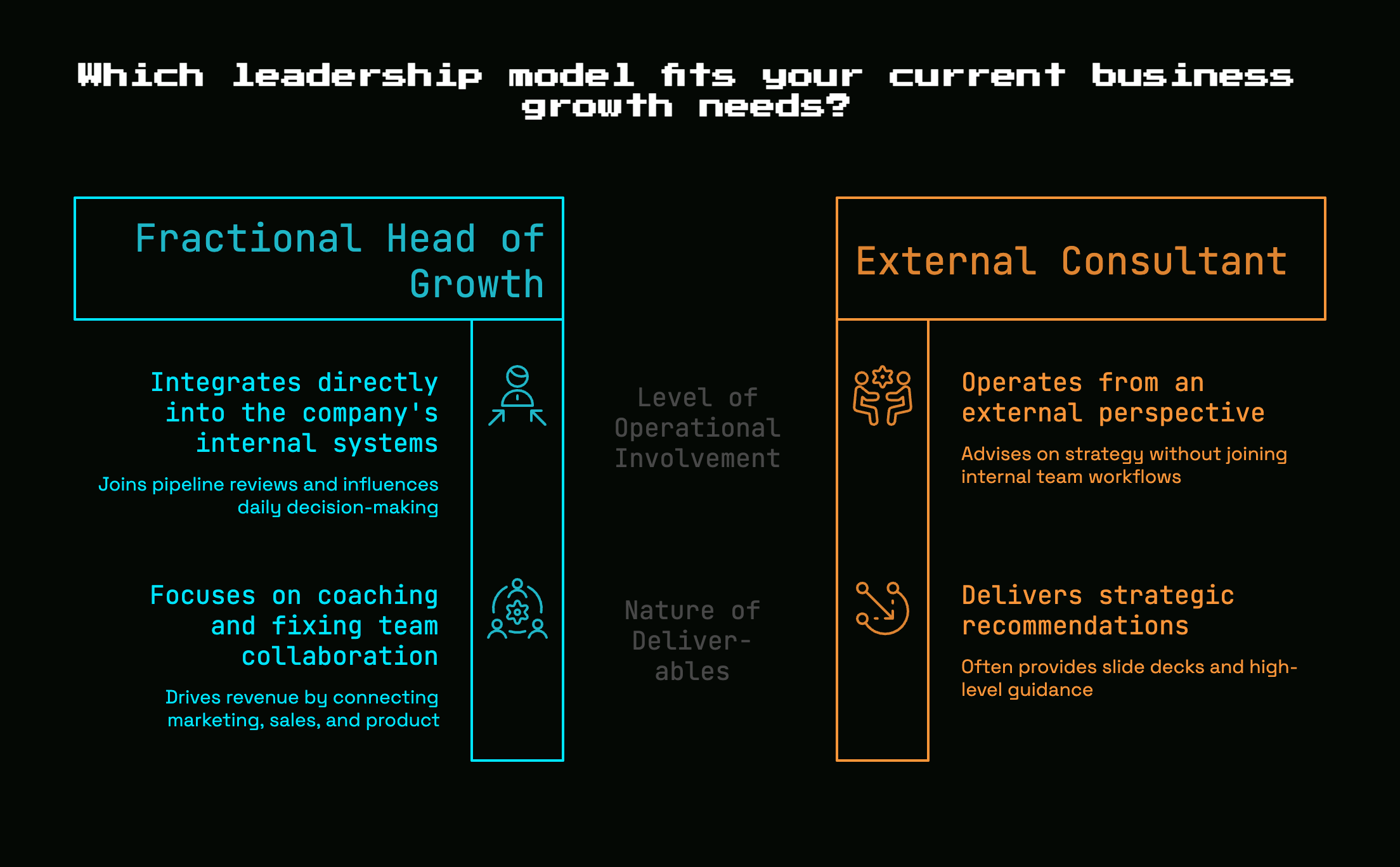
That distinction matters. A consultant often advises from outside the system. A fractional leader gets inside it, joins the pipeline review, notices where leads die, pushes on pricing questions, and helps fix how teams work together. That is a different level of involvement.
Why this role shows up so often around $1M, $5M ARR
This role tends to appear right when the old way stops working.
Around $1M, $5M ARR, your company often has some product-market pull, but your growth motion still runs on memory, hustle, and duct tape. Founder-led sales starts to strain. Your first AE or marketer needs more structure. Channels may be producing activity, but not predictable revenue. At that stage, a full executive bench can feel too heavy, but no leadership at all starts getting expensive.
That is why so many companies at this size look at fractional leadership. You need judgment more than headcount. Or, as some recent thinking on the model puts it, experience density often matters more than piling on another layer of management.
What a Fractional Head of Growth Does All Week
The vague version of this role sounds impressive but useless. The practical version is much simpler: find the bottleneck, pick the few moves that matter, and make sure your team is working on revenue problems instead of activity theater.
A good fractional head of growth spends very little time admiring dashboards and a lot of time turning messy signals into decisions. Sometimes the issue is top-of-funnel. Sometimes it is activation. Sometimes your close rates are fine and your pipeline is weak because your positioning is muddy. Sometimes the biggest problem is that nobody can agree on what “qualified” means.
Audits the funnel and finds the real bottleneck
This is usually the first real job.
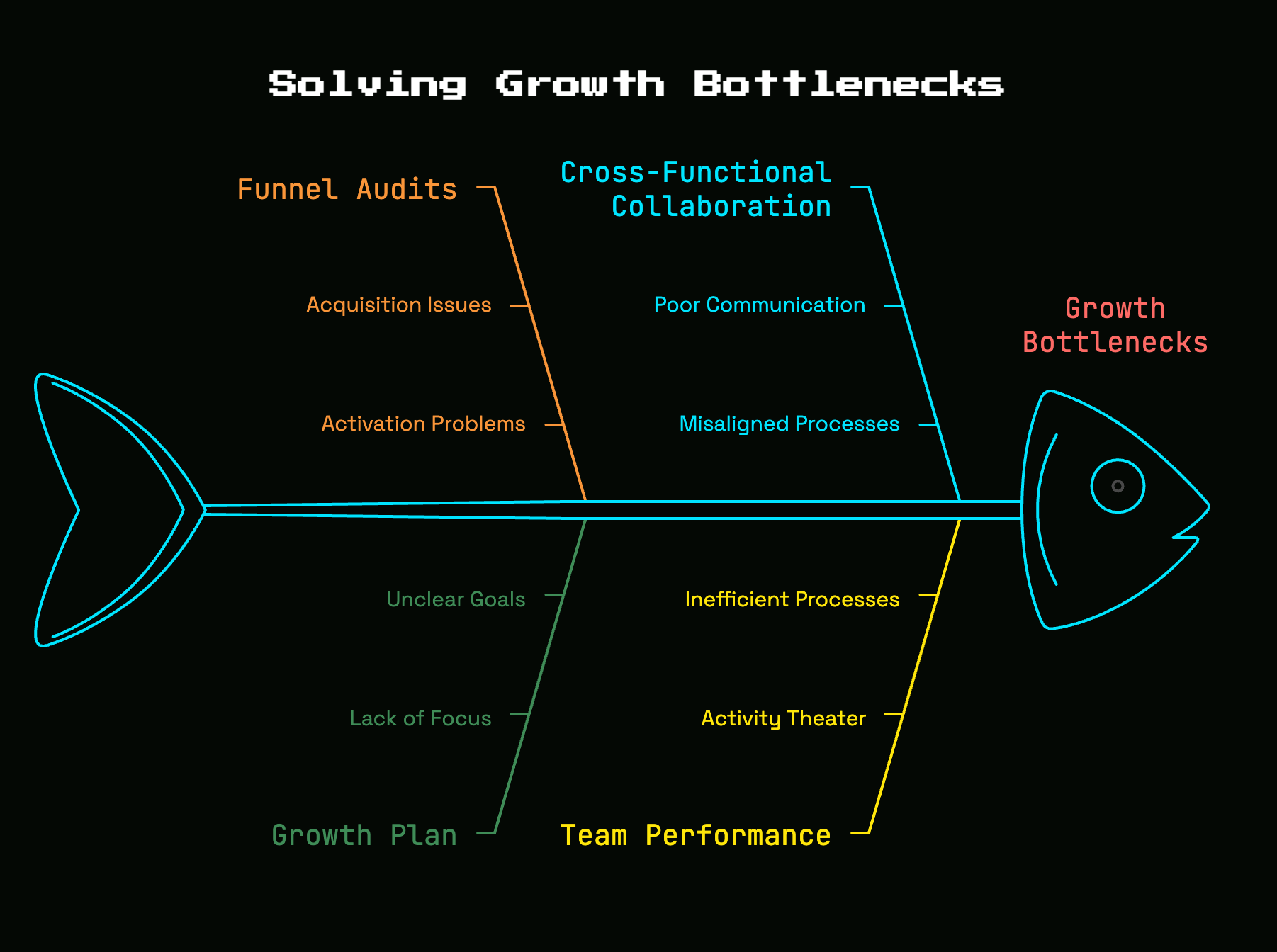
A fractional head of growth looks across acquisition, activation, pipeline, conversion, retention, and expansion to see where momentum is actually getting stuck. That sounds obvious, but honestly, many teams are solving the wrong problem. When growth slows, the default reaction is “get more leads.” But if demos do not convert, trials do not activate, or onboarding leaks users in week one, more leads just mean more waste.
The first fix is often clarity. Clean definitions. Better segmentation. Honest funnel math. A tighter weekly review. If your team needs a better framework for connecting these moving parts, this is the kind of problem solved by building a repeatable revenue motion, not just pushing harder on one channel.
Builds a growth plan your team can actually run
After the diagnosis comes focus.
A good plan does not try to fix everything in one quarter. It picks a few bets, names owners, sets checkpoints, and defines what success should look like. That may include channel priorities, changes to messaging, feedback on pricing or packaging, a better handoff from marketing to sales, or a simpler KPI dashboard that everyone can understand without a data archaeologist in the room.
This is where the role earns its keep. Plenty of teams know their goals. Fewer know what to stop doing. Fractional growth leadership often means protecting your team from random acts of marketing and random acts of sales so time goes toward the handful of moves with a real chance of changing revenue.
Works across sales, marketing, product, and ops
Growth is cross-functional whether your org chart admits it or not.
If marketing brings in leads sales does not want, if product creates signups that never activate, or if ops reports numbers nobody trusts, your problem is not effort. It is connection. A fractional head of growth works in the seams between teams, where most revenue friction lives.
That can mean tightening lead qualification, cleaning up CRM stages, improving the sales story, aligning onboarding to the promise made in ads, or fixing follow-up loops so nobody drops warm opportunities. The job is less about “running a department” and more about making the whole machine pull in the same direction.
What They Usually Own vs What They Usually Influence
One of the most common hiring mistakes is expecting one person to “do all growth” alone. That is not a role. That is wishful thinking with a budget.
A fractional head of growth usually owns outcomes, operating rhythm, priorities, and accountability. Execution still needs a team.
Metrics they’re likely to own
The exact metrics depend on your model, but the role usually carries direct responsibility for a handful of growth numbers tied to revenue. That might include pipeline growth, conversion rate by stage, sales velocity, trial-to-paid conversion, customer acquisition efficiency, retention inputs, or expansion motion.
The important part is not the exact list. It is that the numbers connect across the funnel instead of living in separate team dashboards. In many SaaS companies, fragmented ownership is exactly what creates stalled growth in the first place.
Work they guide but don’t personally execute
A fractional head of growth may not be the person writing every ad, building every workflow, or closing every deal. If you hire one expecting a full in-house team inside a single person, you will be disappointed.
The role usually designs the system, sets direction, reviews output, coaches the team, and keeps execution tied to results. An agency might run paid search. A marketer might ship campaigns. A sales lead might manage rep performance. The fractional growth leader makes sure all of that work adds up to something.
The difference between leadership, management, and hands-on execution
Here’s the simplest way to think about it.
A strategist tells you what could work. A manager keeps a function moving day to day. A hands-on operator does the work directly. A fractional head of growth usually sits in the middle of those modes, with a bias toward leadership.
In lean SaaS teams, the role may get pretty hands-on early. That is normal. But the real value is not becoming your permanent extra set of tactical hands. It is building repeatable motion so the business does not depend on heroics forever.
Fractional Head of Growth vs the Other Roles You’re Probably Comparing
Once the term starts to click, the next question is obvious: do you actually need this role, or something narrower?
That depends on where the problem lives.
Fractional Head of Growth vs full-time Head of Growth
A full-time head of growth makes sense when your motion is already proven, the company has enough complexity to justify daily executive attention, and there is plenty of work for that person to own every week.
A fractional head of growth makes sense when you need senior judgment now, but not forty hours a week of it. The model is often faster to start and easier to de-risk. Research on fractional leadership regularly points to 30 to 45 days for measurable impact, which is a lot faster than a long executive search followed by a long ramp.
Fractional Head of Growth vs growth consultant or agency
A consultant diagnoses. An agency executes a channel. A fractional head of growth should connect the whole system and stay close enough to outcomes to adjust the plan as reality changes.
That difference is bigger than it sounds. If paid search is underperforming, the answer may be bad copy. Or weak positioning. Or a broken demo flow. Or poor follow-up from sales. An agency usually only sees its channel. A growth leader should see the chain.
This is also why some companies pair execution partners with fractional leadership. The operator provides the spine, and specialists do the work around it.
Fractional Head of Growth vs fractional CMO or VP of Sales
A fractional CMO usually leans upstream toward marketing strategy, message, demand creation, and channel mix. A VP of Sales leans downstream toward reps, deal stages, forecasting, and close rates.
A head of growth sits across the path from demand to revenue. That often includes product-led or lifecycle levers too, especially in SaaS. If your challenge is broader than marketing and broader than sales, this role tends to fit better.
For smaller teams, the real question is usually not title but scope. If your business needs one person to connect your entire commercial motion, a broader approach to revenue planning for lean SaaS teams matters more than picking the fanciest label.
When This Is the Right Hire , and When It Isn’t
A fractional head of growth is a strong hire at the right stage. At the wrong stage, it becomes an expensive way to avoid a more basic problem.
Signs you’re ready
You are probably ready when founder-led growth has become a bottleneck, your channels produce motion but not predictability, or your first GTM hires need direction they are not getting internally.
This role also fits well after product-market fit, when momentum is real but uneven. A lot of SaaS companies hit this point around the lower single-digit millions in ARR. Recent SaaS-focused guidance puts the “fractional-ready” zone around post-PMF scaling, especially when revenue plateaus because leadership and execution are out of sync.
Signs you’re not ready yet
If there is no real product pull, no budget to execute, no willingness to change messaging or process, or no appetite for disciplined tracking, this hire will not save you.
Same if your real need is simply more hands. A growth leader cannot replace missing SDR work, content production, RevOps cleanup, and sales follow-up all by magic. Leverage still needs something to leverage.
The hard prerequisite: clean enough tracking
Your data does not need to be beautiful. It does need to be usable.
Somebody should know where leads come from, how opportunities move, where deals stall, and what revenue looks like by source or segment. Without that, too much of the role turns into educated guessing. And guessing is expensive.
If your CRM has duplicate stages, half the source fields are blank, and nobody trusts the numbers from last Tuesday, fix enough of that first. Not perfection. Just enough signal to make decisions.
What the Engagement Usually Looks Like
Most founders feel better about this role once the shape becomes concrete.
Early-stage shape: diagnosis, focus, first wins
Early on, the work is heavier on audit, prioritization, and operating cleanup. The goal is not to launch ten experiments in week one. It is to understand the system, pick the real leverage points, and create a rhythm the team can sustain.
By week two, a lot can change. That messy spreadsheet from a Monday morning pipeline review often gets replaced by a simple weekly scorecard your team can read in five minutes. Definitions get cleaned up. Owners get assigned. A couple of obvious leaks get fixed. Trust starts building because people can finally see what is happening.
Scaling-stage shape: systems, hiring, and channel expansion
Once the basics start working, the role shifts. More time goes to forecasting, experimentation cadence, lifecycle optimization, team structure, pricing and packaging input, and deciding which channels deserve more budget.
At this stage, the leader is less focused on finding basic clarity and more focused on building a machine that can handle growth without wobbling every month.
How much time, cost, and access to expect
Common formats are pretty simple: a few hours a week, one to two days a week, or a monthly retainer with defined outcomes and recurring meetings. In adjacent fractional CMO data, many engagements fall in the 10 to 30 hour per week range and often cost far less than full-time executive hiring once salary, recruiting, and overhead are counted. Some analyses point to 67% cost savings compared with full-time executive structures.
The bigger point is not the exact rate. It is that the model gives you senior capability without committing to a full-time executive seat too early. That is one reason 25% of U.S. companies already use fractional hiring models, and the number keeps rising.
How a Good Fractional Head of Growth Approaches B2B SaaS Growth
The best operators do not just “run growth.” They apply a clear operating logic.
Starts with one core growth loop, not six random channels
Strong growth leadership usually starts by choosing one main engine and building around it. Maybe that is outbound. Maybe it is high-intent paid search. Maybe it is product-qualified leads. Maybe it is lifecycle conversion from trial to paid.
Trying to scale five channels at once is how good teams stay busy and stuck. That is a direct rule worth remembering. Focus wins because it creates signal faster, and signal is what lets you improve the next decision.
Sequences channels based on stage and signal
Different channels solve different problems.
If you need fast feedback, you pick channels that produce signal quickly. If you need high-intent demand, you go where buyers are already looking. If you need category education, you use channels that support message repetition and trust. If you already have users, expansion and lifecycle work may beat net-new acquisition.
The trick is sequencing. Not every channel belongs at every stage, and good growth leaders know the difference between “this channel is bad” and “this channel is early.”
Tightens messaging before pouring on spend
Weak positioning can make every channel feel broken.
That is why a fractional head of growth often fixes homepage copy, ICP clarity, sales narrative, and offer structure before increasing budget. Think of it like fixing the leak before turning up the water pressure. If the message is off, more spend just gets you more expensive confusion.
This is especially common in B2B SaaS, where a small change in who you target or how you frame the problem can improve conversion across the entire funnel.
Common Misconceptions About the Role
Because “fractional” still sounds trendy to some people, this role collects a lot of bad assumptions.
“This is just a cheaper executive”
Cost matters, but cost is not the real point.
The real value is timing, fit, and speed. You get senior judgment matched to the stage you are actually in, instead of hiring too big too early. In many cases, that is the smarter move even if budget were not the issue.
“This person will magically fix growth alone”
Nope.
A fractional head of growth can create focus, expose the real bottleneck, align your team, and improve decisions quickly. But growth leadership is leverage, not magic. Product value still matters. Team follow-through still matters. Execution support still matters.
“Fractional means less committed”
Commitment is not measured by how often someone posts in Slack at 4:47 p.m.
Commitment shows up in scope, cadence, accountability, and outcomes. In fact, the broader fractional market has become far more established than many people realize. Senior talent supply is deep, with 72.8% of fractional professionals bringing 15 or more years of leadership experience. This is not a side hustle category anymore.
Questions to Ask Before You Hire One
A good hire here depends less on the title and more on the match.
What stage have you helped before?
Look for direct experience with companies that resemble your current shape, especially ARR, team size, sales motion, and GTM maturity. Somebody great at scaling a $30M org may be a bad fit for your first repeatable pipeline build.
The stage match matters more than polish.
How do you diagnose growth problems in the first 30 days?
Ask about process, not vibes.
A strong answer should include funnel review, customer insight work, ICP clarity, conversion analysis, team workflow, and a concise point of view about where to start. You want specificity. Not grand promises about “unlocking growth.”
What will you own, and what will you need from your team?
Get painfully clear here. Deliverables, decision rights, reporting cadence, meeting structure, access to data, and execution support should all be spelled out early.
This is the question that prevents the classic mismatch. You expect a builder and get an advisor. Or you expect a strategist and get a channel operator.
If you try one thing before making the hire, make it this: write down the one growth problem you most need solved in the next 90 days. If that problem crosses marketing, sales, product, and process, a fractional head of growth is probably the kind of help that fits.


Discussion