

If you have started asking “what does a FDE do,” you are usually already feeling the pain. Deals keep slowing down on technical questions, onboarding gets weird the moment a customer connects real systems, and your founder calendar somehow ends up blocked every Thursday afternoon for integration calls. An FDE exists to fix that gap, and the role is a lot more concrete than the title makes it sound.
What an FDE actually is
An FDE is a Forward Deployed Engineer: an engineer who works directly with customers to get your product live, solve technical blockers, and turn messy real-world requirements into working software.
That sounds abstract until you say it plainly. Your product works in the demo environment. An FDE makes sure it works inside a customer’s actual environment, with actual data, actual security constraints, actual edge cases, and actual deadlines. That is the job.
Here’s the part that needs to be said directly: this is not support with a fancier title.
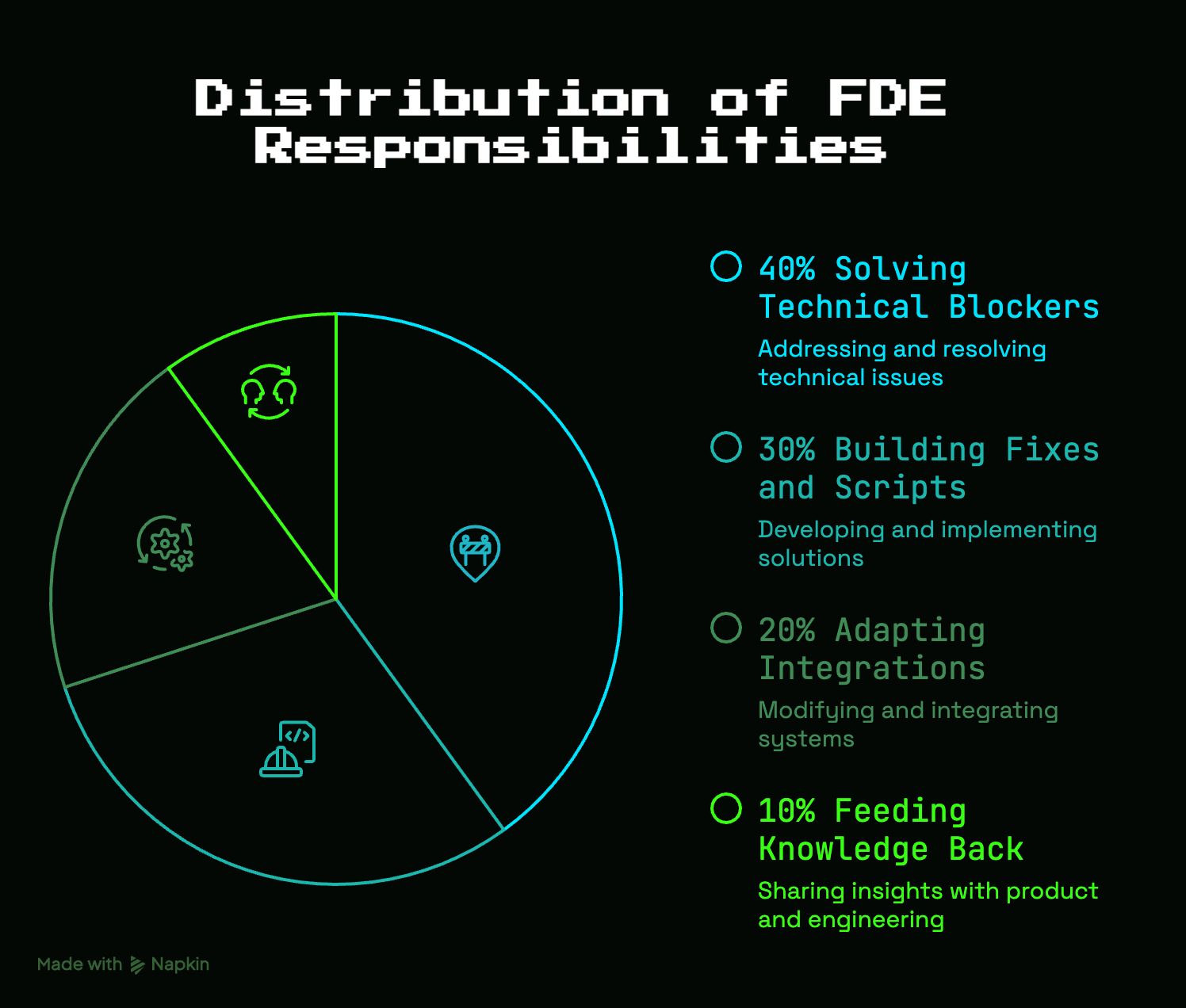
Support reacts to tickets. An FDE diagnoses deeper technical problems, builds fixes, writes scripts, changes configs, adapts integrations, and feeds hard-won field knowledge back into product and engineering. The role sits much closer to delivery and engineering judgment than to help desk work.
A good mental model is a contractor standing in a half-finished kitchen with a blueprint in one hand and a drill in the other. The blueprint matters, but the room in front of you matters more. An FDE lives in that room.
The real day-to-day of an FDE
The practical answer is simple: an FDE spends the week getting customers unblocked and getting your product closer to usable reality.
That usually means customer calls, implementation work, debugging, writing scripts, shaping small product changes, translating customer requirements into engineering language, and helping GTM move deals or renewals that are stuck on technical proof. Some days feel like software engineering. Some feel like solution delivery. Some feel like controlled chaos.
Picture a Friday at 4 p.m. A customer launch is scheduled. Their CRM sync is dropping records because one field mapping breaks when null values show up. Sales is nervous, success is waiting, the customer is already in the admin panel, and your founder is hovering in Slack. An FDE jumps into logs, patches the transformation script, tests the sync against real sample data, explains the issue in plain English, and gets the launch over the line. That is the day-to-day in one scene.
The role is tactical, but not random. The best FDE work creates repeatable patterns. One-off fixes are part of the job. Turning those fixes into templates, product changes, or documented workflows is what keeps the role from becoming a permanent fire drill.
What a typical week looks like
A real week has rhythm, even if it never looks neat on paper.
Early in the week, you usually see discovery work. That means technical scoping calls, architecture conversations, API reviews, security questions, and figuring out what the customer actually needs versus what was promised in a sales call. This part matters because bad assumptions at the start become expensive cleanup later.
Midweek tends to shift into building and testing. An FDE writes scripts, configures integrations, debugs payloads, checks auth flows, maps fields, sets up environments, and verifies that your product behaves correctly with customer systems. If your product touches data, this is often where the hidden complexity shows up.
Later in the week, the work becomes more cross-functional. Customer reviews, internal handoffs, bug reports, follow-up docs, product feedback, and launch readiness checks start stacking up. Then something breaks, a deadline gets moved up, or a deal needs a technical save. That part is normal too.
The job is not a clean sprint cycle. It is a live operating role with engineering depth.
What an FDE ships versus what an account team owns
An FDE ships technical outcomes. The account team owns commercial outcomes.
Your FDE gets the product working, proves technical fit, reduces implementation friction, and makes adoption easier. That includes code, configuration, integration fixes, architecture guidance, and technical troubleshooting.
Sales or success owns pricing, contracts, relationship strategy, procurement movement, renewal structure, stakeholder management, and expansion planning. An FDE can help a renewal happen by fixing the technical issues behind low adoption. An FDE does not own the renewal strategy itself.
That line matters. If you blur it, your FDE becomes a catch-all for every hard account problem, including problems that are not technical at all.
Why companies hire FDEs in the first place
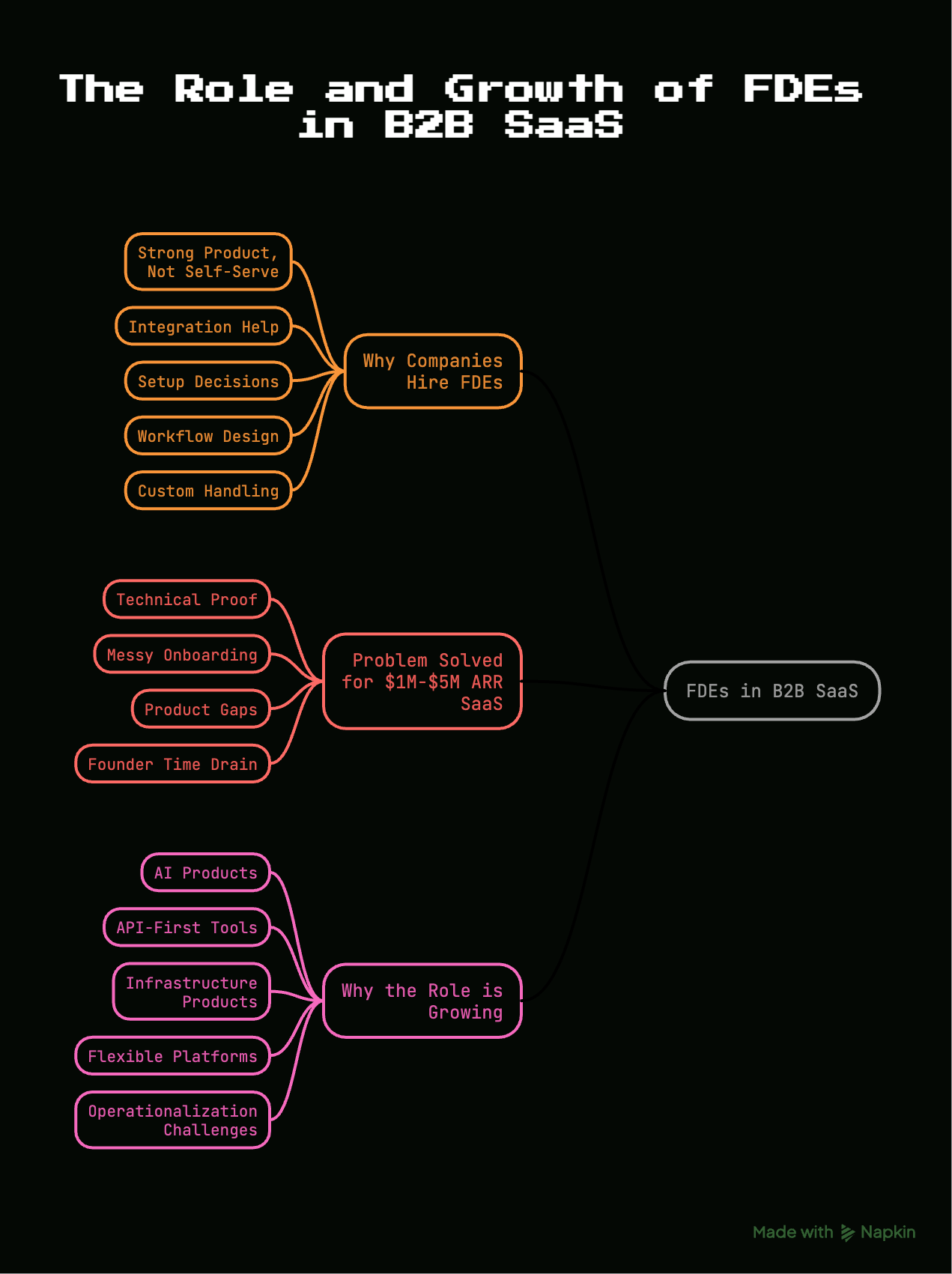
Companies hire FDEs when the product is strong, but not fully self-serve.
That is the business case. Your software can solve real problems, but customers still need integration help, setup decisions, workflow design, or custom handling to get value. The gap is not “does the product work?” The gap is “does the product work in your environment, with your systems, on your timeline?”
For early-stage B2B SaaS, this shows up fast. A founder sells the first stretch of customers through sheer force of will, then discovers that every new account brings slightly different infrastructure, data formats, permissions, or internal workflows. You can keep solving that personally for a while. Then it starts breaking your sales motion and your roadmap at the same time.
An FDE exists to absorb that pressure in a structured way.
The problem an FDE solves for a $1M, $5M ARR SaaS company
At $1M to $5M ARR, the pain is rarely theoretical. Your deals stall because prospects want technical proof before signing. Onboarding gets messy because each account needs more configuration than expected. Product gaps start showing up in live environments, not in internal testing.
This is also the stage where founders keep getting dragged into calls that sound small and end up eating two hours. “Just one integration question” turns into schema mapping, access control, event timing, and three follow-up Slack threads. If that keeps happening, you do not have a founder discipline problem. You have a role gap.
An FDE closes the gap between sales promises and technical reality. That is why the role matters so much when you hire your first rep or start formalizing GTM. Without that bridge, your team sells confidence that the delivery side cannot reliably support.
Why this role is growing now
The role is growing because more B2B software is flexible, technical, and environment-dependent.
AI products need prompt workflows, data pipelines, evals, model behavior tuning, and security reviews. API-first tools need implementation help before value becomes obvious. Infrastructure products need someone who can work directly in the customer’s stack. Flexible platforms are powerful precisely because they can be configured in many ways, which means customers need help choosing and implementing the right one.
Here’s where it gets interesting: modern software is easier to buy but not always easier to operationalize. That creates demand for someone who can adapt the product in the field, then feed that learning back into the core roadmap.
What an FDE does across the customer lifecycle
The easiest way to understand the role is to track it across the customer lifecycle. An FDE is not just a pre-sales resource and not just an implementation resource. The job stretches across the full path from technical validation to durable usage.
Before the deal closes
Before signature, an FDE helps your team prove that the product can solve a real problem in a real setup.
That includes technical discovery, where your FDE asks sharp questions about architecture, integrations, security requirements, identity systems, data sources, and workflows. It includes solution design, where your FDE maps your product to the customer’s environment instead of hand-waving through the hard parts.
This is also where proof-of-concept work happens. Sometimes that means writing a quick adapter, standing up a demo against sample data, or validating that an API limit will not break the use case. Sometimes it means joining security or architecture calls and explaining exactly how the system fits. Good FDE work speeds deals up by removing uncertainty. Bad technical discovery does the opposite.
During onboarding and implementation
Once the deal closes, the work gets more hands-on.
An FDE helps with setup, integration, data mapping, workflow configuration, and troubleshooting. If your product depends on multiple systems talking to each other, this is where the role becomes indispensable. It is not enough to hand a customer a help center article and wish them luck.
The main goal here is reducing time-to-value, which means the time it takes for a customer to get a real result from your product. Not a successful login. Not a completed setup checklist. A real result.
An FDE shortens that path by removing technical friction fast. That might mean cleaning payloads, fixing a webhook issue, setting up role permissions properly, testing edge cases before launch, or building a small internal tool that makes repeated onboarding steps faster. Every hour saved here compounds across adoption and retention.
After go-live
After launch, the role does not disappear. It changes shape.
Now the work becomes performance tuning, edge-case handling, use case expansion, documentation, and pattern recognition. Customers start using the product in less predictable ways. Hidden limits show up. A workflow that looked fine in week one becomes inefficient in week six. An integration that worked for one team needs to scale to five more.
A strong FDE handles those issues, but also notices what should stop being custom forever. If the same workaround appears in three accounts, that is no longer just field work. That is product signal. The role is valuable because it does both jobs at once: solve the immediate issue and expose the repeatable one.
How an FDE is different from adjacent roles
This is where most confusion starts. Plenty of roles touch customers and technology. An FDE is different because the job combines engineering execution with customer-facing delivery under real deadlines.
FDE vs sales engineer
A sales engineer proves the product during the sales process. An FDE stays closer to implementation and post-sale technical delivery.
There is overlap. Both join calls, answer technical questions, and help remove buyer hesitation. But the center of gravity is different. A sales engineer is optimized for credibility during the deal. An FDE is optimized for making the product actually work after the exciting part is over.
If your main problem is demos, objection handling, and technical validation before signature, you are leaning toward a sales engineer. If your main problem starts the moment a customer says yes, you are describing an FDE.
FDE vs solutions architect
A solutions architect designs the system. An FDE often builds and debugs the system.
The architect role is more likely to define the recommended setup, integration pattern, security model, or deployment approach. The FDE takes that plan into reality: configures it, tests it, fixes what breaks, and adapts it when the customer environment does not match the slide deck.
Think of the architect as drawing the route and the FDE as driving the truck through traffic, roadwork, and one suspicious detour sign.
FDE vs customer support or customer success
Support reacts to issues. Success drives adoption and business outcomes. An FDE handles technical work that requires engineering judgment.
That distinction matters because many startups accidentally dump advanced technical delivery onto support or success teams. Those teams end up carrying problems they were never built to solve, like authentication bugs, schema mismatches, custom scripts, rate limits, or environment-specific failures.
An FDE goes deeper. The job is not just answering questions. The job is fixing the underlying technical blocker.
FDE vs product engineer
A product engineer builds the core platform for many users. An FDE solves urgent customer-specific problems, then translates repeated patterns into product feedback.
The difference is not code versus no code. Both can write code. The difference is where the work starts. Product engineering usually starts from roadmap priorities. FDE work starts from field reality.
That urgency is useful, but the catch is obvious: if you never turn repeated field work into product work, your FDE becomes a permanent patch layer.
What skills make someone effective in the role
You should look for a blend, not a pure specialist.
The best FDEs are strong enough technically to fix real problems, clear enough with customers to run hard conversations, and product-minded enough to spot patterns before custom work spins out of control. That combination is rare, which is why good hires here change the shape of a company fast.
Technical range
An effective FDE needs range.
That includes APIs, integrations, debugging, data handling, scripting, cloud basics, authentication, logs, and enough software engineering ability to make safe changes quickly. Not every task requires production code, but the role breaks down fast if the person cannot read systems, trace failures, and build practical fixes.
This is not a narrow backend role. It is applied engineering. One hour you are checking JSON payloads, the next you are writing a script to transform records, then reviewing a bug with product engineering, then fixing config in a customer environment.
Customer-facing judgment
Technical skill is not enough. An FDE spends real time on calls, often when customers are stressed.
That means asking sharp questions, controlling scope, explaining tradeoffs in plain English, and staying calm when something is blocked. The best FDEs do not flood customers with jargon or promise custom work too early. Instead, you get someone who can say, clearly, what is happening, what gets fixed now, and what belongs in product later.
That judgment protects your team from accidental commitments.
Product sense and pattern recognition
The best FDEs notice repetition early.
If the same field mapping issue keeps showing up, if every implementation needs the same script, or if buyers keep asking for the same workaround, a strong FDE does not just keep patching. A strong FDE pushes for a permanent fix, a product change, or at least a documented implementation pattern.
That instinct is what separates useful field engineering from expensive custom labor.
Where an FDE spends time inside your company
An FDE sits at the intersection of sales, success, product, and engineering. That is part of the value and part of the risk.
If the role is working well, every team gets leverage from it. Sales gets technical validation. Success gets faster implementations. Product gets high-quality field feedback. Engineering gets clearer specs and fewer vague escalations.
Working with sales and GTM
With sales and GTM, an FDE helps close confidence gaps.
That means joining technical discovery calls, validating use cases, helping with proof-of-concept work, and reducing friction for first-time buyers who need more than a polished demo. In early-stage SaaS, this often makes the difference between “interested” and “signed.”
The role also helps your first sales rep succeed faster. Without an FDE, the rep either avoids technical deals, drags founders into every hard call, or sells things the implementation side cannot support.
Working with product and engineering
With product and engineering, an FDE converts field pain into usable input.
That includes detailed bug reports, feature requests grounded in real usage, technical specs for recurring asks, and sometimes production-ready code. Instead of vague feedback like “customers are confused,” you get concrete reports like “accounts using this CRM fail sync when custom objects exceed this structure.”
That kind of translation is gold. It shortens the loop between customer pain and product improvement.
When you should hire an FDE and when you should not
You should hire an FDE when technical complexity is blocking growth and the problem keeps repeating.
Not once. Repeatedly. If you’re still weighing it, here’s the full decision framework.
Signs you are ready to hire one
You are ready when deals need technical validation to close and that work keeps landing on founders or engineers. You are ready when onboarding is too custom for success to handle alone. You are ready when customers hit edge cases that standard support cannot solve. You are ready when field feedback keeps getting lost between GTM and product. You are ready when integrations have become a hidden tax on revenue.
The pattern matters more than the title. If the same technical blocker keeps slowing sales, launch, and adoption, the role is real.
Signs you need a different hire instead
Sometimes “need an FDE” is the wrong diagnosis.
If pipeline is weak, your problem is not technical delivery. Your problem is coverage or demand generation, and the better hire is usually an AE or GTM resource. If onboarding is mostly administrative, checklist-driven, and low in technical depth, you probably need implementation or customer success. If your product is so custom that every customer effectively buys a different thing, your problem is product focus.
An FDE should bridge product and reality. An FDE should not compensate for a business that has not decided what product it actually sells.
The catch: what can go wrong with the role
The role is powerful, but it goes sideways fast without boundaries.
The biggest risk is turning your FDE into a dumping ground for every hard customer issue. Support escalates anything technical. Sales drags in the role for every late-stage call. Success treats it like implementation backup. Product assumes field work will absorb product gaps forever.
Then the job becomes one-off work all day, no pattern capture, no product learning, and no leverage. That is expensive and demoralizing.
How to avoid turning FDEs into a custom dev shop
You avoid this by controlling scope hard.
Your FDE should know what gets built once for one account, what gets templated for similar accounts, and what gets rejected because it does not fit the product. If you skip that discipline, every customer request starts looking reasonable in isolation. Stack ten of them together and you are accidentally running an agency inside your SaaS company.
Clear lines help. Define what bespoke work is acceptable, what requires product review, and what never happens no matter how large the account looks this quarter.
How to keep field work from breaking your roadmap
Field work only helps your roadmap if it feeds a real system.
That means templates for common implementations, documentation for repeated fixes, escalation rules for urgent issues, and a feedback loop that turns recurring requests into product priorities. Without that loop, your FDE keeps rediscovering the same problem with different logos attached.
The trick is simple: custom once, document twice, productize by the third repeat.
What success looks like from your side
From your side, success is not “the FDE stayed busy.” Busy proves nothing.
Success looks like fewer stalled deals, faster launches, stronger retention in technically complex accounts, cleaner product feedback, and less founder dependency in technical sales and onboarding. You should feel the operational drag lift.
A good FDE hire also changes internal behavior. Sales gets more confident. Success stops firefighting problems outside its depth. Product gets sharper input. Engineering stops guessing what customers mean when something “doesn’t work.”
Metrics that actually matter
Track implementation time, proof-of-concept win rate, time-to-value, expansion from technically complex accounts, and the number of repeat issues converted into core product fixes.
Those metrics tell you whether the role is creating leverage or just soaking up chaos. If implementation time drops, technical deal conversion improves, and repeated field problems start disappearing into product, you hired correctly.
The simplest way to decide if you need an FDE
The fastest decision rule is not theoretical. Review your last five stalled deals or messy onboardings and look for the same technical blocker showing up again and again.
If the pattern is recurring integration work, technical proof gaps, environment-specific failures, or founder-led implementation saves, you do not have isolated incidents. You have a function trying to exist without a name.
Try that one exercise this week. Pull the last five cases, mark the blockers, and count the repeats. If the same issue keeps showing up, the role is real, and “what does a FDE do” stops being an abstract question. It becomes an obvious hire.


Discussion