

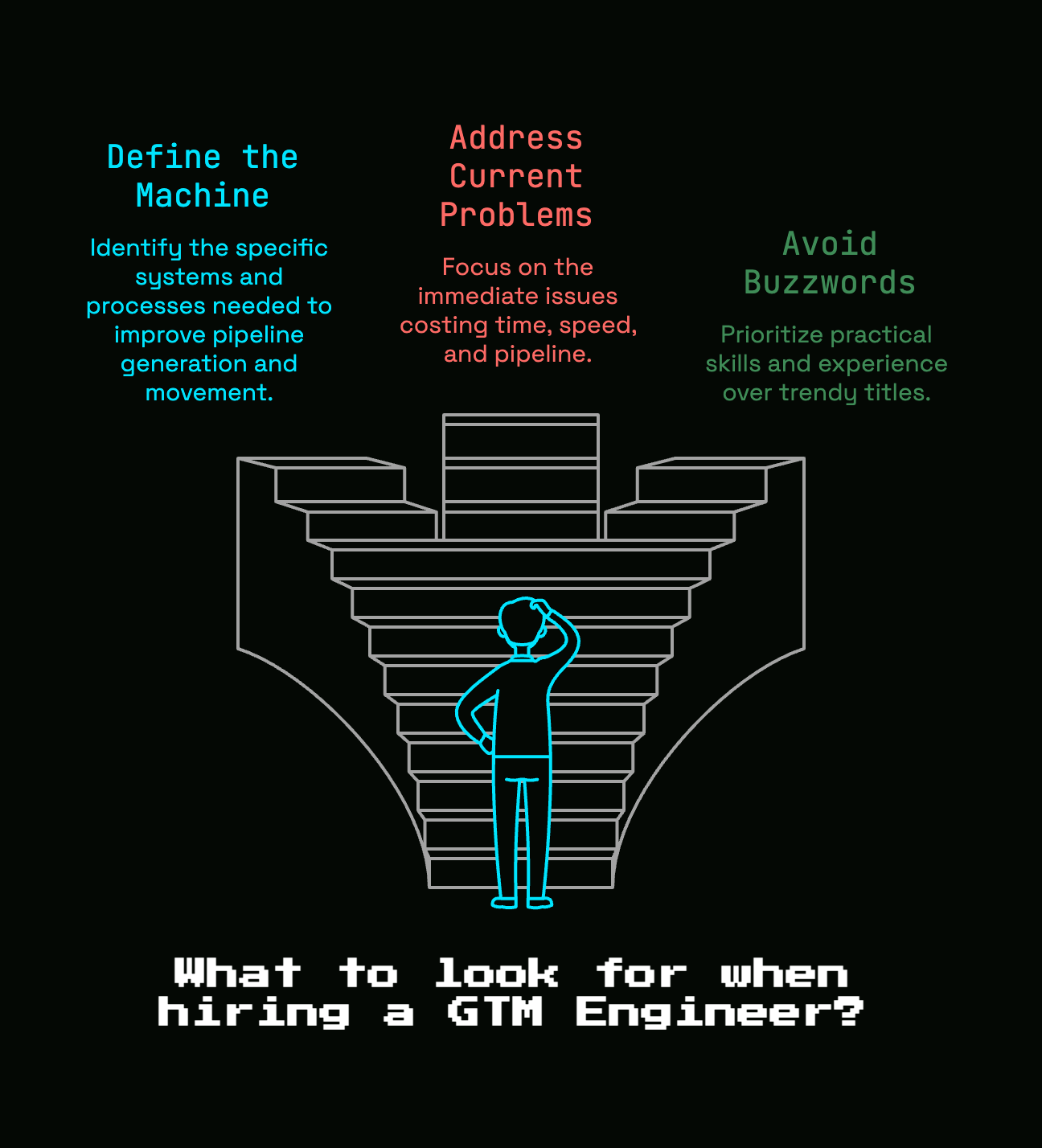
Hiring a GTM engineer sounds simple right up until you start reading resumes. Then the title turns slippery fast, because one candidate means CRM admin with a few automations, another means outbound builder, and another means a near-product engineer who happens to sit close to revenue. If you’re hiring GTM engineer talent for the first time, the trick is to ignore the label at first and get clear on the machine you actually need built.
Why this hire feels confusing in the first place
“GTM engineer” has become one of those titles that feels obvious until you have to define it out loud to your team. In practice, the market still uses the term loosely. Some job posts mean a workflow builder inside RevOps. Some mean a technical outbound operator. Some mean a systems architect connecting CRM, enrichment, product signals, and reporting across the funnel.
That confusion is not imaginary. Demand for the role has risen fast, with 3,000+ postings showing up on LinkedIn in January 2026 after much lower counts just months earlier. A fast-growing category almost always creates title inflation. People rename existing work. Companies bundle three jobs into one title. Candidates shape the role around the tools they know best.
For a B2B SaaS company around $1M to $5M ARR, this gets especially messy because the first real need often appears before the org chart is mature. You may have a founder still patching CRM fields at 10:30 p.m. on a Thursday, a marketer cleaning lists by hand, and a first sales hire about to walk into a pile of routing issues. In that moment, “GTM engineer” can sound like the answer to everything.
It isn’t.
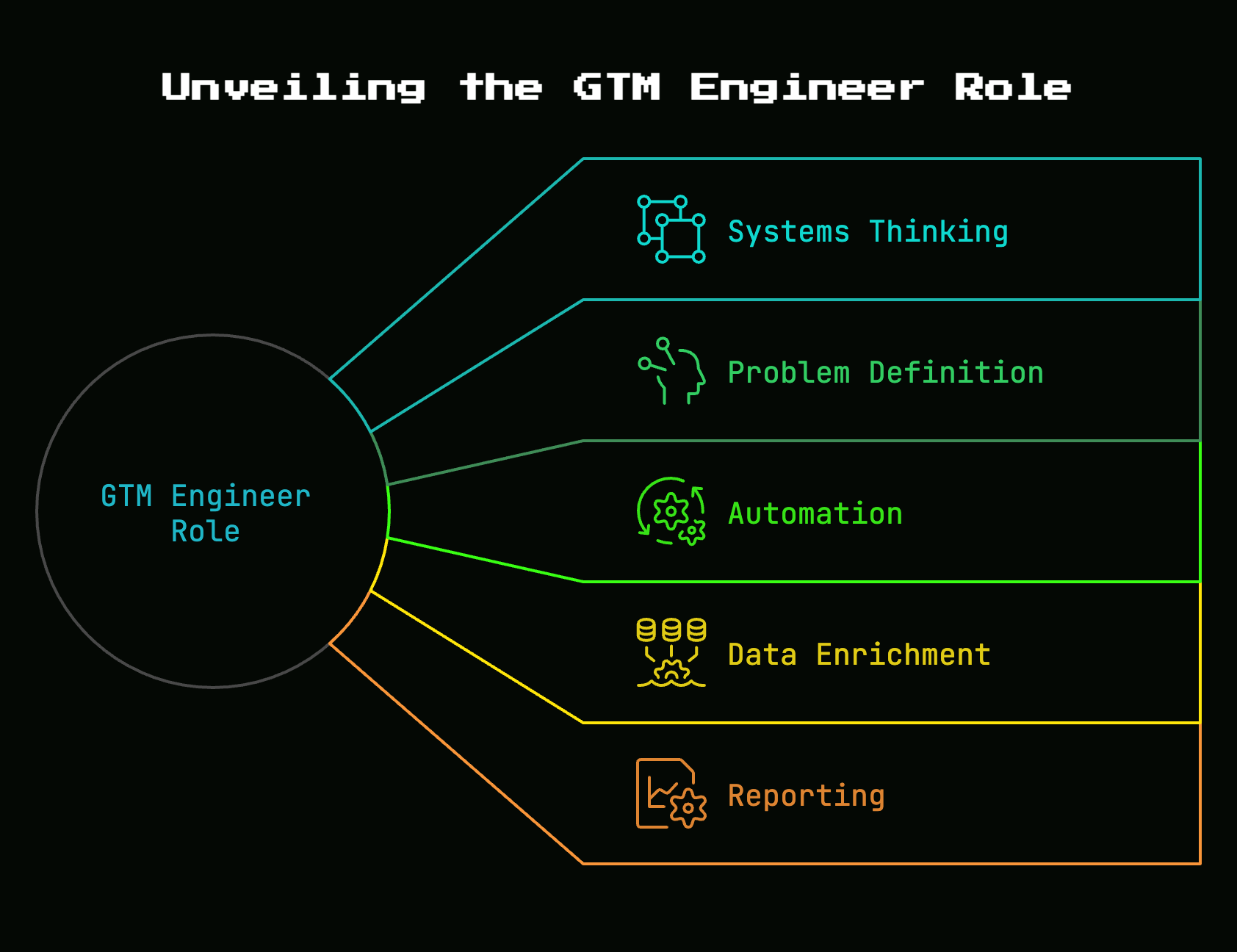
A GTM engineer is not magic. The role is the person who builds the systems behind pipeline generation and movement: handoffs, routing, enrichment, ownership logic, reporting inputs, signal capture, and automation. The point is not more tooling for its own sake. The point is to help revenue work scale without turning into chaos.
That’s why the first hiring move is not to chase buzzwords. It’s to define the actual problems costing time, speed, and pipeline right now. Once you do that, this role becomes much easier to recognize.
What a GTM engineer actually does
Short version: they build and maintain the systems that turn your GTM motion into something repeatable, rather than something that lives in people’s heads. For the full breakdown of responsibilities, day-to-day work, and where the role fits in your org, see the complete GTM engineer guide. What matters for hiring is different: not what they do, but how to tell if a candidate can actually do it.
What to look for first: systems thinking, not tool collecting
If you only remember one thing from this guide, make it this: the first screen is systems thinking, not tool familiarity.
A candidate can know Clay, HubSpot, Salesforce, n8n, Zapier, Apollo, OpenAI APIs, and half the internet. That still does not mean the candidate can design a revenue system that survives contact with real teams, messy data, and changing process.
Tool fluency matters. But it comes second.
Your best first filter is whether the candidate can see the whole machine, identify where the machine leaks revenue, and build fixes that stay useful after the launch-day excitement fades. That’s the difference between someone who stacks tools and someone who builds infrastructure.
Signs of real systems thinking
Systems thinking shows up in how a candidate describes work. A strong candidate can map a workflow from trigger to action to downstream consequence. Not just “lead comes in, route to rep,” but also what happens if the company record already exists, what happens if country is missing, what happens if the lead source conflicts with self-reported attribution, what happens if the assigned owner is inactive, and what happens to reporting after all of that.
That kind of thinking is gold because go-to-market systems break at the edges. The easy path is usually obvious. The painful part is what happens when real data comes through at 4:57 p.m. on a Friday and half the fields are wrong.
You want a candidate who talks naturally about dependencies. If field A is populated by tool X, then changing validation on field A affects scoring, routing, and dashboards. If ownership logic changes at the account level, that affects contacts, opportunities, and customer handoffs. If enrichment runs before dedupe, you pay to enrich duplicates and pollute reports. That instinct matters more than memorizing vendor features.
You also want tradeoff awareness. Speed versus control. Flexibility versus governance. Lightweight workflow versus maintainable architecture. A strong candidate can explain why a fast no-code fix may be smart now, or why it will cost you three rebuilds later.
Why tool names can fool you
Tool lists are easy to fake. Outcomes are not.
Right now, tool-stack fluency is common in the market. Reports show 92% use a CRM, Clay appears constantly in job descriptions, and AI coding tools are becoming normal. That means hearing a familiar tool name tells you less than it used to.
The catch is that trendy tooling can create a false sense of depth. “Built with five tools” sounds impressive until you realize the workflow had no monitoring, no fallbacks, no ownership logic, and no measurable business result. Meanwhile, “fixed routing so inbound demo requests reached the correct rep in under five minutes” sounds almost boring, but that’s the kind of work that changes pipeline outcomes.
A useful hiring habit is to mentally strip the tool names out of every answer. What’s left? If the answer still sounds strong, you’re probably talking to a real builder. If the answer collapses into platform jargon, slow down.
The non-negotiable foundation: data quality discipline
Clean data beats clever automation every time. That’s not a glamorous opinion, but it’s the right one.
A GTM engineer working on bad data is like someone tiling over a cracked floor. The room may look better for a week. Then the shape underneath starts showing through, and now you’ve hidden the problem inside something harder to fix.
Data quality discipline sits at the center of this role because almost every system depends on it. Lead routing depends on reliable fields. Scoring depends on consistent definitions. Handoffs depend on ownership logic. Reporting depends on fields being named, populated, and governed the same way every time.
This is why data hygiene gets treated as non-negotiable in serious GTM engineering discussions. If your team launches on duplicate-riddled, incomplete records, automation scales the mess faster. The role only works when somebody cares enough to slow down and establish source-of-truth habits first.
What strong candidates notice about messy data
Strong candidates notice bad data almost immediately. Not in an abstract “data is messy everywhere” way, but in a practical, slightly itchy way.
You want the candidate who spots duplicate accounts caused by domain variations. The stale contacts still marked active in a key segment. The lifecycle stages that conflict across contact and account records. The ownership field that gets overwritten by imports. The enrichment flow filling top-of-funnel records while late-stage opportunities still lack core firmographics. The lead source taxonomy that makes attribution look clean while actually hiding half the picture.
That instinct matters because strong builders rarely start by automating the shiny thing. They start by checking the floorboards.
A good candidate will also notice the operating impact of messy data. Duplicate account creation does not just make the CRM ugly. It fractures territory assignment and causes reps to trip over each other. Missing employee-count fields do not just weaken segmentation. They make scoring and routing weaker downstream. Bad lifecycle governance does not just annoy ops. It poisons reporting.
Questions that reveal data discipline
Data discipline shows up fast if you ask practical questions. Ask how the candidate would audit CRM health in the first two weeks. Ask which fields should be required at different stages, and why. Ask how to prevent a routing workflow from damaging reporting later. Ask what should be normalized before enrichment begins. Ask how to avoid duplicate creation across inbound forms, imports, and outbound-sourced accounts.
Listen for specificity. Good answers mention deduplication logic, naming conventions, audit cadence, ownership rules, lifecycle definitions, source-of-truth fields, and edge-case handling. Weak answers stay at the level of “clean up the CRM” or “standardize data.”
One especially revealing question is simple: if a routing workflow starts misassigning leads, what do you check first? Strong candidates usually move through field values, trigger logic, fallback paths, record ownership state, and recent changes to related workflows. That answer tells you whether the candidate has actually cleaned up real breakage before.
Proven build ability matters more than title or years
This role is still new enough that titles are a weak signal. Years in the exact title are an even weaker one.
A lot of strong candidates will come from SDR operations, marketing ops, RevOps, growth, sales engineering, or technical support paths. Plenty are self-taught. In one benchmark dataset, 121 of 228 respondents were self-taught, which tells you something useful about how this role is forming. Skill accumulation is happening faster than title standardization.
So focus on proof of work. What has the candidate actually designed, built, debugged, improved, and maintained?
The portfolio projects worth asking about
Ask for concrete builds, not generic “projects.” Good examples include lead routing systems, enrichment pipelines, account scoring models, territory assignment logic, sequencing triggers tied to intent or product signals, CRM integrations with sales or marketing tools, AI-assisted research workflows, and dashboard inputs tied back to pipeline stages.
Those examples matter because they force the candidate to talk through a real system with business consequences. A routing system reveals judgment. An enrichment workflow reveals data discipline. A scoring model reveals tradeoff thinking. An AI research flow reveals whether the candidate automates useful work or just interesting work.
If your first sales rep is coming soon, ask for examples that touch ownership and handoffs. If outbound is messy, ask for contact-account matching, list-building logic, and sequence triggers. If your RevOps team is buried, ask for redesign work that reduced manual operations time.
What “good” evidence looks like
Good evidence has texture. It includes the before state, the problem, the constraints, the design choices, the implementation details, the failure modes, and the result.
“Built outbound automation” is thin.
“Reworked outbound account sourcing so contacts were only sequenced after account dedupe, ownership check, and enrichment confidence threshold, which cut bad-fit outreach and improved meeting quality” is much better.
The strongest examples also show maintenance awareness. Not just launch. What got monitored? What broke later? What got changed after users touched it? What documentation existed? How was success measured beyond “the workflow ran”?
This is one of the clearest signals in hiring. Real builders remember the edges because the edges were where the pain lived.
Why self-taught backgrounds can still be a strong signal
Some of the best GTM engineer candidates won’t have a neat resume arc. That’s fine. Honestly, it may be better.
Because the role is young, a tidy title progression often matters less than the pattern underneath. Somebody who started in SDR work, got annoyed by manual research, built a prospecting workflow, learned CRM architecture, and then expanded into data, routing, and integrations may be exactly the kind of operator you want.
The same goes for somebody from marketing ops who learned APIs to fix brittle campaign syncs, or a RevOps generalist who kept becoming the person everyone called when systems broke across functions.
The common thread is not pedigree. It’s demonstrated curiosity plus shipped systems. The market itself reflects that reality. The average posting asks for only about 4.1 years of experience, and many strong candidates are being judged on transferable work rather than title purity.
Cross-functional fluency is part of the job
A GTM engineer has to work across sales, marketing, RevOps, and customer success without becoming a ticket taker for all of them. That balance is harder than it sounds.
The role only works when the person can hear a business complaint, translate it into a systems problem, and then rebuild the system without losing the business context. “Leads are bad” may actually mean enrichment confidence is weak, routing is late, and the scoring threshold is pushing junk to reps. “Reporting is broken” may actually mean lifecycle definitions differ by team. “Outbound isn’t working” may actually mean contact-account matching is wrong and personalization inputs are too thin.
This translation skill is a big part of the job. The tools are the easy part.
What strong communication looks like in practice
Strong communication here looks concise and grounded. The candidate explains technical concepts in plain language, asks good intake questions before building, documents decisions clearly, and can tell a sales leader what changed without drowning the explanation in implementation detail.
That matters because GTM engineering work changes how people operate. Reps need to trust routing. Marketing needs to trust lifecycle transitions. Success needs to trust account context. Founders need to trust reporting. If the person building the system cannot explain it simply, adoption suffers.
Look for candidates who naturally ask questions like: who uses this field, what decision does this workflow support, what happens if the data is missing, how will success be measured, and who owns maintenance after launch? Those are communication habits, but they are also architecture habits.
The red flag: building in a silo
A siloed builder can still ship a lot of workflows. That’s what makes this red flag dangerous.
The problem shows up later. The workflow technically works, but reps ignore it. The handoff between marketing and sales gets slower. Reporting stops matching reality. Customer experience gets clunky because account context never moves downstream. Now you have more automation and less trust.
This role is especially vulnerable to that failure mode because a clever builder can look impressive in an interview. The safer hire is the candidate who cares about user behavior, not just system behavior.
If a candidate talks about workflows as if people barely matter, slow down.
Coding ability: useful differentiator, not the first question
Coding is useful. It can raise the ceiling of the role. But it is not the first thing to screen for.
That point gets lost because technical flash is seductive. A candidate who can write Python, build custom APIs, scrape data, and spin up internal tools sounds exciting. And sometimes that person is exactly right. But if systems thinking and data judgment are weak, coding ability just helps the candidate build bad systems faster.
When coding truly matters
Coding matters when your stack needs custom connections or logic that low-code tools cannot handle cleanly. That includes custom APIs, nonstandard data transformations, warehouse syncs, internal interfaces, web scraping, advanced signal processing, and AI-enabled workflows that need more control than a template connector can provide.
If your go-to-market motion depends on product usage data, event streams, complex scoring, or custom enrichment logic, coding starts to matter more. If your team needs internal tools that reps or ops can use directly, coding matters more. If you keep hitting the edges of no-code tools, coding matters more.
The market reflects that premium. Salary research shows a coding premium of roughly $45K on average, which makes sense because custom building expands what the role can own.
When no-code is enough for now
For an early-stage SaaS company, no-code or low-code excellence may be exactly enough. If your biggest problems are CRM architecture, workflow logic, handoffs, enrichment, ownership rules, and outbound execution plumbing, a strong operator with deep systems judgment can create huge ROI without deep software engineering chops.
In fact, that may be the smarter first hire if your current bottleneck is operational mess, not advanced technical ambition. A beautifully coded workflow is still the wrong answer if what you really need is cleaner routing, stricter field governance, and better rep adoption.
This is where stage matters. Early on, reliability beats sophistication.
How to avoid overhiring for technical flash
Overhiring happens when you buy the ceiling you imagine instead of the floor you need fixed.
A very technical candidate can still be the wrong first GTM engineer if the candidate dismisses CRM hygiene, skips naming conventions, ignores rep workflow, treats documentation as optional, or seems bored by maintenance work. That person may be talented, but not for this seat right now.
The safer question is not “Can this person code?” It’s “Will this person fix the machine that is actually slowing revenue today?” Sometimes those answers overlap. Sometimes they really don’t.
How to tell a GTM engineer apart from adjacent roles
If you’re also considering RevOps, marketing ops, sales ops, or a demand gen hire for this problem, the role comparison in the main guide breaks down where each one stops and a GTM engineer starts.
Match the hire to your stage and actual bottleneck
The right hire depends less on what the internet says GTM engineers do and more on what is broken in your business right now.
That’s the buyer’s-guide logic here. Before evaluating candidates, identify the bottleneck. Is your issue infrastructure, process cleanup, reporting, outbound scale, speed-to-lead, or system redesign? The answer should shape the profile you hire. If the honest answer is senior judgment without a full headcount yet, a part-time head of growth is worth considering before you open the req.
If your first sales rep is coming in soon
This is one of the clearest times to make the hire, or at least define the role sharply.
Your first sales rep should not inherit a messy CRM, unclear ownership, weak enrichment, and handoffs held together with hope. That is how good reps end up doing admin work, distrusting lead flow, and inventing shadow processes in spreadsheets.
At this stage, prioritize candidates who can tighten lead routing, account ownership, lifecycle stages, enrichment coverage, basic reporting, and sales-marketing handoffs. Fancy scoring can wait. Reliability cannot.
A good first GTM engineer here creates a cleaner runway for the rep, so selling starts faster and operational friction stays lower.
If your outbound motion is messy
Messy outbound creates a special kind of waste because it can look productive while quietly burning time and domain reputation.
If this is your bottleneck, prioritize candidates who understand list-building logic, contact-account matching, enrichment depth, personalization inputs, sequencing triggers, suppression rules, and workflow brittleness. You want somebody who can make outbound cleaner and more repeatable, not somebody who simply adds more volume.
One useful principle from GTM engineering practice is to validate the signal manually before automating it. If the targeting logic does not make sense in a Google Sheet and a short daily review, automation will not rescue it at scale. That mindset separates healthy builders from tool-happy ones.
If you already have ops help but systems still break
This is where another generalist often fails to solve the real problem.
If you already have someone managing tools, tickets, and routine operations, but systems still break across functions, you may need a builder who can redesign workflows and connections rather than manage queue volume better. A good GTM engineer can reduce the amount of recurring operational pain by fixing root causes.
One good benchmark from industry guidance: if RevOps is spending more than 20% of time on data hygiene instead of revenue-building work, that often points to a capacity and infrastructure problem. In that case, the hire should lean toward architecture and workflow design, not just administration.
Budget, compensation, and what you’re really paying for
Compensation for GTM engineers is wide because scope is wide. That’s frustrating, but it’s also logical.
You are not buying a standardized title. You are buying a mix of business judgment, systems design, tool fluency, maintenance discipline, and possibly coding depth. The price changes based on how much of that mix you need.
Typical salary ranges by seniority
In the U.S., junior GTM engineer roles often land around $90K to $130K base. Mid-level roles commonly range from $130K to $175K. Senior roles often reach $175K to $250K. Staff or principal profiles can go well beyond that, especially in AI-heavy environments or highly technical revenue stacks.
Broader salary research shows typical U.S. base around $100K to $180K for many roles, with total compensation often running higher once variable pay and equity are included. Median comp sits roughly in the low-$130Ks, but that number can hide a lot of spread.
For a bootstrapped or early-scaling SaaS company, this means you need to decide whether you need an operator, a builder, or a near-architect. Do not budget for one and expect the output of another.
Cash vs equity vs ownership
If you cannot win on base salary, compete on ownership and scope honestly, not as a euphemism for underpaying.
A lot of early companies assume equity alone will make up the gap. Usually it won’t. Research suggests meaningful equity is often limited in this market anyway, with 68% reporting little or no real equity upside. So if you are offering less cash, the role itself has to be compelling.
That means real ownership over systems, clear executive access, room to build, and visible connection to revenue impact. The right candidate for an early-stage company often values that more than title polish, especially if the mandate is clear and the problems are real.
Variable pay can also make sense, but only if the metrics are fair. Tie incentives to measurable system outcomes connected to pipeline quality, speed, conversion, or operational efficiency, not vague “support revenue” language.
The hidden cost of a cheap mis-hire
A cheap mis-hire in this role is expensive in a very specific way.
It creates broken routing, bad data, wasted rep time, false reporting confidence, duplicate tools, and months of rebuild work. It also creates organizational trust damage. Sales stops trusting lead quality. Marketing stops trusting attribution. Founders stop trusting dashboards. That trust takes longer to repair than the workflows themselves.
So yes, salary matters. But paying less for the wrong person often means paying again, plus cleanup.
Interview signals that actually predict success
The best interviews for this role reveal how the candidate thinks through a messy business system. They do not just confirm tool familiarity or confidence under pressure.
You want evidence of diagnosis, judgment, architecture, and maintenance awareness.
Ask for one workflow teardown
Ask the candidate to walk through one real workflow from trigger to action to outcome. Pick something practical, like inbound lead routing, product-signal activation, account enrichment, or a sequencing trigger.
The useful part is not the happy path. It’s the edges. What fields mattered? What dependencies existed? What failure cases showed up? How did the candidate test it? What broke after launch? What changed later? How was success measured?
Strong candidates can tell this story clearly. Weak candidates drift into jargon, skip business context, or cannot explain what happened after launch.
Use a simple systems design exercise
A straightforward systems exercise works well here. For example, ask the candidate to design lead routing for inbound demo requests, or an enrichment flow for target accounts entering outbound sequences.
A good answer should include field requirements, dedupe logic, ownership rules, fallback conditions, timing, monitoring, documentation, and measurement. It should also include a point of view on tradeoffs. Maybe speed matters more than enrichment completeness in one motion. Maybe routing must pause if account ownership is unclear. That judgment is the signal.
The best candidates also ask clarifying questions before designing. Not as a stalling tactic, but because real systems depend on context.
Listen for business judgment, not just mechanics
Mechanics matter. Business judgment matters more.
The strongest candidates consistently tie workflows back to speed-to-lead, meeting quality, conversion rate, rep efficiency, cleaner reporting, or reduced manual work. In other words, the candidate understands what the system is for.
This commercial bias keeps the role grounded. You want somebody who asks whether the workflow helps close deals or improves pipeline quality, not just whether it is technically elegant. A commercial bias is one of the clearest predictors that the hire will stay useful as your company changes.
Red flags that should slow you down
This market is young, which means shiny candidates are everywhere. Some are excellent. Some are mostly vibes plus tools.
A few red flags should make you pause.
Too much emphasis on tools, not outcomes
If the resume is packed with platforms but thin on measurable impact, architecture choices, or business results, slow down. Tool fluency is cheap compared with judgment.
The best candidates can explain why a system was built, what changed because of it, and what tradeoffs were made. The weaker version just names tools like collectibles.
Automation without governance
Some candidates love building flows but barely mention naming conventions, permissions, ownership logic, audit trails, documentation, or rollback plans. That’s a problem.
Automation without governance feels productive at first. Then someone leaves, a field changes, a sync breaks, and nobody knows why routing suddenly looks haunted. If the candidate does not think about control, maintenance, and clarity, the systems will decay quickly.
Narrow function bias
A candidate who only thinks like outbound, only thinks like marketing ops, or only thinks like CRM admin may solve the familiar slice and miss the larger machine.
This role needs cross-funnel range. Not mastery of every function, but enough understanding to see how a change in one place affects another. If every answer pulls back to one narrow comfort zone, be careful.
No evidence of maintenance thinking
This one matters a lot. Launching is only half the job.
If a candidate cannot explain how a workflow gets monitored, fixed, updated, documented, and handed off, you are looking at a builder who may create future mess faster than future value. Maintenance thinking is not boring. It is what makes systems durable.
A practical scorecard for your first GTM engineer
A simple scorecard helps because this role attracts candidates with very different backgrounds. Comparing everybody on the same criteria keeps you from hiring the most charismatic tool demo.
Core capabilities to score
Use a structured scorecard across these seven areas:
- Systems thinking
- Data quality discipline
- Workflow design
- Cross-functional communication
- Technical depth
- Business judgment
- Execution reliability
Score each area separately. Systems thinking and data discipline should carry the most weight for a first hire. Workflow design and business judgment come right behind. Technical depth matters, but the exact level depends on your stack and stage. Communication and execution reliability matter more than many teams expect, because this role succeeds through adoption and maintenance, not just initial builds.
If you want a simple rule, require a clear pass on systems thinking, data quality, workflow design, and business judgment before getting excited about anything else.
Nice-to-haves vs true must-haves
This is where teams often drift into wish-list hiring.
True must-haves for a first GTM engineer usually include the ability to map workflows end to end, improve data quality, build and maintain cross-tool automations, communicate clearly with GTM stakeholders, and tie system decisions back to revenue outcomes.
Nice-to-haves include deep coding, advanced AI-tool fluency, warehouse experience, product analytics depth, and experience with your exact stack. Helpful? Absolutely. But not all are mandatory for every early-stage company.
If your hiring brief starts reading like three roles glued together, cut it back. You are not trying to hire the entire future revenue systems team in one shot.
What a strong first 90 days should look like
Once you’ve made the hire, the goal shifts from vetting to onboarding. For a day-by-day 30/60/90 plan you can hand your new GTM engineer directly, see what to hand a GTM engineer in the first 90 days.
The first thing to try before opening the role
Before writing the job description, write down the three revenue-system problems costing the most time or pipeline right now.
Be specific. Not “CRM is messy.” More like “Inbound demo requests are hitting the wrong owner 15% of the time.” Not “outbound is inefficient.” More like “Reps are researching accounts manually because enrichment and contact matching are unreliable.” Not “reporting is broken.” More like “Lifecycle stages don’t match between marketing and sales, so conversion reporting can’t be trusted.”
That short list will clarify whether your next hire is truly a GTM engineer, what profile is needed, and how to evaluate candidates without getting distracted by trendy tools or inflated titles.
Try that first. If the three problems all point to systems, data, handoffs, and workflow design, you’re probably looking for the right role. And if you can describe the mess clearly before interviews start, you’ll have a much better shot at hiring someone who can actually fix it.


Discussion