

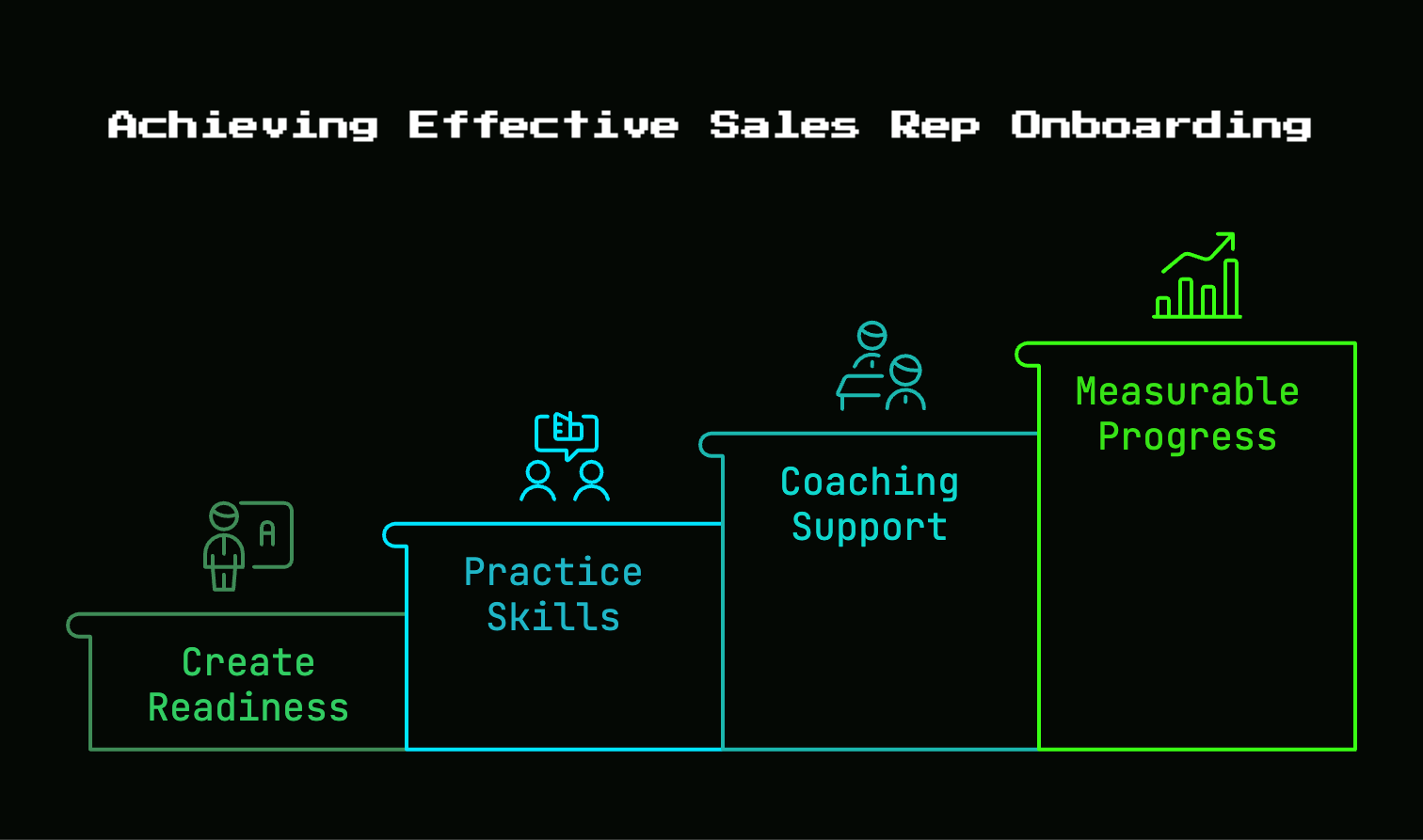
Most sales rep onboarding fails for a simple reason: it teaches information, not behavior. If your new hire spends week one clicking through docs, week two watching calls, and week three still freezing in discovery, your sales rep onboarding system is not onboarding anyone into the job. It is just introducing the company. This tutorial shows you how to build a plan that creates readiness, practice, coaching, and measurable progress from day one.
What this tutorial helps you fix
A new rep does not fail because a pricing page was hard to find or a product deck was missing one slide. A new rep fails because onboarding never turns knowledge into repeatable action. That is the gap.
Here’s the thing: a rep can “complete” onboarding and still be nowhere near ready to sell. Access granted. Forms signed. Calls shadowed. Quiz passed. None of that guarantees the rep can run discovery, handle pushback, leave clean notes in the CRM, or create momentum in a deal.
That matters because the cost of getting this wrong is brutal. Structured onboarding can improve retention by 50% and reps who complete structured onboarding are 50% more likely to hit quota within nine months. Strong programs also improve new-hire productivity by 70% and formal onboarding can increase sales productivity by up to 54%. On the other side, replacing a rep often costs $100,000 to $200,000, and early attrition stacks up fast.
So the goal is not to make onboarding feel polished. The goal is to make a rep sale-ready, faster and with less drama.
What you need before you start
You do not need a giant enablement team or a glossy learning portal. You need a few basics in place, clearly defined and easy to find.
A clear sales motion
Before building onboarding, define how selling works in your business right now. Keep it simple: who the ideal customer is, what pain points show up most often, how a deal moves from first touch to close, how long deals usually take, and what counts as a real opportunity.
If any of that feels fuzzy, fix it first. A rep cannot learn a moving target. In a bootstrapped B2B SaaS company at $1M to $5M ARR, the sales motion often lives in someone’s head or in scattered Slack threads. Pull it into one document. Not a masterpiece. Just the actual motion.
One owner and one manager
Pick one person who owns the onboarding plan. Then make the direct manager responsible for coaching inside that plan. Those are different jobs.
Ownership spread across a founder, a top rep, customer success, and “whoever has time” breaks fast. The rep gets mixed messages, standards drift, and no one notices the holes until pipeline is empty. One owner keeps the program coherent. One manager makes it stick in real work.
Core materials and systems
Gather the materials a rep will actually use. Your CRM, call recordings, pitch deck, demo flow, pricing basics, objection notes, a handful of strong closed-won deals, and examples of good emails and follow-ups. That is enough to start.
Use real material, not generic training filler. A messy call recording from a Tuesday at 2:17 p.m. teaches more than a polished internal deck because it shows the job as it actually happens.
A 30-60-90 day scorecard
Create a scorecard before the rep starts. Tie it to behaviors and outputs, not just training completion. A rep should know exactly what “on track” looks like by day 30, 60, and 90.
This is the backbone of the whole system. Without it, onboarding turns into vibes, and vibes are terrible managers.
Step 1: Define what “fully onboarded” means
If you do not define the finish line, onboarding never ends. It just turns into a long orientation with occasional calendar invites.
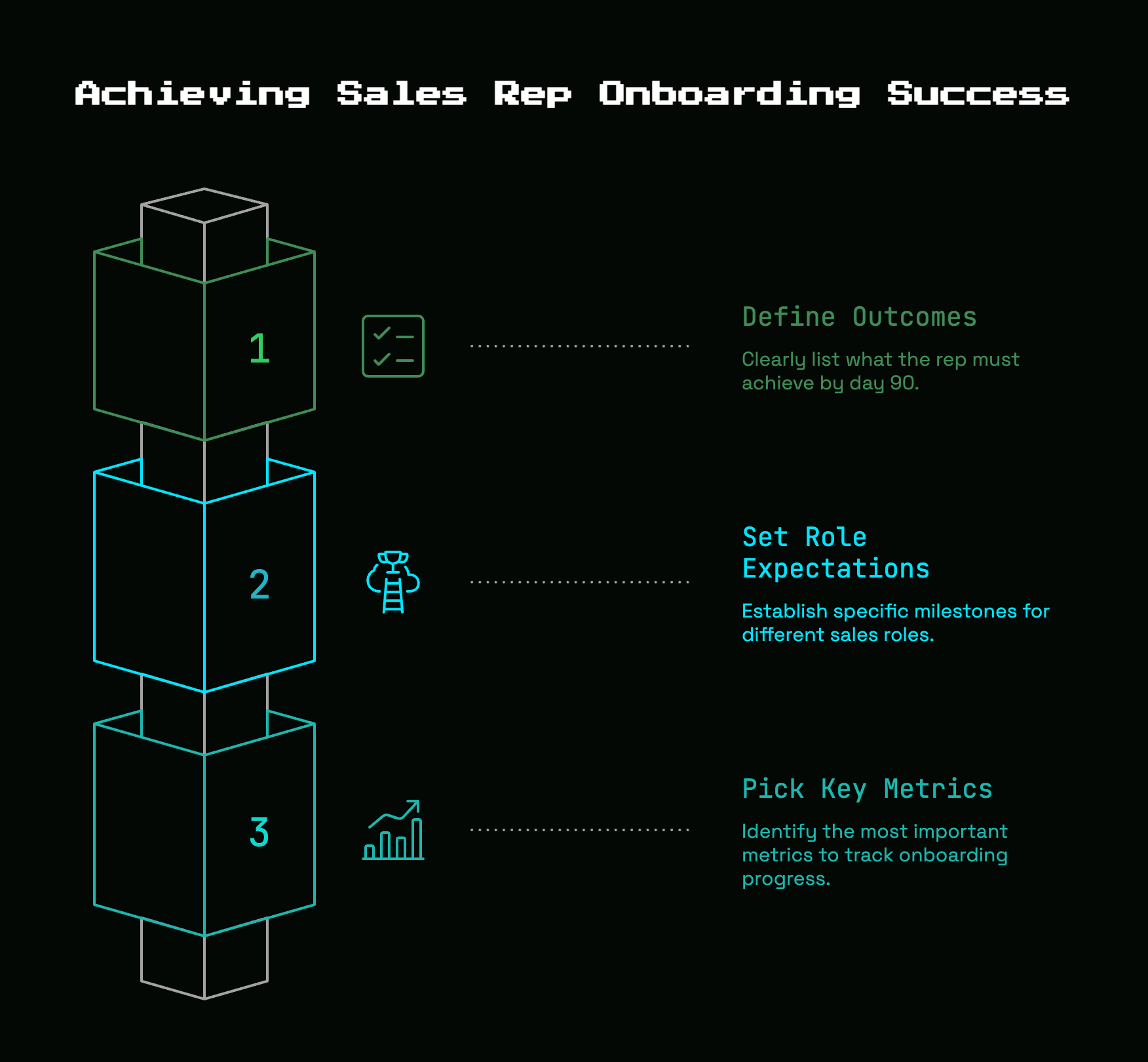
List the outcomes, not just the topics
- Write down what the rep must be able to do by day 30.
- Add what the rep must do independently by day 60.
- Define what full execution looks like by day 90.
- Use verbs tied to the job, such as run discovery, deliver a demo, handle objections, update CRM fields correctly, and secure clear next steps.
- Remove any item that only describes exposure, like “review pricing deck” or “attend product training.”
The point is to describe performance, not attendance. “Knows the product” is vague. “Can explain the top three use cases in plain English and connect each one to buyer pain” is usable.
Checkpoint: if a manager cannot observe it on a call, in a CRM record, or in a roleplay, it does not belong as a core onboarding outcome.
Set role-specific ramp expectations
- Define separate expectations for SDRs, AEs, or a first full-cycle rep.
- Match milestones to the actual job, not to a generic sales template.
- Set realistic targets for meetings, opportunities, demos, and pipeline by role.
- Document what the rep owns alone versus what requires support.
An SDR does not need the same day-60 standard as an AE. A full-cycle rep in an early team often needs both prospecting and closing skills, which means the plan must cover both motions in sequence. One generic track creates confusion and fake underperformance.
Pick the metrics that actually matter
- Track time-to-first-opportunity.
- Track time-to-first-demo.
- Track time-to-first-deal.
- Track pipeline created.
- Track roleplay or readiness scores.
- Track manager assessment by milestone.
These give you both leading and lagging signals. That matters because average sales ramp often stretches from 3 to 9 months without a strong system, and one benchmark shows ramp time rising from 4.3 months in 2020 to nearly 5.7 months in 2024. Waiting for quota attainment to judge onboarding is like checking the smoke alarm after the kitchen already burned.
Step 2: Build a 30-60-90 day onboarding plan
Now turn the destination into a usable timeline. Keep it structured, but not stuffed with busywork.
Days 1-30: Learn the market, message, and motion
- Teach the ICP, main buyer pains, top use cases, and common competitors.
- Walk through the sales process from first outreach to closed-won or closed-lost.
- Train the core tools: CRM, calendar, call recording, email, and demo environment.
- Introduce the key talk tracks for outreach, discovery, and next steps.
- Start listening to strong calls and reviewing winning deals.
The focus here is foundation and early confidence. Not total mastery. By the end of this phase, the rep should understand who buys, why buying happens, and how your sales motion actually works.
Days 31-60: Practice in live selling situations
- Shift from passive learning to active roleplays.
- Add call shadowing with written takeaways.
- Start reverse-shadowing, where the rep leads part of the interaction.
- Assign supervised outreach and early opportunity handling.
- Review calls and written follow-ups every week.
This is where onboarding starts to stick. A rep does not become effective by hearing good answers. A rep becomes effective by trying answers out loud, getting feedback, and repeating the cycle.
Days 61-90: Prove independent execution
- Move the rep into full discovery ownership.
- Require clean CRM hygiene and consistent follow-through.
- Test objection handling in live calls and deal reviews.
- Evaluate whether next steps are clear, specific, and buyer-owned.
- Reduce hand-holding while keeping coaching cadence intact.
By this point, the rep should not sound like a trainee. The rep should sound like someone who belongs in front of customers.
Keep the plan visible and shared
- Put the full plan in one shared document or workspace.
- Show milestones, deadlines, scorecard items, and coaching notes in the same place.
- Review it weekly with the rep and manager.
- Mark items complete only when performance is visible, not when content gets viewed.
Visibility matters more than fancy formatting. A plain Notion page that gets used every Friday beats a beautiful onboarding deck no one opens after day two.
Step 3: Strip your training content down to the essentials
More content does not make onboarding better. It usually makes it worse.
Start with the minimum knowledge needed to sell
- Identify the five or six things a rep needs for early calls.
- Prioritize buyer problems, product value, objections, pricing logic, and next-step language.
- Delay deep product history, edge-case workflows, and every internal nuance.
- Sequence the material based on when the rep will need it.
The trick is to teach just enough to create action. A rep does not need every feature before running discovery. A rep needs to understand the buyer’s problem well enough to ask smart questions and position value clearly.
Use real examples instead of polished theory
- Pull clips from real calls.
- Use real email threads and actual deal notes.
- Show real objections that came up in closed-lost deals.
- Compare strong and weak call openings from your own pipeline.
- Explain why one worked and the other fell flat.
Real examples create pattern recognition. Theory creates nodding.
Turn tribal knowledge into reusable assets
- Write down the strongest discovery questions.
- Capture the phrases that explain value clearly.
- Save examples of effective follow-up emails.
- Document common deal patterns and stage risks.
- Store everything in one easy-to-find place.
If your best selling knowledge depends on who sits closest to the new hire, you do not have an onboarding system. You have office osmosis, and office osmosis does not scale.
Step 4: Get the tools set up before day one
Slow setup kills momentum. A rep who spends the first three days asking for permissions starts behind and feels behind.
Prepare system access and permissions
- Set up email and calendar access before the start date.
- Give CRM access with the right fields, views, and permissions.
- Enable call recording, sales engagement tools, and demo access.
- Confirm access to internal docs and past call libraries.
- Test everything before day one.
Checkpoint: the rep should log in on the first morning and be able to work immediately. No ticket queue. No scavenger hunt. No “IT is looking into it.”
Create one source of truth
- Choose one hub for onboarding materials.
- Put checklists, training links, scorecards, call examples, and meeting cadence there.
- Link to tools from that hub instead of spreading resources across five systems.
- Keep version control tight so old documents do not linger.
A scattered setup creates friction that looks small but compounds fast. Ten minutes lost here, fifteen minutes there, then suddenly your rep feels dumb for not knowing where anything lives.
Preload examples and templates
- Provide starter outreach templates.
- Include discovery note examples.
- Add clean follow-up email examples.
- Show what good CRM entries look like.
- Include a few strong next-step summaries from real deals.
Templates are guardrails, not scripts. They reduce early mistakes and set a quality bar from the first week.
Step 5: Teach the sales process in the order a rep actually uses it
Do not train by department or by org chart. Train by workflow.
Start with discovery before deep product detail
- Teach how to open a call and set an agenda.
- Train qualification around pain, urgency, and fit.
- Practice follow-up questions that go past surface-level answers.
- Teach product positioning only after the problem is clear.
- Use demo material to support discovery, not replace it.
Buyers do not care about your product map on minute two. They care whether you understand the problem. Only 13% of customers believe sales reps understand their needs. That is a sales execution problem, not a slide deck problem.
Train the handoffs and stage exits
- Define what must happen before a deal moves stages.
- Show what qualifies an opportunity versus a polite conversation.
- Document what gets logged in the CRM at each stage.
- Clarify when a deal gets disqualified and why.
- Review examples of clean stage movement from past deals.
Clear stage exits protect pipeline quality. If a rep cannot explain why a deal moved, the deal should not move.
Define what “good” sounds like on a call
- Share examples of strong openings.
- Share examples of sharp positioning.
- Share examples of clear next-step language.
- Compare them against weak versions.
- Explain the difference in plain English.
“Build rapport better” is useless coaching. “Open with the reason for the call, confirm the buyer’s goal, and ask one problem-framing question before pitching” is something a rep can actually use.
Step 6: Make practice mandatory, not optional
Practice is where behavior gets built. Everything before this is setup.
Run roleplays tied to real call scenarios
- Build roleplays from common objections, pricing pushback, competitor comparisons, no-decision stalls, and bad-fit prospects.
- Assign one scenario at a time.
- Keep each round short and specific.
- Give immediate feedback after each round.
- Repeat the same scenario until the rep improves.
Keep it grounded in the real week ahead. If the rep is about to start outbound to operations leaders, practice that exact context.
Score the practice with a simple rubric
- Score the opening.
- Score question quality.
- Score listening and follow-up.
- Score product positioning.
- Score objection handling.
- Score the close for next steps.
A simple rubric makes feedback concrete. It also helps you compare progress across reps instead of relying on gut feel.
Use recorded calls as practice material
- Pick a real call recording.
- Pause after a prospect comment or objection.
- Ask what the rep would say next.
- Review what actually happened.
- Discuss what was missed and how to recover.
This sharpens judgment fast because the rep learns to read live moments, not just memorize approved lines.
Repeat until the rep sounds natural
- Revisit the same scenarios across multiple weeks.
- Reduce dependence on scripts.
- Push for clarity, not perfection.
- Keep practice going after the rep starts live selling.
Confidence comes from reps. Not reading. Not watching. Reps.
Step 7: Pair every rep with manager coaching from week one
A good onboarding plan without coaching is like gym equipment used as a clothes rack. Technically useful. Functionally wasted.
Set a weekly coaching cadence
- Schedule a standing 1:1 from the first week.
- Use the meeting for call review, deal review, one skill focus, and next-week goals.
- Review the scorecard during the same meeting.
- Keep the cadence fixed.
Consistency wins here. By six months, 86% of new hires have already decided how long they will stay. Early manager attention shapes that decision.
Coach one skill at a time
- Pick one visible skill each week.
- Use call evidence to show what happened.
- Explain what better looks like.
- Practice the fix.
- Check for improvement on the next call review.
If you coach everything at once, nothing sticks. Skill development needs a narrow beam.
Separate coaching from inspection
- Keep pipeline inspection separate from skill coaching when possible.
- Use coaching time to diagnose execution, not just numbers.
- Make room for questions, mistakes, and adjustment.
- Tie feedback to behaviors the rep can control.
If every meeting feels like an interrogation, the rep hides problems. Hidden problems get expensive.
Step 8: Give the rep live selling exposure fast
Live selling should start early, just in controlled form. Waiting too long creates fear and slows ramp.
Start with shadowing and reverse-shadowing
- Have the rep listen to strong live or recorded calls.
- Ask for a short debrief after each one.
- Move to reverse-shadowing, where the rep leads a small section while you observe.
- Increase responsibility based on call quality.
This sequence works because it bridges observation and action. Watching alone is passive. Reverse-shadowing forces recall and decision-making.
Introduce controlled live reps
- Start with low-risk tasks like intros, qualification sections, follow-up emails, or friendlier accounts.
- Give the rep clear boundaries for each live interaction.
- Review expectations before the call or email goes out.
- Expand ownership once quality is consistent.
The goal is momentum without chaos. A rep should feel stretched, not stranded.
Review every early interaction quickly
- Give feedback the same day.
- Focus on one or two fixable issues.
- Tie the feedback to the scorecard or rubric.
- Confirm what success looks like next time.
Fast feedback is sticky feedback. Delayed feedback turns live moments into vague memories.
Step 9: Build feedback loops at 1 week, 30, 60, and 90 days
A strong system teaches and listens. If you only push information outward, you miss the friction points that slow ramp.
Ask the rep where friction shows up
- Run short check-ins at one week, 30 days, 60 days, and 90 days.
- Ask where context is missing.
- Ask what tools or processes feel clunky.
- Ask what still feels unclear in live selling.
- Document patterns.
Early attrition is front-loaded. Up to 20% of new hires leave within 30 days and by 90 days that number can reach 30%. You want friction visible long before that point.
Ask the manager what the rep can and cannot do yet
- Compare the rep’s self-assessment to manager observations.
- Separate knowledge gaps from skill gaps.
- Note whether the issue is execution, confidence, or role fit.
- Update the plan based on that diagnosis.
This is where vague impressions become useful action. “Needs work” is not a diagnosis. “Asks shallow discovery questions and jumps to demo too early” is.
Update the program as patterns show up
- Look for repeated sticking points across hires.
- Fix the sequence, tools, or materials causing the issue.
- Update the scorecard and training assets.
- Keep the system tighter with every new rep.
If every new hire gets stuck in the same place, the onboarding program is the problem.
Step 10: Track onboarding with a simple scorecard
If you do not track it, onboarding stays opinion-based. That is fine until two people disagree about whether a rep is “doing okay.”
Use leading indicators first
- Track training completion.
- Track roleplay scores.
- Track call review scores.
- Track CRM accuracy.
- Track activity quality and meeting readiness.
These indicators tell you if the rep is moving in the right direction before revenue shows up. That matters because lagging metrics arrive late and usually with bad news.
Add business outcomes as the rep ramps
- Add time-to-first-meeting.
- Add first qualified opportunity.
- Add first demo.
- Add first proposal.
- Add first closed-won.
- Add early pipeline contribution.
This connects onboarding to revenue, which is where it belongs. Companies with comprehensive formal onboarding achieve higher quota attainment, and structured onboarding can reduce ramp time by 26% to 50%.
Review the scorecard weekly
- Use the same scorecard in manager 1:1s.
- Bring the same view into leadership reviews.
- Mark progress visibly.
- Use misses to trigger coaching, not blame.
Shared standards remove drama. Everyone sees the same picture.
Step 11: Use AI and automation where it saves time
AI helps most when it speeds feedback and surfaces patterns. It does not replace coaching.
Use AI for call summaries and pattern spotting
- Use call intelligence tools to summarize meetings.
- Review flags like talk-time imbalance, filler words, missed questions, and recurring objections.
- Compare patterns across early calls.
- Turn those patterns into coaching topics.
This is useful because modern sales teams already lean on enablement tech, and 60% of high-performing sales organizations use AI for forecasting and training. Use the speed. Do not hand over judgment.
Automate repetitive admin and reminders
- Automate checklist tracking.
- Schedule training reminders.
- Deliver content in sequence.
- Trigger manager prompts for milestone reviews.
- Pull basic reporting automatically.
Automation keeps the process moving without forcing manual babysitting. That is especially valuable when your team is small and nobody has spare hours.
Keep human coaching in the driver’s seat
- Use AI to flag issues.
- Let the manager explain the context and strategy.
- Keep live feedback and roleplay human-led.
- Treat technology as support, not authority.
A tool can tell you a rep talked too much. It cannot explain why the buyer stopped trusting the conversation.
Step 12: Decide what happens after day 90
Onboarding should end. Learning should not.
Move from onboarding goals to performance goals
- Shift the rep from milestone tracking to normal pipeline, activity, and quota expectations.
- Keep standards explicit during the transition.
- Confirm what full ownership looks like after ramp.
This handoff should feel deliberate. Otherwise day 91 feels like stepping off a curb that was not there.
Keep a monthly skill-building rhythm
- Continue call reviews.
- Keep targeted practice alive.
- Refresh weak areas before they become habits.
- Use live deals as coaching material.
The strongest programs treat onboarding as the start of readiness, not the end of training.
Document what this rep taught you
- Capture what accelerated progress.
- Capture what slowed things down.
- Note missing materials, unclear steps, and coaching gaps.
- Update the system before the next hire starts.
Every onboarding cycle should leave your program better than it was.
Common sales rep onboarding mistakes to avoid
Most onboarding failures are predictable. That is good news, because predictable problems are fixable.
Mistake: treating onboarding like paperwork
Administrative completion is not sales readiness. A rep with every login and signed form still cannot sell until the job gets practiced, coached, and measured.
Mistake: dumping every document on day one
Information overload feels productive because it looks busy. It is not. Reps skim, forget, and stop asking what matters most. Sequence beats volume every time.
Mistake: waiting too long for live practice
If live exposure starts too late, confidence starts too late. Controlled customer contact should begin early, with guardrails.
Mistake: measuring only quota attainment
Quota tells you the outcome after the fact. You need earlier signals such as roleplay quality, call quality, CRM accuracy, and time-to-first-opportunity.
Mistake: leaving managers out of the process
Managers are the system that makes onboarding stick. Without weekly coaching, even a smart plan turns into a folder full of good intentions.
Troubleshooting when onboarding is not sticking
Sometimes a rep looks active on paper and still is not progressing. That usually means the failure point is specific and fixable.
If the rep knows the pitch but freezes on calls
The issue is lack of repetition under pressure. Add more roleplays tied to live scenarios, use recorded-call pause drills, and give the rep smaller live sections to own this week.
If the rep is busy but not creating pipeline
The issue is weak qualification, weak messaging, or sloppy workflow execution. Review outreach quality, call openings, and stage-exit standards before asking for more activity.
If the rep sounds robotic
The issue is over-scripted training. Swap memorization for frameworks, then practice conversational delivery until the rep sounds clear instead of rehearsed.
If the rep keeps making CRM or process mistakes
The issue is unclear standards or too many exceptions. Simplify the process, show examples of correct entries, and inspect the same fields every single week until habits clean up.
If ramp is slow across every new hire
The issue is the system, not the people. Recheck the scorecard, training order, coaching cadence, and how quickly reps reach real customer contact.
What success looks like after this process
A strong onboarding system produces a rep who understands the market, runs consistent conversations, handles tools correctly, and gets to first revenue faster. Not perfect. Ready.
That readiness matters far beyond the sales team. Better onboarding improves customer experience, and 80% of customers say experience matters as much as the product while 86% will pay more for a better experience. Cleaner calls, clearer next steps, and tighter qualification show up everywhere.
Your next move
Build or revise one 30-60-90 day scorecard this week, then use it with the next rep. That single change turns sales rep onboarding from a loose checklist into a real system, and once you have a real system, every hire after that gets faster, cleaner, and far less painful.


Discussion