

Hiring a first sales hire feels like the obvious fix when your calendar is packed and revenue goals are staring at you. But a full schedule is not the same thing as a repeatable sales motion, and getting that call wrong can burn months you do not really have.
Start with the bottleneck, not the org chart
Here’s the thing: most early sales hiring mistakes happen because you solve for personal pain instead of business reality. You are busy, tired, and dropping balls, so a sales rep sounds like relief. But if your pipeline is inconsistent, your messaging keeps shifting, or your best deals still come from instinct and founder magic, a rep will not fix the core problem.
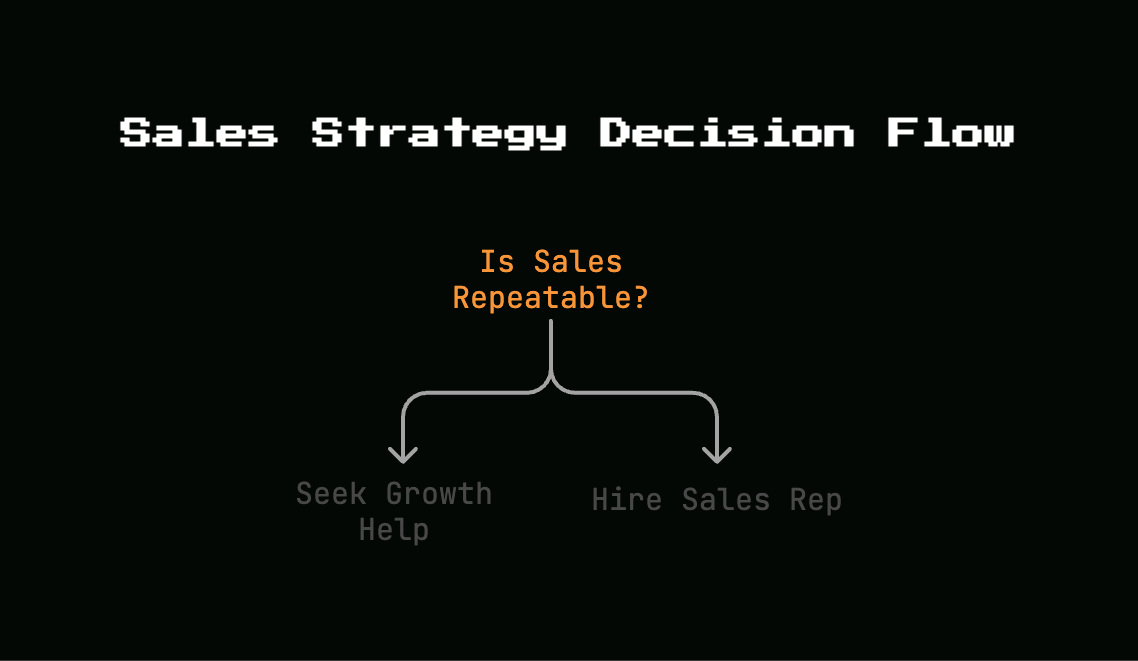
The cleanest rule is simple. Growth help comes first when your go-to-market motion is still messy. A first sales hire comes first only when founder-led selling already works in a way another person can repeat.
How to tell if you're actually ready for a first sales hire
Readiness is less about ARR bragging rights and more about pattern recognition. At $1M to $5M ARR, you can still be early if deals are custom, random, or heavily dependent on your personal network.
You've closed enough deals yourself to spot a pattern
Founder-led selling is not a rite of passage. It is product learning in plain clothes. Startup sales advice consistently points to the founder closing the first 10 to 25 customers, or at minimum proving several wins in the same ICP without heavy customization, before hiring a rep.
That matters because you need to know why people buy. Not why you think they buy, not what sounds good on the homepage, but what actually gets a deal over the line on a Thursday afternoon after the third pricing objection. If you cannot explain that clearly, you are asking a hire to discover the motion while carrying quota.
Your ICP is clear and your deals don't feel random
ICP means ideal customer profile, the kind of customer that keeps buying, sticks around, and gets real value. A clear ICP shows up in boring ways, which is usually a good sign. Similar pain. Similar objections. Similar reasons the deal moves forward.
If one customer buys for workflow automation, another buys for compliance, and a third buys because a friend made an intro, that is not a stable motion yet. It is a collection of wins. The first sales hire needs more than that.
You have enough demand to keep a full-time rep busy
A rep without pipeline is like opening a store on an empty street. Plenty of effort, not much to work with.
You need enough inbound, enough founder overflow, or enough believable outbound opportunity to support full-time selling. If you are still wondering how the next ten qualified conversations will happen, the bottleneck likely sits earlier in the funnel. That is often a sign to work on demand generation or the systems behind your motion before adding headcount.
Your basic sales setup already exists
No, you do not need a giant RevOps stack. But you do need the basics: a CRM that people actually use, clear pipeline stages, notes from calls, messaging that mostly holds up, pricing logic, and at least a rough playbook.
Your first hire should improve the machine. Your first hire should not walk into complete chaos and be asked to build the machine while closing this quarter’s number.
When growth help should come before your first sales hire
Sometimes the wrong first hire is not a bad salesperson. It is a salesperson hired to solve a marketing or positioning problem.
Your pipeline problem starts before the sales call
If demos come in waves, lead quality is weak, or the right buyers are not showing up at all, sales is downstream from the real issue. A rep can work hard and still fail in that setup.
Growth help is usually the better buy here. That could mean tightening demand gen, fixing lifecycle nurture, cleaning up paid acquisition, sharpening messaging, or improving website conversion. If top-of-funnel is unreliable, you need signal before you need more selling capacity.
You're still testing positioning, channels, or pricing
Sales gets messy fast when the story changes every two weeks. If you are still swapping target segments, rewriting the offer, or adjusting pricing every month, a quota-carrying rep ends up chasing a moving target.
The trick is to stabilize the message first. A tighter small-team revenue plan usually does more for early growth than throwing a rep at a shaky market story.
You need part-time senior help, not a full-time closer
This is where fractional support earns its keep. A fractional sales leader, GTM advisor, or operator can help shape process, compensation, territory logic, handoffs, and reporting without the cost of an early VP or CRO.
That bridge has become a lot more common in 2024 through 2026, mostly because early teams want experience without committing to a full executive salary too soon. It also helps you avoid the classic mistake of hiring management before there is anything stable to manage.
When a first sales hire is the right next move
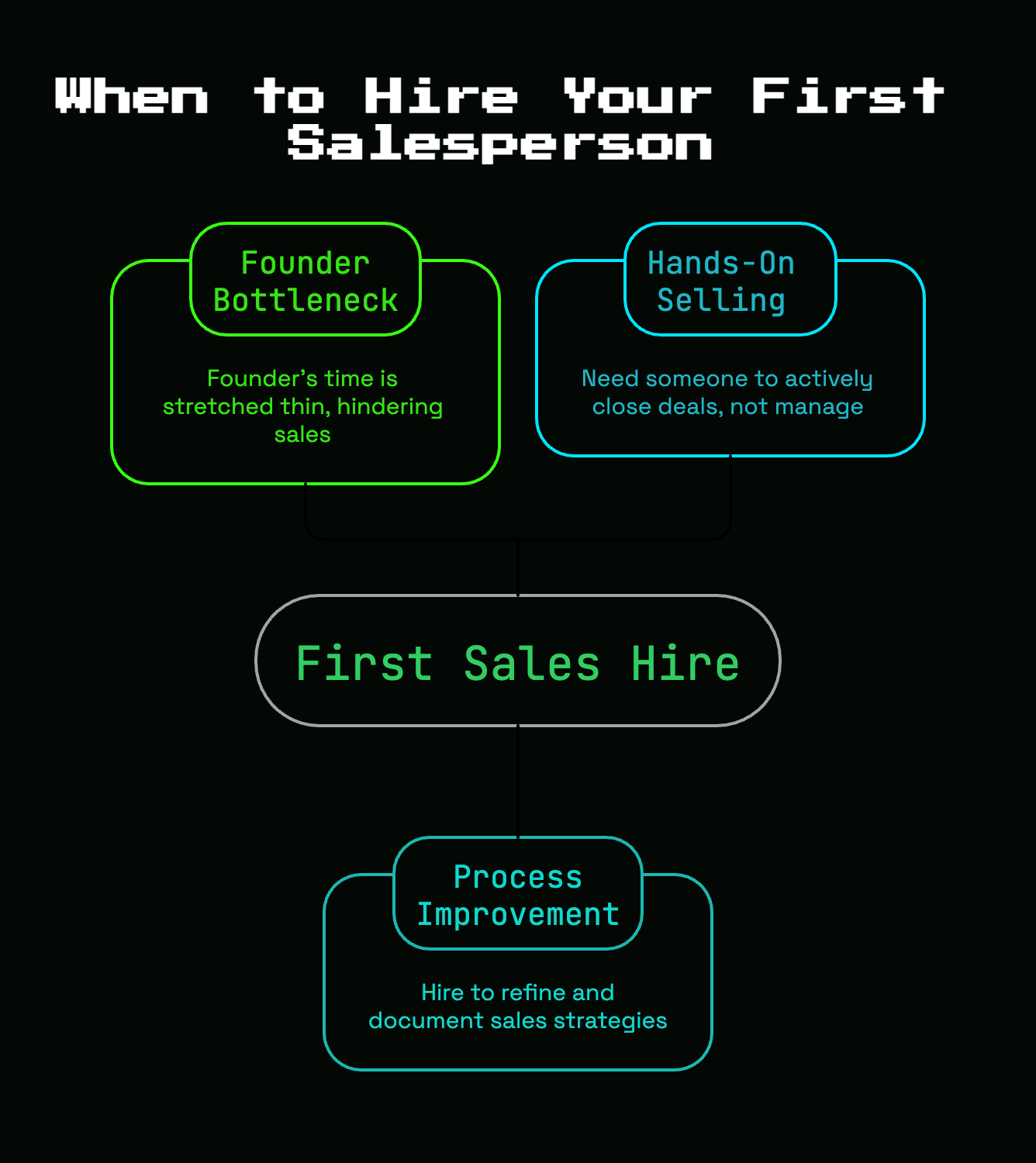
There is a real green-light moment, and it is usually easier to feel than to spreadsheet. The pattern exists, demand exists, and you are now the thing slowing it down.
Founder-led selling is working, but it's becoming a constraint
Picture a packed Tuesday with five demos, two pricing follow-ups, and a product review squeezed in at 5:30 p.m. By Wednesday morning, one prospect has not gotten the proposal, another has not received answers to security questions, and your roadmap work is already slipping.
That is a real bottleneck. If you are closing business but losing speed because sales competes with everything else you need to do, a first sales hire makes sense.
You need someone to repeat and improve the motion
The first hire is not there just to close deals. The role is to run the playbook, sharpen it, document what works, and turn your gut feel into a process another person could follow later.
That builder-seller profile matters. You want somebody who can spot patterns in objections, improve follow-up, keep CRM hygiene tight, and help define what “qualified” actually means in your business.
The role is hands-on selling, not management
Say this out loud before you post the role: your first sales hire is usually not a VP of Sales. It is usually not a CRO either.
Early executive hires often fail because the company wants strategy, forecasting, and leadership, but what the business actually needs is somebody doing the work. A seller-builder fits that gap much better than a polished manager from a big org.
What to look for in your first sales hire
This is where a lot of teams get distracted by resume shine. The better question is not “Who looks impressive?” It is “Who has actually done this kind of messy work before?”
Prior startup reps beat big-company pedigree
A rep from a startup at a similar price point usually beats a polished enterprise seller with layers of enablement, SDR support, and brand gravity behind every meeting. Context matters more than prestige.
You are buying relevance. Selling into a similar buyer, with a similar ACV, in an environment where process was still being built, is a much better signal than a famous logo on LinkedIn.
Builder traits matter more than perfect credentials
Research keeps pointing to the same traits: resourcefulness, curiosity, coachability, resilience, speed, and comfort without a script. Those are not soft extras. They are the job.
In interviews, that looks like clear thinking, honest examples, strong questions, and practical answers about how pipeline gets built. In references, it sounds like somebody who took ownership instead of waiting for a finished playbook.
Test the work, don't just review the resume
Resume review is the weakest part of this decision. A written screen tells you how somebody thinks. A mock discovery call shows how somebody listens. Objection handling reveals whether the person stays calm when the conversation gets awkward, which it always does.
Ask candidates how the first 30 days would look. Ask how pipeline would get built if inbound slowed next month. You are not hiring a biography. You are hiring behavior.
Budget, ramp, and the hidden cost of getting this wrong
Early hiring decisions look cheap on paper right up until the time cost shows up.
What a first sales hire really costs
Base salary is only part of the picture. Add commission, equity, CRM and call tools, recruiting time, onboarding time, and the founder hours needed for coaching and deal reviews. Early reps also often do not hit full variable quickly, so cash planning needs a little realism.
For bootstrapped teams, that matters a lot. The check you write is only half the cost. The attention you redirect is the other half.
Plan for a 3, 6 month ramp, not instant relief
Most guidance puts first-rep ramp at three to six months, with broader sales onboarding benchmarks stretching even longer in weaker setups. That means your first sales hire probably will not solve next month’s revenue problem.
Structured onboarding helps. Secondary data collected in a 2026 roundup suggests structured onboarding is linked to stronger retention and faster productivity, though those figures are best treated as directional rather than gospel. The practical point still stands: if you want speed, give the hire structure.
A bad hire is expensive in more ways than payroll
Bad early sales hires do more than miss quota. Pipeline gets wasted. CRM notes get sloppy. Messaging drifts. Learning slows down because every bad conversation creates noisy feedback.
And the risk is not tiny. Reported failure rates vary widely, from nearly half within 12 to 18 months to even higher claims in some startup circles, but the broad message is consistent: early sales hiring has a high miss rate if readiness is weak.
Common mistakes that make the first sales hire fail
Most failed first hires were predictable in hindsight.
Hiring because you're tired, not because the motion works
Exhaustion is real. It is just not proof that a rep is the answer.
If you are overwhelmed because every deal needs custom work, every demo tells a different story, and every pipeline source is improvised, you are not ready to hand sales off. You are ready to simplify the motion.
Expecting one rep to create demand and close everything
One person can prospect and close in an early-stage company, but only if the offer is clear, the market is reachable, and the sales cycle is manageable. If the same role is supposed to invent messaging, create category demand, qualify leads, run demos, and close revenue with no support, that usually breaks.
Handing off sales too completely
Founders sometimes disappear from sales the second the hire starts. Bad move.
You still need joint calls, regular reviews, and active diagnosis of lost deals. Sometimes the miss comes from rep performance. Sometimes it comes from product, pricing, or positioning. If you stop looking, you stop learning.
Using annual quota as the only success metric
For an early hire, annual quota is too blunt. Ninety-day milestones are better: quality of activity, pipeline creation, learning speed, process contribution, and early conversion signals.
That gives you a much better read on whether the hire is building something durable or just staying busy.
A simple decision framework: growth help first or first sales hire first?
You do not need a perfect model here. You need an honest one.
Choose growth help first if...
Your ICP is still fuzzy, messaging keeps changing, pipeline is weak, founder-led selling is still teaching you what converts, process is loose, or there simply is not enough demand to keep a full-time rep productive.
Choose a first sales hire first if...
Deals are repeatable, your ICP is clear, there is enough pipeline volume, you are the bottleneck, your basic sales setup exists, and the goal is to replicate what already works instead of guessing at a new motion.
Try one move this week: run a readiness audit
Pull your last 10 closed-won and closed-lost deals. Look for repeated buyer pain, repeated objections, repeated reasons for movement, and repeated sources of demand. If the patterns are clean, a first sales hire may be the right next move. If the patterns are messy, fix demand, process, or positioning first.
Frequently Asked Questions
Should your first sales hire be an AE or a VP of Sales?
Usually an AE-type builder-seller. Early on, you need hands-on selling and process building more than management layers.
How many customers should you close before hiring a rep?
A common benchmark is the first 10 to 25 customers, or at least several wins in the same ICP without heavy custom work.
Can one first sales hire handle both outbound and closing?
Sometimes, yes. But only if the message is clear, the market is defined, and pipeline expectations are realistic. If demand is still shaky, that role gets overloaded fast.
How long should you expect ramp to take?
Plan for three to six months to full productivity. Faster is possible, but counting on instant relief is how teams get disappointed.
Is fractional help better than hiring full-time?
If your main gaps are process, positioning, compensation design, or GTM clarity, fractional help is often the smarter first move. It lowers risk while giving you structure.
What should you do before posting the role?
Write down your ICP, your deal stages, your pricing logic, your top objections, and what a good first 90 days looks like. Then hire against that reality, not against wishful thinking.


Discussion