

If your SaaS GTM strategy feels fuzzy, revenue usually feels fuzzy too. At $1M to $5M ARR, that shows up fast: demos that go nowhere, a founder stuck on every deal, and a pipeline that looks busy right up until the month ends light.
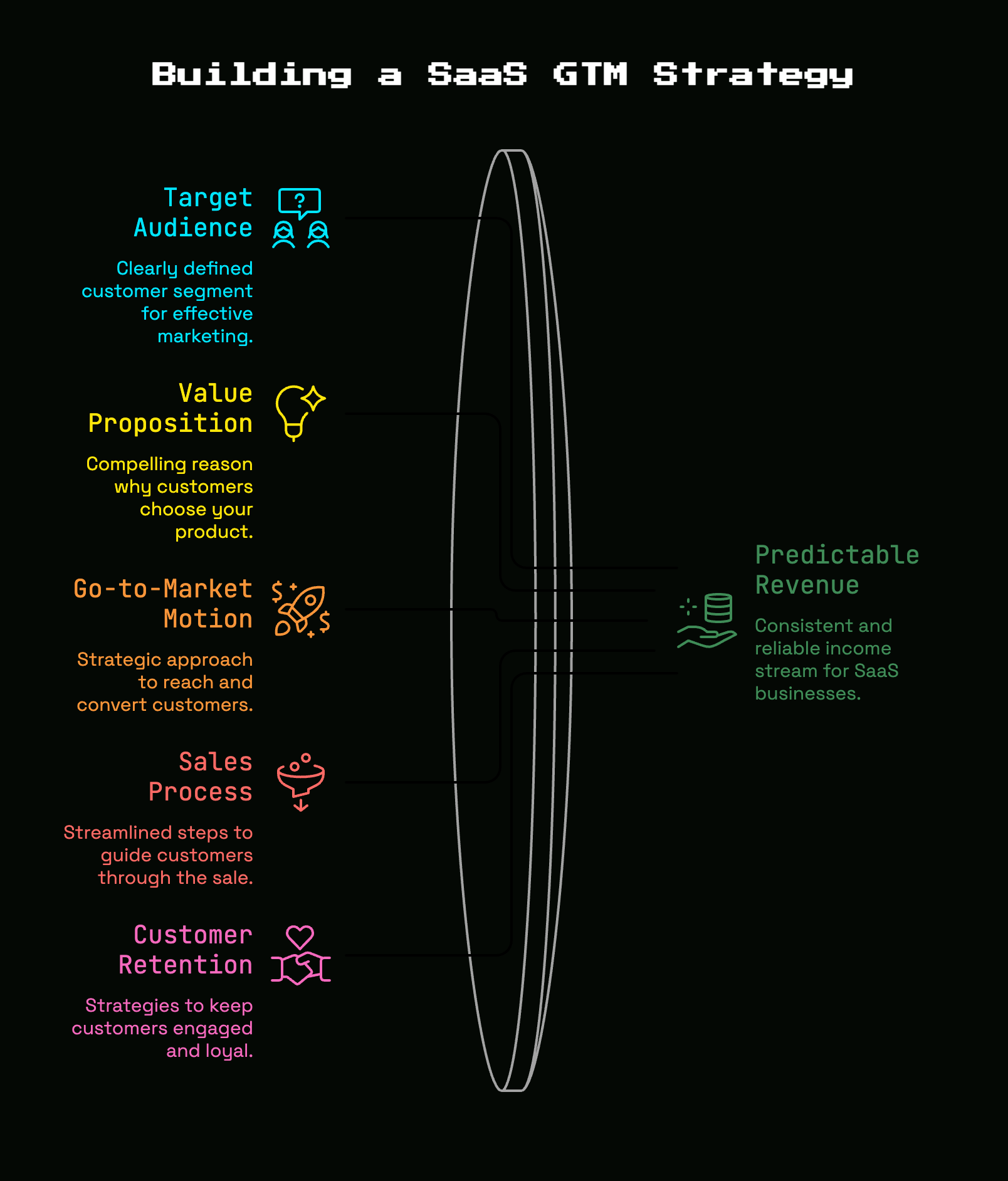
A SaaS GTM strategy is the system that turns your product into predictable revenue. In plain English, it answers five connected questions: who you sell to, why they buy, how you reach them, how the sale happens, and what gets customers to stay and expand. That is broader than a marketing plan and bigger than a sales playbook, because revenue leaks just as easily in onboarding as in acquisition.
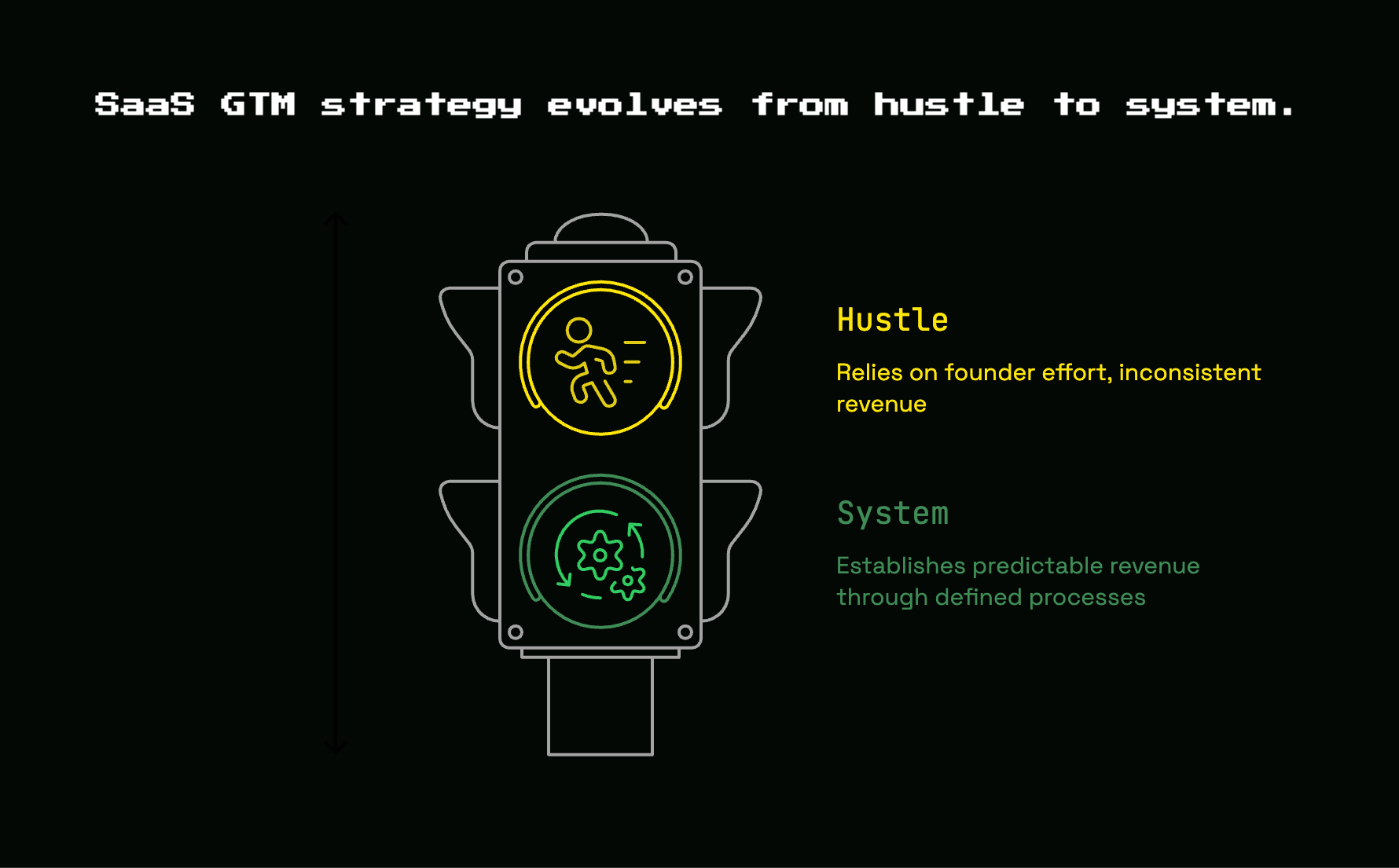
Early on, you can get away with hustle. At some point, usually after one too many Thursday afternoons spent rewriting the homepage and chasing late-stage deals, hustle stops being enough. What you need is a tighter path from market to money.
Here’s what you’ll learn:
- What GTM strategy actually includes
- How to find your main revenue bottleneck
- How to tighten your ICP
- How to sharpen positioning
- How to choose your GTM motion
- How pricing affects conversion
- Which channels deserve your time
- How to build a simple sales process
- Why onboarding belongs inside GTM
- Which metrics matter in 90 days
What a SaaS GTM Strategy Really Is
A lot of teams use “go-to-market” as shorthand for launch plans, ad campaigns, or sales activity. That is too narrow. Your SaaS GTM strategy is the full route from product to revenue, including targeting, messaging, acquisition, sales, onboarding, retention, and expansion.
Here’s the thing: if any one of those pieces breaks, the rest gets blamed. Weak positioning makes paid acquisition look expensive. Bad qualification makes sales look sloppy. Poor onboarding makes churn look like a lead quality problem. GTM is the system that connects those dots so you can fix the real issue instead of swatting at symptoms.
GTM strategy vs. marketing strategy vs. sales strategy
Marketing strategy is about getting attention and demand from the right audience. Sales strategy is about turning qualified interest into revenue. GTM sits above both.
That means your GTM strategy decides who counts as a good-fit account, what promise shows up in your messaging, which channels matter, when a rep gets involved, what happens after close, and how expansion gets triggered. Marketing and sales each run part of the machine. GTM is the machine.
Why small SaaS teams need a tighter GTM than big companies
A bigger company can afford to test six channels at once, hire around bad process, and survive a quarter of confused messaging. You cannot. Thin headcount changes the rules.
Focus beats volume when your team is small. A narrow ICP, a clear message, and one dominant motion will outperform channel sprawl almost every time. The catch is that focus feels slower in the moment. It is not. It is the fastest way to stop wasting sales time on buyers who were never going to close.
Start With the Revenue Problem You’re Actually Trying to Fix
“Grow faster” is not a GTM problem. It is a wish. A useful strategy starts with the bottleneck that is actually constraining revenue right now.
That bottleneck might sit at the top of funnel, in sales conversion, in activation, or in retention. If you skip this step, you end up changing pricing, redesigning onboarding, and launching outbound all in the same month, then learning nothing because everything moved at once.
The five most common GTM problems at early scale
One common problem is too many low-fit demos. Calendar volume looks healthy, but calls are full of curious people with no budget, weak urgency, or the wrong use case.
Another is founder-led sales that does not transfer. The founder knows the story, the objections, and the shortcuts. The first rep gets a CRM full of notes like “good call, follow up next week” and has to guess the rest.
A third problem is inconsistent messaging. Your homepage says one thing, outbound says another, and demos turn into feature tours because nobody can explain the core value in one sentence.
Then there is weak activation. Trial users sign up, poke around, and disappear before they hit first value. Sales keeps feeding the funnel, but the bucket has a hole in it.
And finally, expansion happens by accident. Good customers buy more only when somebody happens to notice usage or gets asked for an extra seat.
Pick one primary bottleneck before you change everything
Choose the one constraint that most limits revenue in the next 90 days. Not the most interesting one, the most expensive one.
Use a simple rule: one main GTM problem, one clear owner, one measurement window. If win rates are collapsing, own that before adding channels. If activation is poor, fix that before buying more traffic. A strategy gets sharp when it says no.
Get Specific About Your ICP Before You Spend More Money
Most teams say the right words about ICP and then keep targeting “any company that could use this.” That is not an ICP. That is a market.
Your ideal customer profile should describe the accounts most likely to buy, onboard successfully, stay, and expand. Revenue matters more than excitement. A segment that loves demos but churns in 60 days is not your best fit.
Define your best-fit customer using revenue, not vibes
Start with customers that closed, implemented, renewed, and ideally expanded. Look for patterns in industry, company size, team structure, use case, urgency, budget, and buying process.
Notice what was true before the sale. Did the buyer already feel pain in a measurable way? Did the team already have a workflow that made setup easier? Did budget live with one owner instead of four stakeholders and a procurement loop?
Retention matters here more than most teams admit. If a segment buys quickly but struggles to adopt, your acquisition numbers will lie to you. Best fit means good before the contract and good after it.
Segment accounts into tiers your team can actually work
Not every decent-fit account deserves the same effort. Tiering helps your team spend time where it has the best odds of paying back.
Tier 1 should be your highest-fit, highest-potential accounts. That is where founder time, custom outreach, and rep attention go. Tier 2 gets lighter-touch outbound and tighter qualification. Tier 3 is mostly self-serve, nurture, or no active effort at all.
This matters because small teams often spread top effort too widely. If every account gets “personalized” attention, none really does.
Red flags that your ICP is still too broad
If your team keeps saying “every team can use this,” your ICP is too broad. If inbound interest is high but conversion is weak, same problem. If demos are full of curiosity but nobody feels urgency, that is another tell.
Broad ICPs sound good in board decks and feel awful in pipeline reviews. Buyers should recognize themselves quickly. If everybody sort of fits, nobody really does.
Nail Your Positioning So Buyers Get It Fast
Positioning is the bridge between what your product does and why somebody should care. Without it, even a strong product sounds interchangeable.
Good positioning reduces explanation. Buyers should get the problem, the outcome, and the reason to believe you before a rep opens slide two.
Build a value proposition around pain, outcome, and proof
Pain is the problem worth fixing now. Outcome is the better state your buyer wants. Proof is the evidence that makes your claim believable.
That sounds simple because it is. “Manual client reporting eats six hours a week” is pain. “Automated reporting in 10 minutes” is outcome. “Used by 120 agencies with multi-account dashboards” is proof.
If your message skips proof, it feels like marketing. If it skips pain, it feels generic. If it skips outcome, it feels like a feature list.
Turn feature-heavy messaging into buyer language
Most SaaS messaging gets stuck in internal terms. Buyers do not wake up wanting “cross-functional workflow orchestration.” Buyers want fewer handoffs, fewer errors, or fewer Sunday night spreadsheet fixes.
Pull phrases from sales calls, support tickets, onboarding notes, and churn interviews. If customers say “it took two days to reconcile this before,” use that language. It lands because it is real.
The trick is not to dumb anything down. It is to translate product detail into human stakes.
Create one-sentence messaging for your homepage, demos, and outbound
You need short versions of the same story for different contexts. Your homepage needs clarity in seconds. Outbound needs a reason to reply. Demos need a clean opening frame.
A useful structure is simple: who it is for, what problem it fixes, and what outcome it creates. Keep the backbone consistent so prospects do not hear three different companies depending on where they meet you.
Choose the Right GTM Motion Instead of Copying Bigger SaaS Companies
A GTM motion is the main way buyers move from interest to purchase. For most B2B SaaS teams, the real choice is product-led, sales-led, or hybrid.
Copying a public SaaS company here is a fast way to waste time. Motion should match your price point, product complexity, and buyer behavior, not somebody else’s headline.
Product-led growth: when self-serve really helps
Product-led growth works when users can reach value quickly without much help. Free trials, freemium plans, and self-serve onboarding reduce friction and can create efficient pipeline.
This works best when setup is light, time-to-value is short, and one user can get started without a committee. Think tools where adoption can spread naturally through invites, usage, or visible output.
The catch is that self-serve does not mean no work. PLG only works when onboarding is sharp, activation is measurable, and upgrade paths are obvious.
Sales-led growth: when buyers need help to buy
Sales-led growth makes sense when deals are larger, implementation matters, or more than one stakeholder needs confidence before signing.
If your product changes workflow, touches sensitive data, or requires setup support, buyers usually want human help. The same goes for higher ACV deals where a bad purchase has visible downside for the buyer.
In those cases, a rep is not friction. A rep is risk reduction.
Hybrid GTM: the default for many B2B SaaS teams
Hybrid is the default for a reason. Many SaaS products benefit from low-friction entry and human help at the right moments.
A prospect might start with a trial, invite two teammates, hit a usage threshold, and then need support with rollout, procurement, or expansion. That is where sales assist earns its keep.
For a $1M to $5M ARR team, hybrid often fits reality better than ideology. You get product signals without asking the product to do the whole job.
A quick decision framework for choosing your primary motion
Use five questions. How expensive is the product? How fast can a user get value? How many stakeholders usually weigh in? How complex is setup? How urgent is the problem?
Lower price, faster value, fewer stakeholders, and simple setup point toward self-serve. Higher price, slower value, more stakeholders, and heavier change management point toward sales-led. Mixed signals usually mean hybrid.
Build an Offer and Pricing Model That Supports Sales
Pricing and packaging are not side notes. They shape conversion, qualification, and expansion more than most teams expect.
If prospects cannot tell which plan fits, sales slows down. If pricing fights the way value is delivered, churn shows up later.
Packaging: what goes in each plan and why it matters
Packaging is the structure of your plans: features, usage limits, seats, support, and service layers. Good packaging guides buyers toward the right fit without forcing a custom conversation too early.
Feature gates can work, but only if they map to real buying moments. Usage limits work when value naturally scales with use. Service layers help when bigger accounts need onboarding, training, or admin control.
The goal is not to create clever tiers. It is to make buying easier.
Pricing that matches value and buying behavior
Seat-based pricing fits products where each added user gets obvious value. Usage-based pricing fits products where value grows with volume, like events tracked, reports run, or workflows processed. Flat-rate pricing reduces decision friction. Custom pricing makes sense when scope varies widely or procurement expects negotiation.
Pick the model that feels natural to the buyer. If the value driver is team adoption, charging on seats makes sense. If the value driver is throughput, usage may fit better. Pricing should feel like the bill arrived in the same shape as the benefit.
Signs your pricing is slowing down your GTM
If your team discounts constantly, pricing may be misaligned with perceived value. If prospects ask for custom plans early, packaging may be too rigid. If trial users keep picking the wrong tier, plan design may be confusing.
Another common signal is stuck expansion. Customers use more, ask for more, but pricing creates awkward jumps instead of natural upgrades.
Pick 2, 3 Acquisition Channels You Can Win, Not 10 You Can Barely Maintain
Channel strategy for small teams is mostly subtraction. You do not need more tactics. You need a few channels that fit your buyers and produce signals quickly.
Choose based on where buyers already look, how fast you can learn, and how much maintenance the channel needs.
Founder-led outbound
Founder-led outbound still works because it creates fast learning. You hear objections directly, test messaging quickly, and target high-fit accounts before a full sales team exists.
It is especially useful when your market is narrow, deal value is meaningful, or your category needs explanation. Tight lists beat broad blasts. Personalized relevance beats volume.
Done well, outbound is not just pipeline generation. It is market research that books meetings.
Content and SEO for compounding demand
Content works best when buyers research before buying or need help understanding the problem. SEO compounds slowly, but over time it can lower acquisition costs and create trust before the first call.
This channel fits categories with education-heavy buying journeys, comparison searches, and recurring pain points. If prospects ask the same questions on calls, that is content fuel.
The catch is patience. Content is not the right fix for a revenue gap that needs closing in three weeks.
Paid acquisition and retargeting
Paid search can work when buyer intent is clear and your landing pages convert. Retargeting can help when sales cycles are longer and prospects need more touches.
Paid social is trickier for many B2B SaaS teams at this stage. If positioning is vague or conversion is weak, paid spend just makes the problem more expensive. Do not use paid to force a motion that the rest of your funnel has not earned.
Partnerships, referrals, and marketplaces
Partnerships can be efficient because trust comes preloaded. Integration partners, consultants, agencies, customer referrals, and relevant marketplaces can all shorten the path to a good-fit buyer.
This channel works especially well when your product fits into an existing stack or service relationship. If buyers already depend on another tool or advisor, that relationship can become distribution.
Design a Sales Process Your First Rep Can Actually Run
A first rep should not invent your motion from scratch. That is how teams get activity without consistency.
You need a simple process that explains what happens from first touch to close, how deals qualify, and what gets handed off after signature.
Map the journey from first touch to closed-won
Keep stages operational: first touch, qualification, discovery, demo, proof, close, onboarding handoff, expansion trigger. Each stage should answer one question about deal progress.
If a stage exists only because “that’s what sales teams do,” cut it. Your process should reflect how buyers actually buy, not how CRM software likes to organize columns.
Write qualification rules that prevent bad pipeline
Qualification should cover fit, pain, urgency, authority, and implementation readiness. Not every deal needs a formal framework, but every deal needs standards.
A meeting is not pipeline just because somebody showed up. Good qualification protects rep time and improves forecasting. It also keeps your team from confusing friendliness with buying intent.
Build a founder-to-rep handoff that does not break conversion
Document winning calls. Save recordings. Write down discovery questions, common objections, proof points, and deal patterns that matter. Create demo flow guidance that explains why each section exists.
Without this, your first rep is left guessing what made founder-led sales work. And honestly, guessing is expensive.
Fix Onboarding and Activation Before Pouring More Leads Into the Funnel
If customers fail to reach first value, GTM is broken even if top-of-funnel looks great. Revenue starts at acquisition, but it compounds in activation and retention.
This is where a lot of small SaaS teams lose momentum. More leads feel exciting. Quiet churn does not. But quiet churn is what keeps revenue flat.
Define activation in one measurable moment
Activation should be one behavior that strongly signals first value. Maybe it is connecting a data source, inviting teammates, publishing a workflow, or completing a first report.
Pick one moment you can measure consistently. If activation is vague, improvement will be vague too.
Remove the first-week friction that kills expansion later
Look hard at the first seven days. Where do users stall? What setup step feels confusing? How long does support take to respond? Which screen leaves people unsure what to do next?
Small blockers early become bigger revenue problems later. Customers who activate faster retain better, refer more, and give sales more confidence in the promise being made.
Use customer feedback loops to sharpen GTM
Onboarding calls, churn interviews, lost deals, and support patterns all feed GTM. They reveal where positioning overpromises, where ICP is off, and where product friction creates false objections.
Treat feedback as routing, not just commentary. It should change message, targeting, and onboarding priorities.
Align Marketing, Sales, Product, and Customer Success Around One Funnel
Alignment sounds like a big-company word, but for small teams it just means everybody uses the same map. Without that, every weekly meeting turns into a debate about whose numbers count.
A shared funnel creates speed. It reduces handoff mistakes and makes problems easier to see.
Agree on definitions for lead, qualified opportunity, activation, and expansion
Pick the terms that matter most and define them once. What counts as a lead? When does a lead become a qualified opportunity? What exact behavior counts as activation? What counts as expansion revenue?
These definitions should be boringly clear. Boring is good here.
Set weekly GTM rhythms that keep the team honest
Keep it lightweight. One pipeline review. One win-loss review. One message feedback loop from calls, onboarding, and support.
That rhythm is enough to catch pattern drift before it becomes a quarter-long problem.
Track the Metrics That Tell You If GTM Is Working
A good GTM dashboard is not a museum of every number your tools can export. It is a short list that tells you whether your main bottleneck is improving.
At this stage, signal matters more than reporting elegance.
Top-of-funnel metrics
Watch traffic quality by channel, demo requests, outbound reply rates, meeting rates, and cost per qualified opportunity where paid spend is involved.
Raw lead volume matters less than who turns into real pipeline. Cheap leads that never close are not cheap.
Conversion and revenue metrics
Track trial-to-activation, opportunity-to-win, CAC payback, ACV, sales cycle length, net revenue retention, and expansion revenue.
Trial-to-activation tells you whether users reach first value. Opportunity-to-win shows sales efficiency. CAC payback shows how quickly customer acquisition spend returns. ACV is average contract value. Net revenue retention shows how much recurring revenue stays and grows over time. Expansion revenue shows whether customers buy more after the initial deal.
Build a simple scorecard for a 90-day GTM cycle
Tie your scorecard to one main bottleneck. If the problem is low win rate, track qualification rate, stage conversion, objections, and close rate. If the problem is activation, track setup completion, time to first value, and activation rate.
Keep the window at 90 days so strategy can actually be tested. Short enough to act. Long enough to learn.
Common SaaS GTM Mistakes That Stall Revenue
Most GTM mistakes look reasonable while you are making them. That is why they persist.
The pattern is usually the same: too many moving parts, not enough shared definitions, and a lot of energy poured into the wrong constraint.
Channel sprawl without a dominant motion
If you are running outbound, SEO, paid search, partnerships, webinars, and a free trial all at once without a clear primary motion, you probably have noise, not traction.
Channels should support a motion. They should not compete with each other for basic identity.
Messaging that sounds polished but says nothing
Polished vagueness is everywhere in SaaS. “Empower teams.” “Unlock efficiency.” “Drive transformation.” Buyers hear this and feel nothing.
Clear beats clever. Specific beats polished.
Hiring sales before the motion is repeatable
The first rep cannot save a broken GTM. If the ICP is blurry, messaging changes weekly, and no qualification rules exist, hiring sales just adds salary to confusion.
Repeatability does not mean perfection. It means the basics work often enough to teach. Bringing in senior growth help to build that repeatability first is often cheaper than a mistimed full-time hire.
Ignoring retention while chasing new logos
New logos feel like progress. Churn feels like a back-office problem. But if retention is weak, growth turns into treadmill math.
For bootstrapped teams especially, retention is part of acquisition economics. Every churned customer makes the next acquisition more expensive.
Real SaaS GTM Strategy Examples Small Teams Can Learn From
You do not need giant case studies to learn useful GTM patterns. A few motion types are enough.
The point is not to copy a company. It is to recognize which conditions make each model work.
A product-led example: low-friction adoption that creates expansion
Picture a workflow tool where one person signs up, imports a template, gets value in 15 minutes, and invites three teammates by day two. That is good PLG.
The product itself creates proof, and team usage naturally opens expansion paths. Pricing can start low, then grow with seats or usage.
A sales-led example: tighter targeting and higher ACV
Now picture a compliance platform selling into finance teams. Setup touches sensitive data, the buyer group includes operations and security, and mistakes are expensive.
In that case, direct sales wins because buyers need confidence, coordination, and a clear rollout plan. Fewer deals, higher fit, bigger ACV.
A hybrid example: self-serve entry with sales assist at the right moment
Hybrid looks like a prospect starting in self-serve, reaching activation, and then getting human help when usage or account fit suggests bigger potential.
Maybe a team hits five active users, connects a second data source, or comes from a Tier 1 account. That is the right moment for outreach. Timed well, sales feels helpful, not interruptive.
A 90-Day SaaS GTM Plan for Small Teams That Need Revenue Now
A good plan for the next 90 days should feel narrow enough to run and concrete enough to measure. No giant transformation. Just focused moves.
Days 1, 30: tighten ICP, messaging, and baseline metrics
Review closed-won, churned, and retained accounts. Talk to recent buyers and recent losses. Rewrite your ICP around patterns tied to revenue, retention, and buying urgency.
Then tighten your message. Update homepage copy, outbound language, and demo opening so the same core story shows up everywhere. Set a basic scorecard tied to your main bottleneck.
Days 31, 60: commit to one primary motion and two core channels
Choose your dominant motion: product-led, sales-led, or hybrid. Then pick two core acquisition channels that fit it.
Clean up pricing or packaging if sales keeps tripping over them. Simplify your sales stages. Write qualification rules. If your first rep is in seat, give structure instead of vibes.
Days 61, 90: improve activation, close the loop, and double down
Define activation clearly and remove the first-week blockers that stop users from reaching it. Review calls, support tickets, and churn reasons for recurring friction.
Then make one decision with confidence: double down on what is working, cut what is noisy, and run the next quarter from a tighter base. Try one thing first: pick your single biggest GTM bottleneck and refuse to work on anything else until you have moved it.
JOIN THE LIST
The GTM systems that compound to $10M+. Twice a month. Join 1,500+ founders & GTM leaders.
› Check your inbox to confirm. See you in two weeks.
No spam. Unsubscribe anytime.


Discussion