

A repeatable sales process sounds boring until you try to hire sales rep number one without it. Then it becomes obvious: if your deals only move forward because you remember every detail from a call you took in a coffee shop three Tuesdays ago, you do not have a process yet. You have founder memory. This guide shows how to turn that into a repeatable sales process your first rep can actually run.
What you’ll need before you build anything
Before Step 1, get a few things in one place. You need 5 to 10 recent won deals, 5 to 10 lost or stalled deals, your call notes, demo notes, follow-up emails, and whatever system currently holds pipeline info. That can be a CRM, but a spreadsheet works if that is what you have.
You also need 60 to 90 minutes of focused time without Slack, inbox, or surprise calendar pings. The goal is not to build a perfect machine in one sitting. The goal is much simpler: create a version of your sales motion that another person can follow without needing your intuition every five minutes.
That distinction matters. Hire #1 does not need a masterpiece. Hire #1 needs a path.
Step 1: Start with the deals you already have
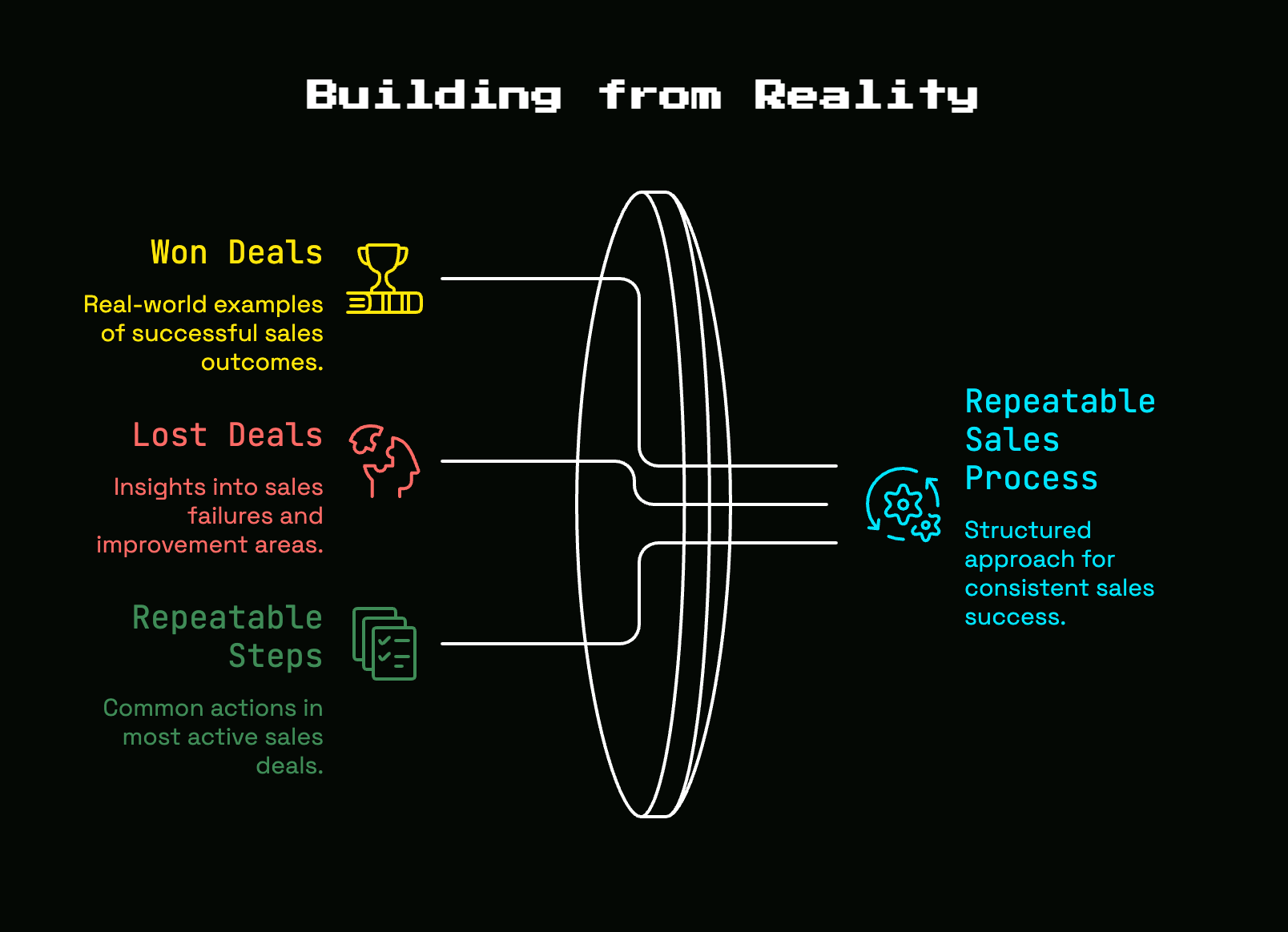
Do not start from a blank doc and try to invent a process that sounds polished. Start with real deals, because your buyers are already showing you how they buy.
- Open your recent deals, one by one.
- Pull notes from calls, emails, demos, and proposals.
- Look for patterns in how interest started, what questions came up, and what moved the deal.
- Capture those patterns in plain language.
- Ignore anything that feels aspirational but has not happened in real life.
Your first version should describe what actually happens when somebody buys, not what you wish happened.
Review 5, 10 recent won deals
Won deals are your clearest source of truth. Go through them slowly enough to notice what repeats.
- Write down what triggered the conversation.
- Note the role of the first contact and the eventual approver.
- Record the main pain point in simple language.
- Mark the moment the deal felt real, such as after discovery, after a demo, or after security review started.
- Note deal length from first conversation to close.
Now look across all those deals. You are trying to spot the same few things showing up again and again. Maybe deals close faster when the buyer already has a broken manual process. Maybe a RevOps lead becomes the internal champion more often than a founder expected. Maybe most wins include a second meeting within seven days of discovery.
That is your pattern. Keep it.
Review 5, 10 lost or stalled deals
Losses are uncomfortable, but honestly, this is where process gaps get obvious.
- Pull a set of deals that were lost, ghosted, or have been sitting too long.
- Note where the deal stopped moving.
- Identify what was missing, such as urgency, access to a decision-maker, clear pain, or a defined next step.
- Look for signs the deal should have been disqualified earlier.
- Write down the common failure points.
You are not doing a postmortem for drama. You are trying to find fuzziness. If a lot of deals stall after discovery, discovery may be too shallow. If demos happen before pain is clear, your process is letting curiosity masquerade as buying intent. If close dates keep slipping, your stage definitions are probably too optimistic.
Write down what already feels repeatable
By this point, some parts of your selling motion probably feel familiar.
- List the steps that happen in most active deals.
- Write each step in one sentence.
- Keep the language basic enough that a new rep could understand it fast.
- Arrange the steps in the order buyers usually move.
- Save this as the rough draft of your process.
This is the base layer. It might look something like: inbound or outbound interest, discovery, qualified demo, stakeholder follow-up, commercial review, closed won or closed lost. Not fancy. Good.
Step 2: Define your ideal customer profile and buyer signals
A new rep cannot work from vibes. “Companies that seem like a fit” is not enough.
- Describe the kinds of accounts that buy successfully.
- Define the signs that a conversation is worth pursuing now.
- Map the people who usually influence the decision.
- Put it all in plain English.
- Remove anything too fuzzy to coach against.
The trick is to make targeting easier, not more theoretical.
Describe your best-fit accounts in plain English
Start with accounts that buy faster, stay happier, and get value without heroic effort.
- Review your best customers.
- Note company size, team shape, industry, and use case.
- Add what problem your product solves for them.
- Write one short paragraph describing a good-fit account.
- Write one short paragraph describing a bad-fit account.
Keep this human. For example: a good fit might be a B2B SaaS company with 20 to 150 employees, a lean go-to-market team, too many manual handoffs, and pressure to make pipeline more predictable. That is much better than a vague statement about “mid-market organizations seeking efficiency.”
List the buying triggers that create urgency
Fit matters, but timing matters almost as much.
- List the events that make prospects care now.
- Tie each trigger to a real problem.
- Prioritize the triggers you see most often in won deals.
- Add examples to help a rep spot them in conversation.
- Keep the list short enough to remember.
Common triggers in early B2B SaaS look familiar: hiring a first ops person, missing a revenue target, moving off spreadsheets, replacing a messy workflow, preparing for a board meeting, or cleaning up handoffs before growth breaks everything. Buyers act when pain becomes expensive.
Name the people involved in the decision
One friendly contact is not a buying process.
- Identify the person who feels the pain day to day.
- Note the person who owns budget or final approval.
- Identify the internal champion who pushes the deal along.
- Call out the common blocker, such as security, finance, or a skeptical manager.
- Write what each person cares about.
This helps your first rep avoid a classic mistake: mistaking access for progress. A champion may love the product, but approval can still die quietly if the economic buyer never sees a business case.
Step 3: Map your sales stages from first touch to closed deal
Now turn your rough pattern into clear stages that mean something.
- Write the sequence of buyer-facing stages.
- Limit the number of stages.
- Define what must be true for a deal to enter and exit each one.
- Separate stage movement from admin work.
- Check that the stages support forecasting.
A pipeline is useful only when each stage reflects real movement.
Keep the number of stages simple
Early teams often overbuild here.
- Start with five to seven stages.
- Name each stage using plain language.
- Remove any stage that exists only because software had a default field.
- Check that each stage reflects a real change in buyer commitment.
- Merge anything too similar.
For most B2B SaaS teams at this stage, simple wins. Something like: New, Discovery, Qualified Opportunity, Demo or Evaluation, Proposal or Review, Closed Won, Closed Lost. Clean stages beat a maze every time.
Define the entry and exit criteria for each stage
A stage should not mean “felt promising after a good call.”
- For each stage, write what must happen before a deal enters.
- Write what confirms the deal is ready to leave that stage.
- Make the criteria observable.
- Use buyer actions, not rep feelings.
- Test each definition against real deals.
For example, Discovery might exit only when pain is confirmed, ownership is known, and a next meeting is scheduled. Proposal or Review might require commercial terms shared and at least one approver engaged. Specific criteria make coaching and forecasting much easier.
Separate pipeline stages from internal tasks
This is a small distinction that saves a lot of confusion.
- List the tasks your rep does during a deal.
- Keep those tasks in checklists, templates, or reminders.
- Do not turn them into pipeline stages.
- Move deals only when buyer progress happens.
- Review your stage list and remove task-based clutter.
Sending a recap email matters. Logging notes matters. Creating a proposal matters. But those are tasks. They support the process. They are not the process.
Step 4: Set qualification rules your first rep can actually use
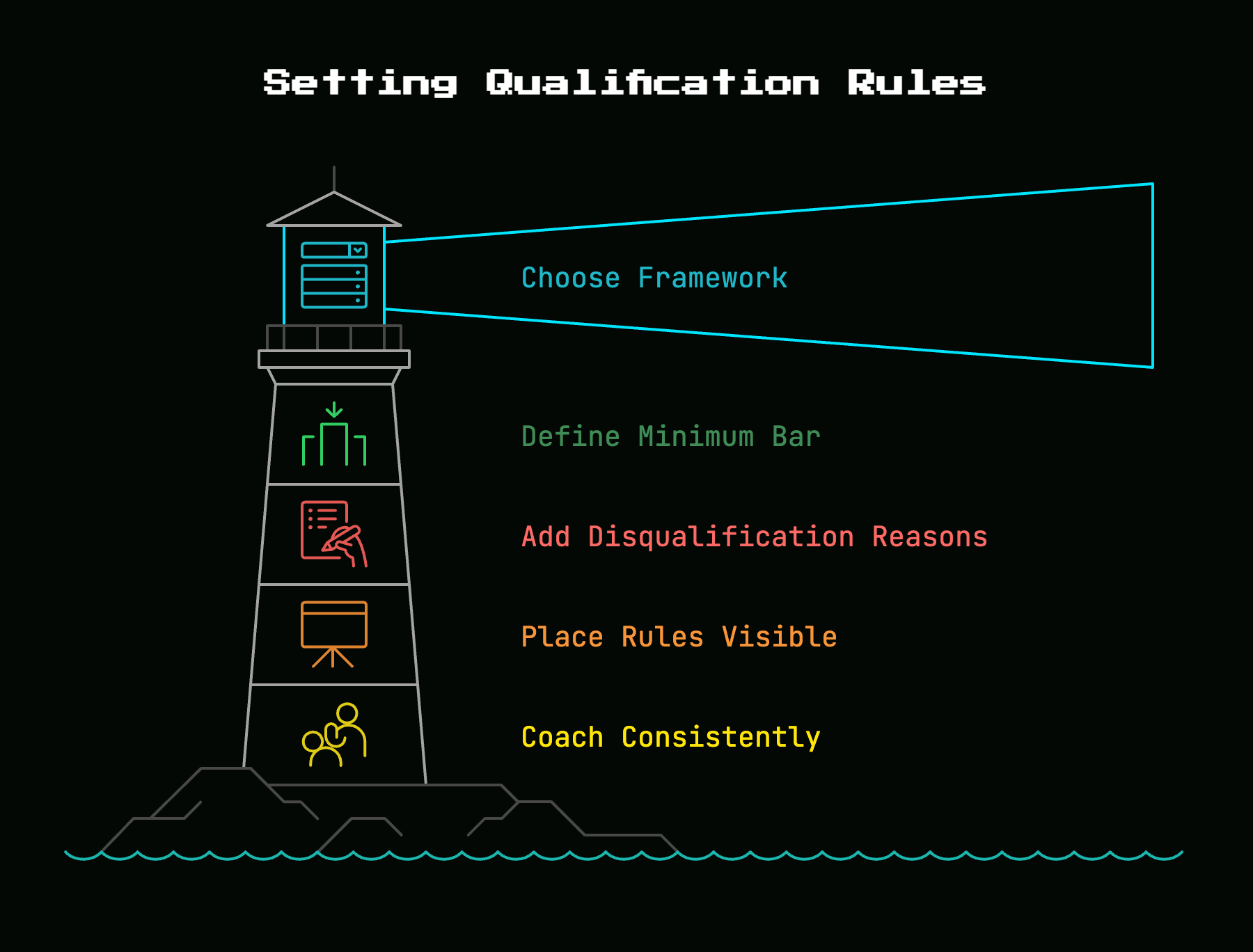
Not every lead deserves equal time, and your first rep should not have to guess.
- Choose a simple qualification framework.
- Define the minimum bar for an active opportunity.
- Add disqualification reasons.
- Put the rules where your rep will see them.
- Coach to them consistently.
A repeatable process gets stronger every time somebody says no early for the right reason.
Pick a simple qualification framework
Use a framework, but keep it lightweight.
- Pick 4 to 5 factors that matter in your deals.
- Define each factor in plain English.
- Add one or two example questions for each factor.
- Avoid turning the call into an interrogation.
- Keep only the parts that improve judgment.
Pain, ownership, timing, current process, and decision path are enough for most teams. That covers whether the problem is real, who cares, why now, how work happens today, and how a buying decision gets made.
Decide the minimum bar for a real opportunity
This is where you prevent zombie pipeline.
- Write the conditions that must be true before a deal enters your active pipeline.
- Keep the list short.
- Make every condition observable.
- Apply the same standard to founder-led and rep-led deals.
- Review edge cases and tighten the rule if needed.
A solid minimum bar might be: a defined pain point, a named owner, a credible use case, and a next meeting scheduled. If those are missing, the deal may still be a lead, but it is not a real opportunity yet.
Write disqualification reasons on purpose
Disqualification should be useful, not vague.
- Create a short list of common no-fit reasons.
- Use labels a rep can apply quickly.
- Separate “not now” from “never.”
- Add notes on re-engagement timing when relevant.
- Track the patterns.
Examples include no clear pain, wrong team size, no owner, timing pushed beyond six months, or feature gap tied to a required workflow. Once these reasons are documented, your pipeline gets cleaner fast.
Step 5: Build your core messaging for each part of the process
Your first rep should not have to reverse-engineer your best calls from memory.
- Create a simple message map.
- Draft discovery questions.
- Build a demo narrative.
- Write follow-up templates and objection responses.
- Keep everything flexible enough to sound human.
Consistency matters, but robotic language kills trust.
Create a simple problem-value-message map
Start with the buyer’s problem, not your product menu.
- List the top 3 to 5 problems buyers mention.
- Write the business impact of each one.
- Connect each problem to the outcome your product creates.
- Turn that into a few short talk tracks.
- Use the buyer’s words whenever possible.
If a prospect says, “handoffs keep breaking between marketing and sales,” your message should answer that pain directly. Not with a feature dump, but with a clear line from broken handoffs to cleaner visibility and fewer dropped opportunities.
Draft discovery questions that uncover real pain
Discovery should produce insight, not a transcript.
- Write 8 to 12 questions you want your rep to know cold.
- Focus on current workflow, friction, consequences, and urgency.
- Include follow-up prompts that dig deeper.
- Remove any question that sounds performative.
- Organize them by topic, not script order.
Good questions sound simple: how is this handled today, where does it break, what happens when it slips, who feels that pain most, what has already been tried, and what needs to be true for change to happen now?
Write a demo narrative, not just a feature checklist
A demo should follow the buyer’s world.
- Start with the problem uncovered in discovery.
- Show the workflow in the order the buyer experiences it.
- Connect each product moment to a result.
- Skip features that do not support the story.
- End with the next decision, not with a grand tour.
Think of it like walking somebody through a kitchen in the order dinner happens. Sink, prep space, stove, cleanup. That makes sense. Pointing at every drawer just wastes time.
Prepare follow-up and objection-handling templates
Templates save time if they still sound alive.
- Draft a short recap email template.
- Write a next-step follow-up for stalled deals.
- Build responses to your most common objections.
- Leave space to personalize the details that matter.
- Test each template against a real deal.
Your objection notes should focus on what the buyer actually means. “Too expensive” often means unclear value, low urgency, or missing approval. “Need to think about it” often means no agreed evaluation path.
Step 6: Turn your process into a simple playbook
Now package all this into something your rep can use.
- Put the process in one shared document.
- Organize it by stages, qualification, messaging, and examples.
- Keep it short.
- Add real artifacts from real deals.
- Make it easy to update.
A good playbook feels like a field guide, not a company handbook.
Keep the playbook short enough to use
If your playbook feels like homework, it will be ignored.
- Aim for clarity over polish.
- Use short sections and direct labels.
- Cut theory that does not change behavior.
- Keep guidance close to the actual work.
- Review it and remove fluff.
Ten practical pages beat fifty impressive ones.
Add examples from real deals
Examples make the process real.
- Add a sample discovery note.
- Include a real recap email.
- Show one deal path from first touch to close.
- Include a call snippet or demo structure.
- Explain why the example worked.
One concrete example teaches faster than abstract advice, especially for a first rep trying to picture what “good” actually looks like.
Document what “good” looks like at each stage
Rep judgment improves faster with visible standards.
- Show what complete discovery notes include.
- Define what a useful next-step plan looks like.
- Show the expected CRM update for stage changes.
- Include a clean handoff summary if founder support stays involved.
- Use examples, not vague adjectives.
Step 7: Set up your CRM so the process is visible
Your CRM should reinforce the process, not fight it.
- Update stages to match the playbook.
- Add only the fields you truly need.
- Build views that surface problems.
- Use automation sparingly.
- Test the setup in a live deal.
A CRM becomes useful when it helps coaching and forecasting, not when it stores trivia.
Create required fields for qualification and next steps
Required fields should answer coaching questions.
- Add fields for pain point, owner, decision-maker, close date, stage, and next meeting.
- Make the minimum useful fields required.
- Skip fields that nobody uses in reviews.
- Use consistent field names.
- Check whether every field supports action.
If a field never helps you coach a rep or forecast a deal, cut it.
Build pipeline views that make bottlenecks obvious
Good views remove guesswork.
- Create a view for active deals by stage.
- Create a view for deals with no next meeting.
- Create a view for aging opportunities.
- Create a view for close dates in the current period.
- Review each view for signal, not clutter.
The trick is to make trouble visible before the month ends and everybody starts hoping harder.
Add lightweight automation where it saves time
Automation should do boring work, nothing more.
- Add reminders for overdue next steps.
- Trigger task creation when a deal enters a stage.
- Add prompts for missing qualification fields.
- Keep notification volume low.
- Review anything annoying and simplify it.
Clever automation usually ages badly. Helpful automation stays quiet and earns its place.
Step 8: Define the metrics that tell you if the process works
A process is not repeatable because it exists in a document. It is repeatable when the numbers stop looking random.
- Choose a small set of metrics.
- Track movement between stages.
- Measure time in process.
- Review activity quality.
- Use the metrics to coach, not just report.
Keep the list short enough that you will actually look at it.
Track conversion rates by stage
Stage conversion shows where the process leaks.
- Measure how many deals move from each stage to the next.
- Review the percentages monthly.
- Compare founder-run and rep-run opportunities if both exist.
- Look for sudden drop-offs.
- Tie weak conversion back to stage definitions or messaging.
If discovery converts well but demo-to-proposal does not, the issue is probably not top-of-funnel activity. It is likely in qualification, narrative, or stakeholder access.
Measure sales cycle length and deal age
Time tells the truth quickly.
- Track average days from first meeting to close.
- Track days spent in each stage.
- Flag deals that sit too long without movement.
- Compare fast wins with long drags.
- Tighten stage criteria if deals camp in one place.
Long deal age usually points to one of two things: false opportunities or vague next steps.
Watch activity quality, not just activity volume
More activity can hide a weak process.
- Review whether calls lead to clear next steps.
- Check whether demos follow real discovery.
- Look at follow-ups tied to buyer progress.
- Ignore vanity counts when they do not connect to movement.
- Coach for useful actions, not busy motion.
A full calendar is not proof of a working sales system.
Step 9: Test the process yourself before handing it to hire #1
Before a rep owns this, run it in the wild.
- Take a few current opportunities.
- Move them through the new stages.
- Use the qualification rules.
- Apply the messaging and templates.
- Note every place the process feels awkward.
If you cannot follow your own system, your rep will not either.
Run a few live deals through the new stages
Use real deals as test cases.
- Pick three to five active opportunities.
- Assign each one a stage based on your new definitions.
- Check whether the qualification bar is truly met.
- Use the demo and follow-up structure.
- Write down where the process breaks or feels unclear.
This step turns theory into something useful fast.
Notice where judgment still lives only in your head
Founders carry lots of unwritten shortcuts.
- Notice when you make an exception without a stated rule.
- Catch moments when you “just know” a deal is worth extra effort.
- Write down the signals behind that instinct.
- Turn repeatable judgment into a visible rule or note.
- Remove any magic that only works because it is you.
Hidden judgment is one of the biggest blockers to a clean handoff.
Tighten anything that creates confusion
Your first draft should shrink after testing.
- Rename fuzzy stages.
- Rewrite unclear criteria.
- Remove extra fields.
- Simplify messages that sound stiff.
- Update the playbook immediately.
The best first version is usually smaller, clearer, and less impressive on paper. Which is exactly why it works.
Step 10: Train hire #1 on the process without overwhelming them
Documentation alone does not create repeatability. Training does.
- Introduce the process in chunks.
- Explain the logic behind it.
- Practice it in live and simulated settings.
- Review work against the same standard every time.
- Repeat the important parts until they stick.
One long onboarding lecture is a terrible substitute for practice.
Teach the why behind each step
Rules are easier to follow when the reason is obvious.
- Explain why each stage exists.
- Show how qualification protects time.
- Connect discovery questions to better demos.
- Explain how CRM hygiene affects forecasting.
- Reinforce the logic during reviews.
A rep who understands the why can adapt without drifting.
Use shadowing, role-play, and call reviews
Training sticks through repetition.
- Let your rep listen to real calls.
- Practice discovery and objection handling in short role-plays.
- Review demo flow before live meetings.
- Debrief calls quickly while the details are fresh.
- Repeat common scenarios until they feel natural.
Hearing it once is not enough. Trying it matters.
Score early calls against the playbook
Consistency comes from a shared review standard.
- Create a simple scorecard.
- Review discovery, demos, and follow-ups using the same checklist.
- Focus on a few core behaviors at a time.
- Give clear examples of what was strong and what needs work.
- Tie coaching back to the documented process.
That is how a documented process becomes a repeatable one.
Step 11: Create a feedback loop to improve the process every month
A process that never changes becomes fiction.
- Review wins, losses, and stuck deals on a schedule.
- Update the playbook when patterns shift.
- Keep version control simple.
- Share changes clearly.
- Check that the CRM still matches the process.
A short recurring review beats occasional overhauls.
Review wins, losses, and stuck deals on a schedule
Use a simple rhythm.
- Put a 45-minute review on the calendar every month or every other week.
- Bring recent wins, losses, and stale opportunities.
- Look for pattern changes.
- Note where the rep struggled versus where the process failed.
- Turn observations into updates.
A Tuesday afternoon review can save a quarter of drift.
Update the playbook when patterns change
The market moves. So should your guide.
- Revise messaging when buyer language changes.
- Adjust qualification when no-fit deals slip through.
- Tighten stage criteria when forecasting gets mushy.
- Update examples when new patterns outperform old ones.
- Remove outdated guidance fast.
The playbook should reflect reality, not nostalgia.
Keep version control simple
Do not overbuild this.
- Keep the playbook in one shared doc.
- Add dated notes for each update.
- Mark the current version clearly.
- Summarize what changed at the top.
- Review old rules before they cause confusion.
Early on, simple is enough.
Common mistakes that make a repeatable sales process fall apart
Most sales processes do not fail because the idea is bad. They fail because the system becomes too heavy, too fuzzy, or too easy to ignore.
Building too much process too early
A first sales process should be lean.
Too many stages, too many required fields, and too many rules slow your rep down before consistency has a chance to form. Start with the few steps that matter most. Add only what earns its place through real use.
Letting every deal become a special case
Exceptions multiply quietly.
If every odd-looking deal gets pushed forward anyway, stage definitions stop meaning anything. Some edge cases are real, but most “special cases” are just process leaks with a nice story attached.
Confusing methodology with process
These are not the same thing.
A methodology shapes how you sell, like how you frame value or run discovery. Your process is the sequence of stages, criteria, and actions that move a deal forward. Style matters, but a rep still needs to know what stage a deal is in and why.
Ignoring handoffs between founder and rep
This one gets messy fast.
If both of you are half-owning deals, nobody truly owns deal progress. Define when founder involvement starts, when it ends, and what information must be handed over each time.
Troubleshooting: what to fix when the process isn’t working
Even a good process will show stress. The useful move is to diagnose the symptom instead of guessing.
If deals keep stalling after discovery
Look at the front half first. Discovery may be too shallow, qualification may be too generous, or next steps may be vague. Tighten the rule for what counts as a qualified opportunity, and make sure every discovery call ends with a calendar-based next step.
If demos happen but deals don’t advance
This usually points backward, not forward. Feature-led demos often happen when pain was never fully uncovered or the right stakeholders were not involved. Fix discovery, tighten demo narrative, and stop demoing for curiosity alone.
If pipeline looks full but forecasts miss
Your stages are probably inflated, your close dates are too hopeful, or your qualification bar is too low. Clean the pipeline hard. A smaller pipeline with believable opportunities is much more useful than a crowded one built on wishful thinking.
If your first rep keeps going off-script
Notice whether the rep is improving the process or drifting away from it. If the changes lead to better conversations and cleaner progression, your process may need updating. If the rep is skipping qualification, freelancing stage movement, or improvising every message, coaching needs to get sharper.
What good looks like after 30, 60, and 90 days
A repeatable sales process should improve quickly, but not magically. The early signs are practical.
By 30 days: consistent stages and cleaner notes
Within the first month, your pipeline should look less chaotic. Deals should sit in clearer stages, notes should be easier to read, and next steps should be more obvious. That alone makes reviews less painful.
By 60 days: stronger qualification and fewer zombie deals
By this point, you should notice fewer weak opportunities hanging around for sentimental reasons. The rep should be applying the qualification rules more consistently, and your active pipeline should feel more believable.
By 90 days: clearer forecasts and easier coaching
This is where the payoff starts to feel real. Forecast calls get faster because stage meaning is clearer. Coaching gets easier because you can point to specific rules, examples, and gaps instead of relying on vague impressions.
Your next move: try this with one live deal this week
Do not turn this into a giant side project. Pick one active opportunity and run it through your new stage definitions, qualification bar, and messaging notes this week.
You will notice the gaps almost immediately. Good. Fix those first. That is how a repeatable sales process gets built: one real deal at a time, until your system is easier to follow than to ignore.


Discussion