

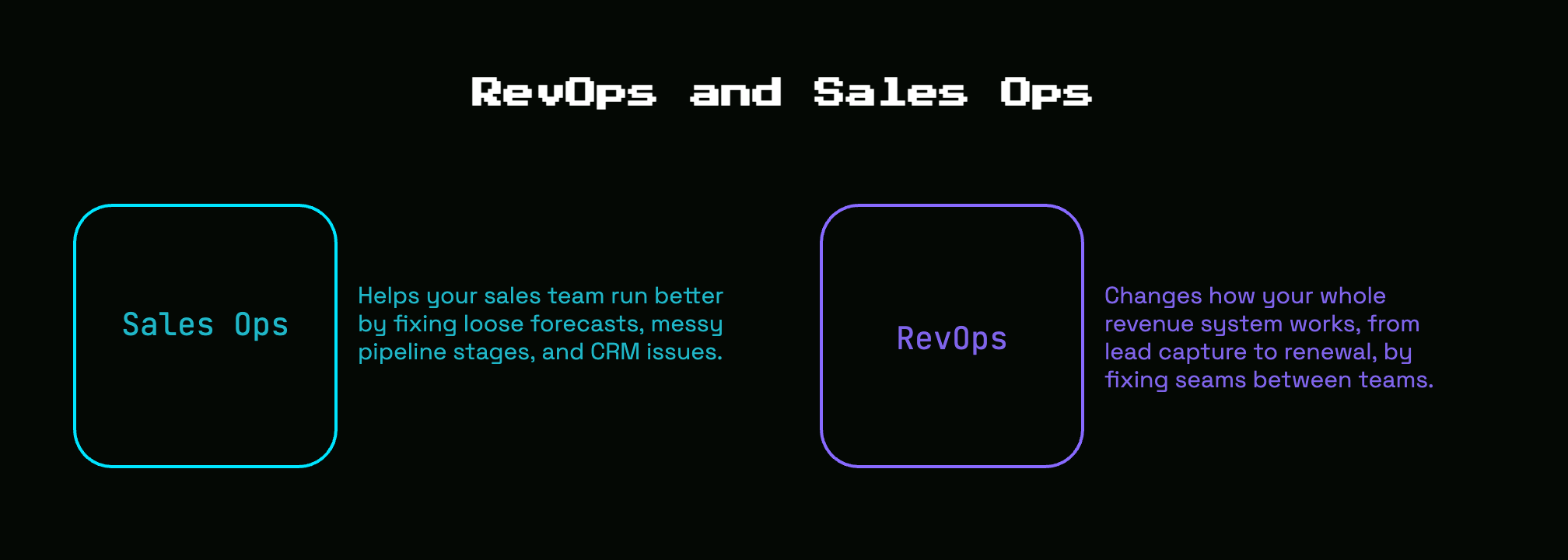
If you’ve been staring at job titles and wondering why RevOps vs sales ops sounds like the same thing with different branding, that confusion is normal. The real difference is much simpler, and much more practical: Sales Ops helps your sales team run better, while RevOps changes how your whole revenue system works, from lead capture to renewal.
Quick answer: RevOps and Sales Ops solve different problems
Here’s the short version.
Sales Ops is the right answer when your biggest pain lives inside the sales team. Forecasts are loose, pipeline stages are messy, reps work deals differently, and the CRM feels like a junk drawer full of half-labeled fields and old contacts. Sales Ops fixes that.
RevOps is the right answer when the pain sits between teams. Marketing says sales ignores leads. Sales says lead quality is bad. Customer success inherits accounts with missing context. Dashboards disagree depending on which tool you open. RevOps exists to fix those seams.
So what actually changes? Ownership changes. Reporting lines change. Metrics change. The kind of problems your ops person can solve changes too.
For most B2B SaaS companies around $1M to $5M ARR, Sales Ops is usually the better first move. RevOps becomes the better move once handoffs, shared data, and lifecycle ownership start breaking often enough that sales-only fixes stop working.
Quick overview of RevOps vs Sales Ops
Before getting into the deeper stuff, it helps to see the split in one glance.
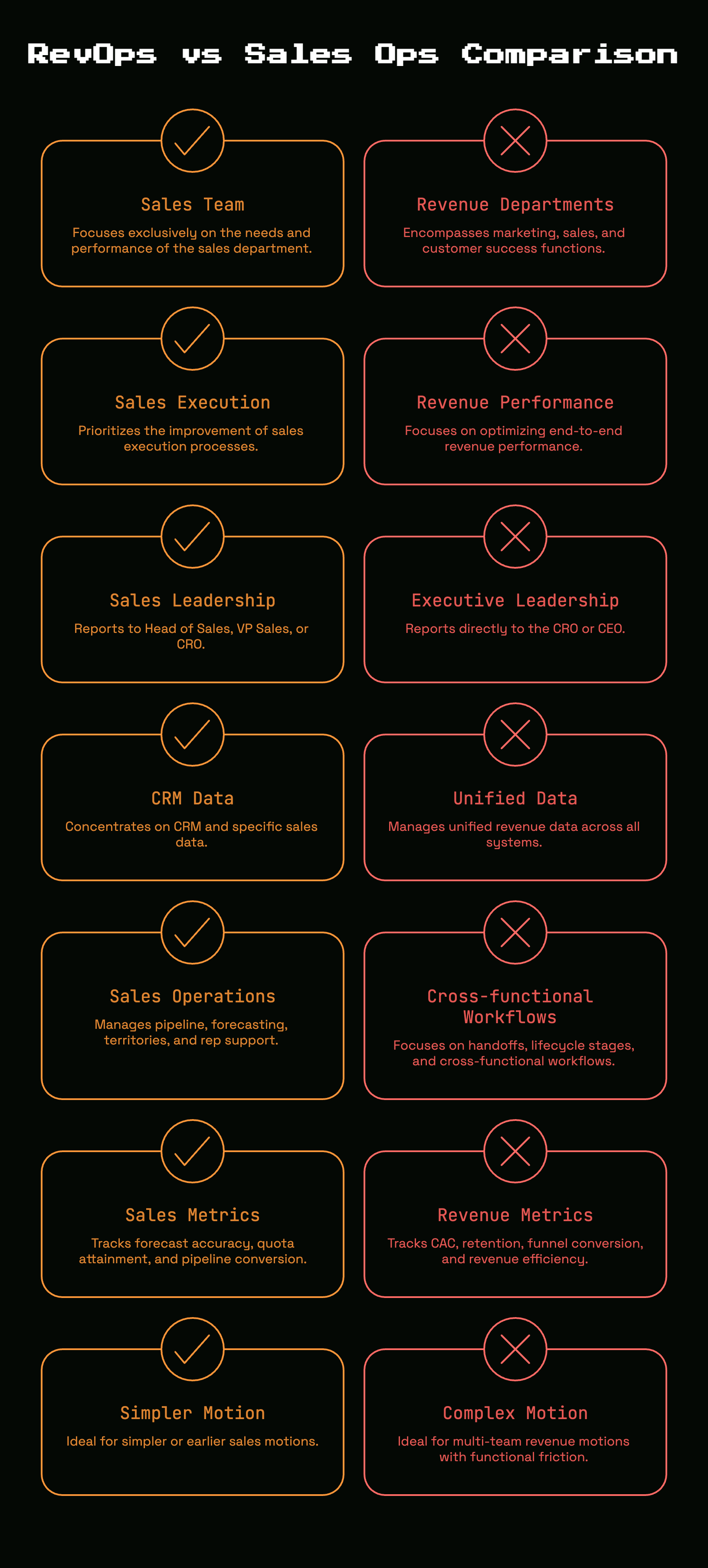
| Area | Sales Ops | RevOps |
|---|---|---|
| Primary scope | Sales team | Marketing, sales, and customer success |
| Main goal | Better sales execution | Better end-to-end revenue performance |
| Typical reporting line | Head of Sales, VP Sales, CRO | CRO or CEO |
| Core data focus | CRM and sales data | Unified revenue data across systems |
| Main process focus | Pipeline, forecasting, territories, rep support | Handoffs, lifecycle stages, cross-functional workflows |
| Success metrics | Forecast accuracy, quota attainment, pipeline conversion | CAC, retention, funnel conversion, revenue efficiency |
| Best fit | Simpler or earlier sales motion | Multi-team revenue motion with friction between functions |
That headline difference is backed up by how most teams define the roles. In plain terms, scope is the difference.
What Sales Ops is
Sales Ops is the function that helps your sales team execute with less chaos. That usually means keeping the CRM usable, tightening stage definitions, supporting forecasting, managing territories, helping with compensation administration, and building reports that show what is actually happening in pipeline.
In a small SaaS company, a first Sales Ops hire often spends Monday morning cleaning up duplicate opportunities, Tuesday fixing broken workflow rules, Wednesday helping with forecast calls, and Friday trying to answer why one rep converts demos at 28% while another sits at 11%. The work is practical, close to the field, and tied directly to how the sales team sells.
What RevOps is
RevOps is the function responsible for coordinating the whole revenue engine. That includes marketing, sales, and customer success, sometimes with billing and support pulled in too. Instead of focusing only on what helps reps close more deals, RevOps looks at the entire path from first touch to expansion and renewal.
That sounds like a bigger Sales Ops title, but it is actually a different operating model. RevOps is less about optimizing one department and more about designing one shared system.
The shortest way to think about the difference
Sales Ops optimizes one team.
RevOps connects the handoffs between teams.
If you remember just that, most of the confusion disappears.
Scope: what each function actually owns
Scope is the biggest real-world difference because scope decides what gets fixed and what gets ignored.
Sales Ops ownership
Sales Ops usually owns the sales process once a lead is inside the sales motion. That includes pipeline structure, deal stages, forecast support, territory design, compensation administration, opportunity hygiene, activity tracking, and CRM upkeep for the sales org.
This is deeper than admin work. Strong Sales Ops teams spend most of their time on planning and decision support, not just cleanup. Research from Salesmotion says the best teams spend 60 to 70% of time on strategic work like forecasting, territory design, and compensation modeling.
The line usually stops where another function starts. Marketing operations may own lead scoring and campaign attribution. Customer success may own renewals and onboarding workflows. Finance may own billing data. Sales Ops might touch those areas, but usually does not have final authority over them.
RevOps ownership
RevOps owns the flow across the full customer lifecycle. That means lifecycle stage design, lead routing, MQL-to-SQL definitions, handoffs into sales, handoffs into onboarding, renewal workflows, expansion triggers, shared system rules, and reporting that spans multiple teams.
A big part of the job is owning the seams. If a lead gets enriched in one tool, routed through another, worked in the CRM, and then handed to customer success after close, RevOps is responsible for that chain making sense from start to finish.
That broader ownership is why RevOps often ends up shaping your lean go-to-market systems, not just your CRM setup. The job is to make the stack behave like one revenue machine instead of a row of disconnected apps.
Reporting structure and decision power
This is where the “same work, different title” idea usually falls apart.
Where Sales Ops usually sits
Sales Ops usually reports to a Head of Sales, VP Sales, or CRO with a sales-first mandate. That setup is logical because most Sales Ops work serves sales execution directly.
When the function sits inside sales, priorities naturally lean toward rep productivity, forecast confidence, pipeline inspection, and deal movement. If the sales leader needs cleaner forecast calls by next quarter, Sales Ops gets pulled toward that work first.
Where RevOps usually sits
RevOps usually reports to a CRO or CEO because the role needs authority across functions. That reporting line matters more than the label itself.
If RevOps is supposed to settle arguments about lead quality, lifecycle stages, ownership at renewal, or which dashboard is real, the function needs the power to set shared rules. Without that authority, RevOps becomes a suggestion box with admin access.
Industry guidance reflects that structure. RevOps is typically placed with leaders who can govern end-to-end revenue, not just one department.
Why reporting lines change outcomes
Org charts shape behavior. A Sales Ops leader inside the sales org can fix stage definitions, rep workflows, and forecast discipline quickly. But if marketing is creating bad lifecycle data or customer success is using different account definitions, that same person may have no real way to force alignment.
That is the direct test: if your ops team cannot resolve cross-functional issues, you do not really have RevOps.
Budget follows this too. System ownership follows this. Even political oxygen follows this. A function that reports into sales will usually spend its energy serving sales, even if the title sounds broader.
Goals and success metrics
Metrics tell you what a function is designed to optimize. Titles can lie. Scorecards usually do not.
Sales Ops metrics
Sales Ops typically measures success with sales execution metrics: pipeline coverage, conversion rates by stage, sales cycle length, forecast accuracy, quota attainment, rep productivity, and time to ramp for new hires.
Those are useful metrics. In fact, dedicated Sales Ops teams often outperform teams without that support. Gartner-backed research points to 15 to 20% higher revenue growth when companies have a dedicated sales ops function.
But the lens is still sales-first. The question is usually, “How do you help reps close more and managers forecast better?”
RevOps metrics
RevOps uses a wider scorecard. Customer acquisition cost, lifetime value, net revenue retention, full-funnel conversion, revenue efficiency, expansion rate, and end-to-end forecast quality matter more here.
That means RevOps cares about what happens before a deal opens and after it closes. If marketing creates low-fit pipeline, RevOps cares. If onboarding delays hurt expansion six months later, RevOps cares. If gross new bookings look good but retention is sagging, RevOps cares.
What changes when you switch the scorecard
Once the target changes, team behavior changes with it.
A sales-only scorecard tends to reward local optimization. More pipeline. Faster deal movement. Cleaner commits. A revenue-wide scorecard forces a different question: is the whole machine producing efficient, durable revenue?
That shift matters more now because buying is less neatly contained inside sales than it used to be. A large share of B2B buying already happens through digital interactions, long before a rep gets involved. So if your ops lens starts at opportunity creation, you are missing a lot of the real system.
Process design: team efficiency vs end-to-end customer journey
This is where the difference gets tangible fast.
Sales Ops process focus
Sales Ops process work usually centers on the sales motion itself: stage definitions, exit criteria, activity expectations, territory assignments, handoff into AE workflows, pipeline rules, and forecast categories.
The goal is simple. Reduce friction inside sales so reps spend more time selling and less time guessing.
That can include workflow cleanup, better dashboards, smarter territory splits, or more disciplined opportunity management. If your founder is still running pipeline from memory and Slack, Sales Ops can make things feel sane again.
RevOps process focus
RevOps process work starts earlier and ends later. It includes lead routing, lifecycle stages, plain-English MQL-to-SQL definitions, service-level agreements between teams, handoff rules into onboarding, renewal triggers, expansion workflows, and churn-risk signals.
This is also where operational design starts to overlap with fixing the right automations first. RevOps is usually the function asking whether routing, enrichment, follow-up, and lifecycle changes happen at the right moment across tools, not just inside one queue.
The practical difference is that RevOps is not just trying to make the sales team faster. It is trying to make the customer path smoother from start to renewal.
What breaks when only sales is optimized
A lot, honestly.
You can make sales faster while making the rest of the system worse. Picture a Friday afternoon demo request from a high-fit account. Marketing captures it. Enrichment half-works. The lead gets assigned with no SLA, no owner clarity, and no alert that anyone trusts. It sits untouched until Monday. Sales complains lead quality is bad. Marketing complains follow-up is slow. Customer success later inherits an account that bought the wrong package because discovery notes never made it through.
Inside sales, pipeline may still look tidy. Outside sales, the system is leaking.
That is the core reason RevOps exists. Not to rename Sales Ops, but to stop these gaps from repeating.
Data ownership and system governance
If scope is the biggest conceptual difference, data ownership is usually the first place you feel it operationally.
Sales Ops and CRM-centered data
Sales Ops usually owns sales data quality inside the CRM. That means opportunity fields, stage rules, close dates, activity capture, dashboards, pipeline reports, and field discipline for the sales team.
There is real strength here. Sales Ops tends to go deep. If you need clean opportunity data, forecast logic, and rep behavior tied to actual CRM workflows, a focused sales ops function is often better than a broad one that stays too high level.
RevOps and unified revenue data
RevOps usually owns consistency across systems: CRM, marketing automation, billing, support, product signals, and customer success tools. The job is to create shared definitions for accounts, lifecycle stages, lead status, attribution rules, and revenue reporting.
In other words, RevOps aims for a common source of truth. Not just “the CRM is right for sales,” but “the revenue data model makes sense across the business.”
That often means putting more thought into making CRM workflows reliable, because the CRM becomes part of a larger operating system instead of a standalone sales database.
Why data quality matters more in RevOps
Bad data is annoying in Sales Ops. In RevOps, bad data breaks the model.
Duplicate accounts ruin routing. Mismatched lifecycle definitions make funnel reports useless. Sloppy product or billing syncs distort retention forecasts. Broken ownership rules cause handoffs to disappear into thin air.
And AI does not save you from that. It amplifies whatever foundation already exists. ZoomInfo’s maturity model is useful here: start with insight on clean data, then move into automation, then orchestration. Skip the cleanup and advanced workflows usually turn into expensive noise.
Tech stack ownership and automation
Tool ownership tells you a lot about how the function thinks.
Sales Ops tooling priorities
Sales Ops usually cares most about the tools reps and sales managers touch every day: CRM admin, sequencing tools, forecasting platforms, territory tools, compensation software, call intelligence, and sales dashboards.
The goal is smoother execution. Less rep friction. Better manager visibility. More predictable sales behavior.
That can get surprisingly complex. Research suggests sales ops teams now manage a large number of tools, often well beyond the CRM itself, because modern selling depends on a dense layer of sales software.
RevOps tooling priorities
RevOps looks at the stack from a systems angle. The question is less “Is this a good sales tool?” and more “Does this improve how data and actions move across marketing, sales, billing, and success?”
That means integrations matter a lot more. Sync reliability matters. Enrichment quality matters. Trigger logic matters. Routing matters. Shared definitions matter. The stack has to pass information cleanly between teams, not just support one team well.
A lot of modern RevOps guidance treats automation as the backbone of modern RevOps, which is a useful phrase because it captures the real shift: automation is not a side project, it is the connective tissue.
AI readiness: what changes and what does not
AI fits both models, but not in the same way.
In Sales Ops, AI often shows up in forecast support, rep guidance, pipeline inspection, and admin relief. Helpful stuff. Narrowly applied.
In RevOps, AI has a broader job. It can help unify data, trigger routing, surface churn risk, spot funnel leakage, and coordinate workflows across systems. ZoomInfo found that 55% of ops teams are already weekly AI power users, and the gains look real when the basics are already in place.
The catch is that AI does not replace process maturity. It rewards it. Clean data first, stable automation second, smarter orchestration third. Same old rule, just with shinier software.
Forecasting and planning
Forecasting is one of the clearest places where the two functions diverge.
Sales Ops forecasting
Sales Ops forecasting usually focuses on bookings. That includes pipeline inspection, stage-based forecasts, commit rollups, coverage analysis, capacity planning, and helping managers understand whether the quarter is actually real.
It is operational, near-term, and tightly linked to sales execution. If the VP of Sales wants better confidence for next month’s board update, Sales Ops is squarely in that lane.
RevOps forecasting
RevOps forecasting is wider. It connects pipeline creation, conversion, bookings, onboarding capacity, retention, churn, and expansion. The point is not just to estimate what closes this quarter, but to understand the full chain of revenue inputs and outputs.
That broader model matters because revenue problems often start upstream or show up downstream. Weak lead quality today can hit bookings next quarter. Poor onboarding can hit expansion later. RevOps tries to connect those dots before they turn into surprises.
What a broader forecast helps you decide
A wider forecast gives better decisions, especially when cash matters.
If you are bootstrapped, guessing wrong on hiring or spend hurts more. Broader forecasting helps you decide when to hire, which channels are actually producing durable revenue, where funnel leakage is hurting efficiency, and whether retention risk is about to erase hard-won new bookings.
Sales Ops helps you predict the sales number.
RevOps helps you predict the business around the sales number.
Day-to-day work: what changes week to week
This is the part most hiring plans skip. The title changes less than the calendar.
A typical Sales Ops week
A typical Sales Ops week is full of sales-adjacent work. Cleaning pipeline. Updating dashboards. Tightening forecast categories. Checking rep commits. Fixing broken CRM workflows. Adjusting territories. Reviewing conversion by stage. Helping reps follow process.
The work is often fast-moving and highly visible. A manager asks why a report is off, and it gets fixed that day. A rep cannot move a deal because of a validation rule, and that gets solved before lunch.
A typical RevOps week
A typical RevOps week is more cross-functional and less tidy. Resolving lead routing failures. Aligning lifecycle definitions between marketing and sales. Reconciling account data between CRM and billing. Reviewing funnel leakage from form fill to meeting booked. Cleaning up handoffs into onboarding. Coordinating a process change that touches marketing, sales, and success all at once.
The calendar fills with meetings across functions because the problems live across functions too.
A concrete example helps. At 4:37 p.m. on a Thursday, someone notices that trial signups from a paid campaign are entering the CRM without company size data, so high-fit accounts are not getting routed fast enough. In a Sales Ops model, that may sit partly outside the role. In a RevOps model, it is directly in scope because it affects qualification, routing, speed-to-lead, and downstream conversion.
The hidden change: fewer local fixes, more system fixes
This is the real shift.
Sales Ops often fixes what sales feels.
RevOps fixes what the revenue system creates.
That means fewer one-off patches for one team, and more effort spent redesigning the underlying process so the same problem stops showing up in three places.
Hiring and org design
A lot of this comes down to what kind of pain you actually have right now, not what job title looks impressive on LinkedIn.
When a first Sales Ops hire makes sense
A first Sales Ops hire makes sense when sales pain is immediate and obvious. Your first rep is in place. Forecast calls are messy. Pipeline reviews are inconsistent. Stages mean different things to different people. The CRM is turning into a junk drawer.
In that situation, Sales Ops usually pays back faster because the problem is concentrated and visible. A focused hire can improve forecast accuracy, rep consistency, and manager visibility quickly.
When a first RevOps hire makes sense
A first RevOps hire makes sense when multiple teams already affect revenue in meaningful ways and no one owns the full path between them. Marketing is generating pipeline. Sales is converting it. Customer success influences retention and expansion. Data sits in multiple systems. Handoffs keep breaking.
Readiness matters more than ARR. There is no magic threshold. Even research that points to higher RevOps adoption among fast-growing companies also says organizational readiness matters more than a simple revenue number.
The hybrid model many teams actually use
A lot of companies land in the middle, and that is usually sensible.
Sales Ops stays specialized, but reports into a broader RevOps leader alongside marketing ops and customer success ops. That gives you deep sales support without losing cross-functional alignment.
For many scaling SaaS teams, this is the most realistic long-term shape. Not either-or, but layered ownership with one person responsible for the system.
Pricing and team cost
These are functions, not products, so “pricing” really means headcount, complexity, and how much coordination your business can absorb.
Sales Ops cost profile
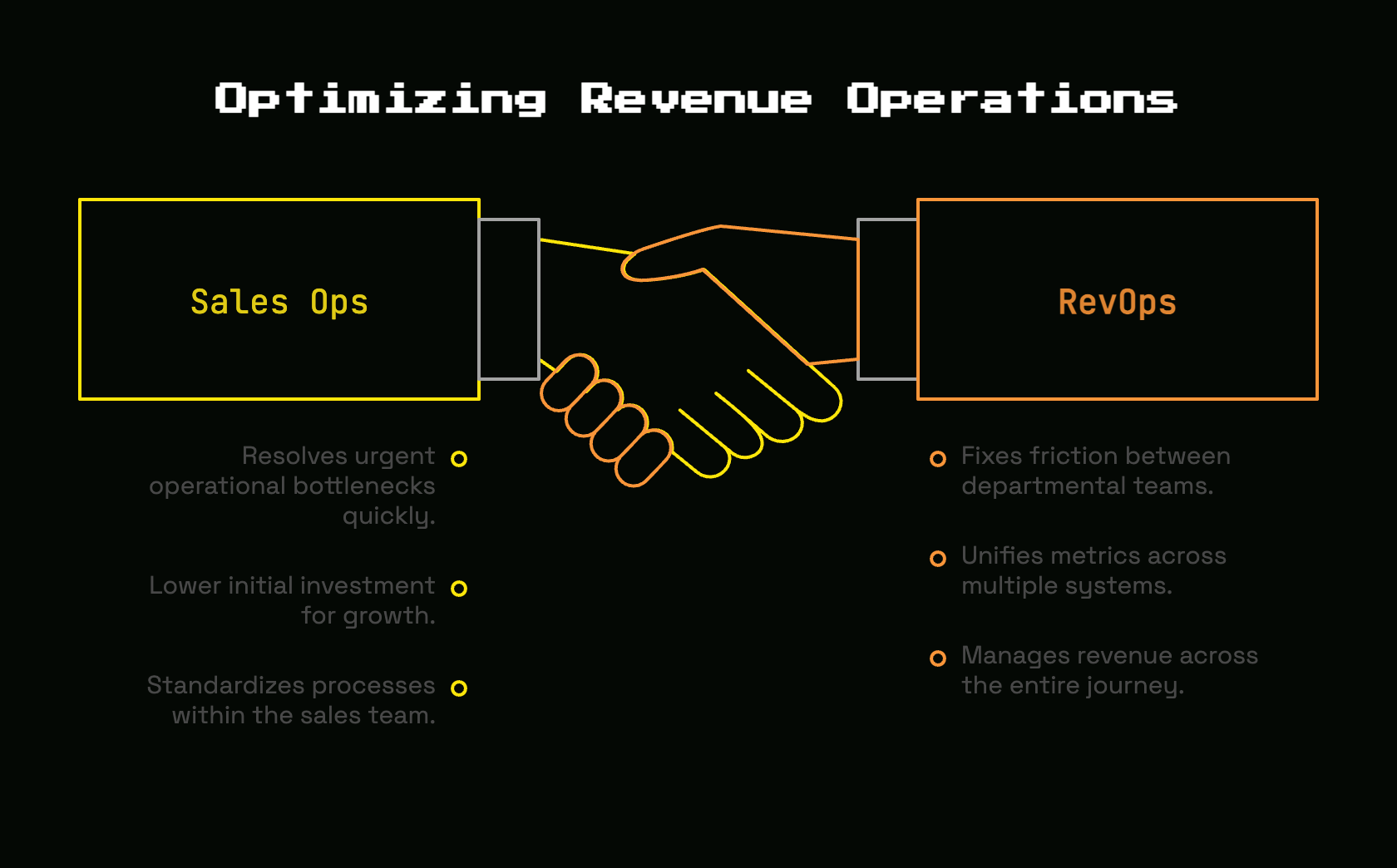
Sales Ops is usually cheaper and simpler to start. One person can often handle forecasting support, CRM structure, reporting, compensation admin, and sales process design for a small team.
That is why it is often the practical first hire. You get a lot of immediate value without needing to redesign how three departments work together.
RevOps cost profile
RevOps usually costs more, not just in salary but in organizational load. The role needs broader skills, more system discipline, stronger executive support, and better cross-functional buy-in.
The payoff is not just sales efficiency. It is less duplication, fewer broken handoffs, cleaner forecasting, and better coordination across the revenue motion.
The real pricing question: cost of headcount vs cost of misalignment
The more useful question is not “Can you afford RevOps?” It is “What is misalignment already costing you?”
If leads sit untouched for two days, if dashboards conflict in board meetings, if customer success finds bad-fit deals after close, if marketing and sales are optimizing against different definitions, you are already paying for the gap. Just not on a salary line.
Common misconceptions
A lot of expensive hiring mistakes start here.
“RevOps is just Sales Ops with a fancier title”
It is not.
RevOps has broader scope, broader accountability, and more authority across functions. Sales Ops can evolve into RevOps, and some of the skills overlap, but the operating model is different. One optimizes sales. The other governs the revenue system.
Calling a sales-only role “RevOps” without giving it cross-functional ownership usually creates more confusion, not less.
“Sales Ops is only admin work”
Also wrong.
Weak Sales Ops gets trapped in cleanup and ticket-taking. Good Sales Ops shapes forecasting, territory design, compensation, process discipline, and strategic planning. Research consistently shows the strongest functions spend most of their time on strategic work, not on being human middleware for the CRM.
If your view of Sales Ops stops at dashboards and field updates, you are underselling the role badly.
“Every growing SaaS company needs RevOps now”
Not really.
RevOps is useful when your revenue motion is complex enough to need shared governance. Force it too early and you can end up with vague ownership, overbuilt processes, and someone trying to run a multi-team operating model before the teams themselves are stable.
Trend-chasing is how small companies build big-company overhead before earning it.
When to choose Sales Ops
This is the easier decision for a lot of smaller SaaS teams.
Choose Sales Ops if your biggest pain is inside the sales team
If forecasting is messy, pipeline stages are fuzzy, reps follow different motions, CRM discipline is weak, or you are still running sales from memory and Slack, choose Sales Ops.
A focused fix is often the right fix. You do not need a whole-house renovation when the main leak is in one room.
Choose Sales Ops if your funnel is still simple
If marketing is still light, customer success is founder-led, and the sales motion is not yet split across multiple teams, RevOps is probably more structure than you need.
In that setup, sales execution matters more than cross-functional orchestration because there is not much to orchestrate yet.
When to choose RevOps
This choice gets clearer once the friction starts crossing team boundaries.
Choose RevOps if handoffs are your biggest bottleneck
If lead quality fights never end, attribution is fuzzy, renewal ownership is unclear, dashboards disagree, or no one can explain where good opportunities go to die, choose RevOps.
Those are not sales problems in disguise. Those are cross-functional operating problems, and Sales Ops alone usually cannot solve them completely.
Choose RevOps if your revenue motion is already multi-team
Once marketing, sales, and customer success each have measurable impact on revenue, someone needs to own the system between them.
That is where RevOps starts earning its keep. Not because the title is modern, but because the business now has shared revenue mechanics that need one owner.
Verdict: which one wins?
Sales Ops wins when your goal is focused sales execution. RevOps wins when your real problem is revenue friction between teams.
For most SaaS companies around $1M to $5M ARR that are hiring carefully, Sales Ops is usually the first move. It solves immediate pain faster, costs less to start, and brings discipline to the part of the business that is usually loudest first.
RevOps becomes the right move once handoffs start breaking, data spreads across multiple systems, customer success meaningfully affects revenue, and no one owns the full lifecycle.
Here’s the thing to try: write down your last five revenue problems. If most of them happened inside sales, hire for Sales Ops. If most of them happened between teams, you are ready for RevOps.


Discussion