

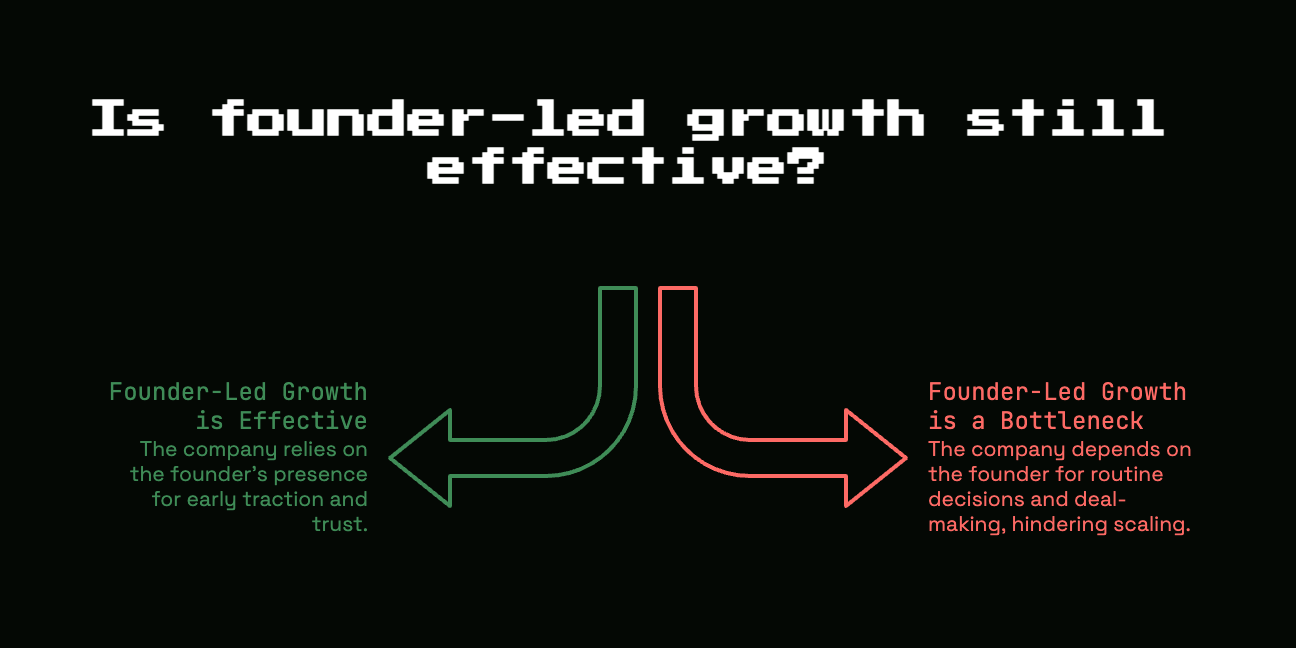
Founder-led growth is growth powered directly by you: your voice, your judgment, your relationships, and your ability to get a prospect from “interesting” to “let’s do this” faster than anyone else on your team. It works beautifully for a while. Then one day you notice you cannot step away for a long coffee, let alone a week, without something important stalling, and that is when founder-led growth stops feeling like an advantage and starts feeling like a trap.
What Founder-Led Growth Actually Means
Founder-led growth means your company’s momentum depends heavily on your direct involvement across sales, marketing, product direction, or all three at once. You are not just setting strategy. You are in the demos, in the DMs, in the comment section, in the pricing call, and in the product discussion right after a customer asks for something awkward but revealing.
In plain English, the business grows because you keep pushing it forward personally.
That is not automatically bad. Early on, it is often exactly right. In B2B SaaS, especially between zero and early traction, buyers are not buying a polished machine. They are buying belief. They want to know whether you actually understand the pain, whether you will still care after signing, and whether the product will keep moving in the right direction. A founder can answer all of that in a way a homepage or junior rep simply cannot.
This is part of why founder-led companies tend to perform so well. Bain found that founder-led companies have outperformed non-founder-led peers by a wide margin over time. The point is not that founders are magical. The point is that speed, clarity, and customer obsession are powerful when the market is still messy.
Why Founder-Led Growth Works So Well at First
At the beginning, founder-led growth feels almost unfair. You move faster than bigger competitors because nobody needs to schedule three meetings to make a decision. You can hear a prospect object to your pitch at 9:15 a.m., rewrite the message by noon, and test the new version on another call the same afternoon.
That speed matters more than most teams realize.
Early growth usually comes from conviction before optimization. You know why the product exists. You know what bad alternatives buyers are stuck with. You know where the category language is broken, because you have had the same painful conversation twenty times. So your company gets traction not because every function is mature, but because your understanding is unusually sharp and close to the customer.
There is also less loss in translation. A sales rep may learn the pitch. A marketer may learn the positioning. But at the start, you are the original source. Nothing gets watered down because nothing has been handed off yet.
Trust travels faster when it comes from a person
People trust people before they trust companies. That is especially true in B2B SaaS, where the product may still be evolving and the buying decision carries career risk for the buyer. A polished company page can explain features. Your voice can explain intent.
That difference is bigger than it sounds.
When you write a thoughtful post, run a live demo, reply to a sharp comment, or tell the story behind a product decision, prospects get something a brand asset rarely gives them: a sense that there is a real brain behind the product. Founder-led marketing and founder-led sales both work because trust moves faster when it is attached to a person with actual stakes in the outcome.
Research on founder content points in the same direction. Buyers often respond more strongly to founder visibility because it feels more credible and less rehearsed than brand-only messaging. In practice, that means your posts, interviews, and customer conversations can warm up deals before a rep ever books the meeting.
Your feedback loop is ridiculously short
A short feedback loop is one of the biggest hidden advantages in founder-led growth. You talk to prospects directly. You hear confusion in real time. You notice which use case gets an immediate nod and which one lands with a polite pause. Then you adjust.
That kind of learning is hard to fake.
If a founder is on calls, writing content, reviewing lost deals, and watching product usage, the business gets compressed learning cycles. Positioning improves faster. Objection handling gets sharper. Product priorities get cleaner. You are not guessing what the market wants from secondhand notes in a CRM field that says “timing not right.”
And honestly, that is why founder-led growth can punch above its weight in the $1M to $5M ARR range. You are still close enough to the ground to notice patterns before they show up in a dashboard.
The Catch: Founder-Led Growth Is Great Until Your Company Starts Orbiting One Person
Here’s the thing: the same qualities that create early traction can quietly create long-term drag.
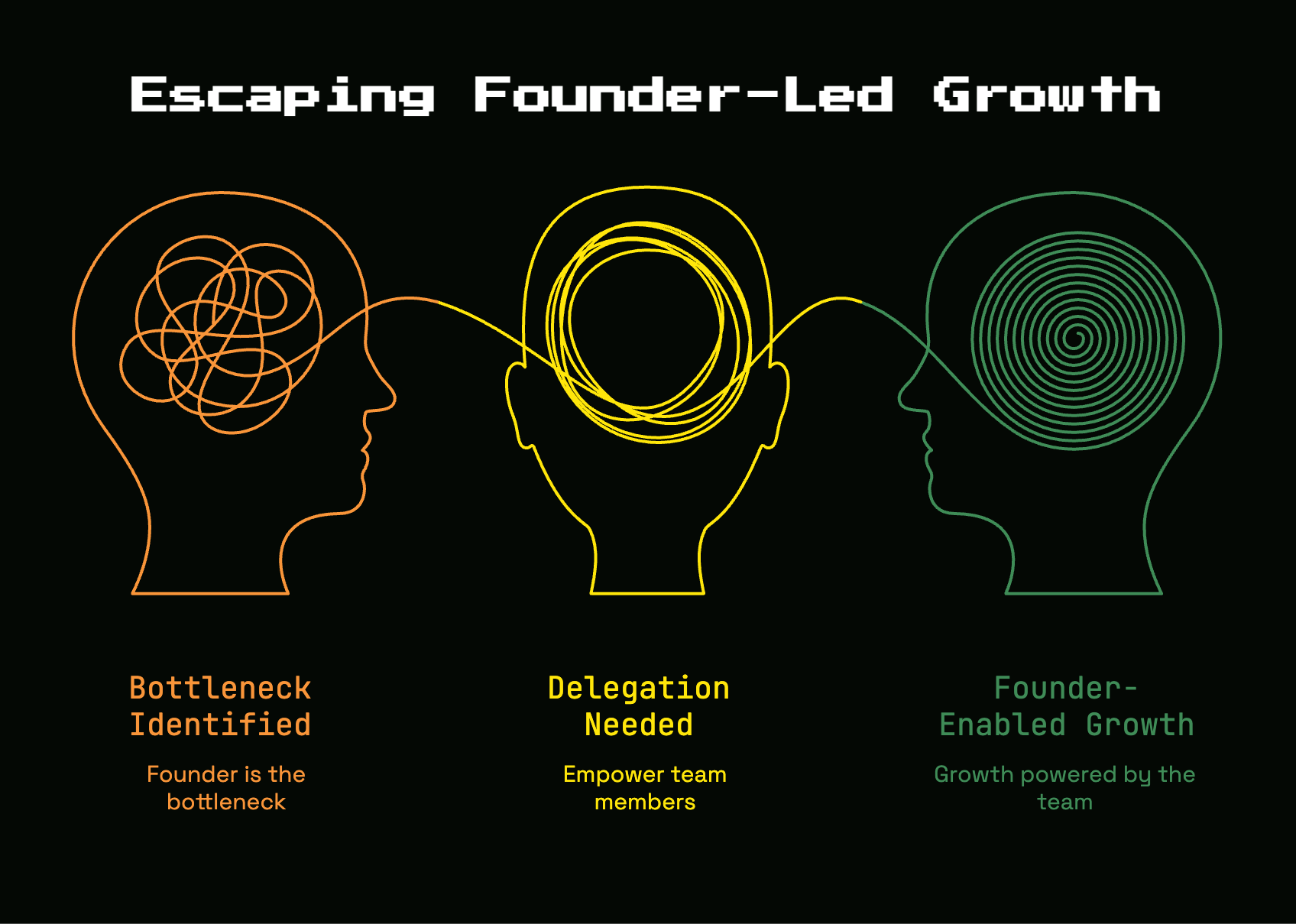
Founder-led growth stops working when your company starts depending on your constant presence to function. At that point, your involvement is no longer additive. It is load-bearing. If growth depends on you showing up over and over to rescue deals, rewrite messaging, and settle routine decisions, you do not have a growth engine yet. You have a very hardworking founder.
That distinction matters because effort can hide fragility for a long time.
A bootstrapped company can power through this stage by sheer force. A scaling team can even mistake it for discipline. But if every major outcome still routes through you, your company is not scaling. It is stretching.
The First Sign It’s Breaking: You’re the Bottleneck
The first clear sign is simple: too many things stop when you stop.
Not every decision, of course. But every meaningful one. The tricky deal. The pricing exception. The message for the new campaign. The roadmap call after an enterprise prospect asks for a missing integration. Everybody waits because your judgment has become the operating system.
This is common in the $1M to $5M ARR band because you are past the earliest chaos but not yet fully systemized. You probably have a few hires, maybe a first rep, maybe someone handling demand gen, maybe a product lead who still wants your final call. From the outside, it looks like a company. Inside, it still feels like your nervous system with extra tabs open.
Sales stalls when every deal needs your rescue
This is the most obvious version. Your rep runs discovery, maybe even the demo, but when the buyer gets serious, you get pulled in. Suddenly you are the closer, the pricing authority, the objection handler, and the credibility layer all at once.
A rep in that setup is not really owning revenue. A rep is teeing up founder-led sales.
That creates a few problems fast. Forecasting becomes fuzzy because deal quality is still judged by your gut. Pricing becomes inconsistent because exceptions happen in live calls. Coaching becomes hard because your team cannot separate “what worked” from “what the founder personally salvaged.” If this sounds familiar, it is worth tightening the mechanics of how lean teams build repeatable revenue motions, because instinct alone does not transfer.
Marketing sounds strong only when you write or say it
Founder-led content can be a huge advantage. But if your pipeline noticeably softens the second you stop posting, speaking, or commenting, the system is too dependent on your output.
The problem is not that your content works. The problem is that nobody has figured out how to turn your perspective into a repeatable publishing motion. So your team waits for your draft, your approval, your rewrite, or your spontaneous insight from a customer call.
You end up in a strange situation where your company has “marketing,” but the message only really works when it comes directly from you. That is a trust win early on. It becomes a scaling problem later.
Product decisions pile up in your inbox
Founder centralization rarely stays in sales and marketing. It bleeds into product. Customer requests pile up. Priorities get debated in Slack. Your team wants your take on every roadmap tradeoff because you hold the richest context.
That sounds efficient until it starts slowing everything down.
When product choices sit in your inbox, execution gets muddy. Teams hesitate. Small decisions become emotional because nobody knows which principle matters most. Customer-facing teams make promises based on guessed priorities. Product teams wait for clarity that arrives late. Then everyone feels behind, even when the real issue is not effort but centralization.
The Three Ceilings Founder-Led Growth Eventually Hits
Founder-led growth does not usually fail all at once. It hits ceilings, one after another.
At first, growth keeps happening, just a little more painfully. Then one ceiling becomes obvious, you push through it, and another appears. That progression matters because it explains why this problem can stay hidden even while revenue is still rising.
The reach ceiling
Your network is finite. Your calendar is finite. Your content output is finite.
One person can only create so many trust-building touchpoints in a week. You can post more, take more calls, join more podcasts, comment more aggressively, and still run into the same reality: pipeline demand eventually needs more surface area than one human can provide.
This is where founder-led visibility should evolve into something broader. Your voice still matters, but it needs support from content systems, distribution, and team execution. Otherwise growth tops out at the edge of your personal bandwidth.
The dependency ceiling
This ceiling is less visible but more dangerous. Revenue motions depend on your judgment, so the whole company becomes operationally fragile.
Hiring gets weird because new people cannot own outcomes without your approval. Execution gets slow because exceptions keep piling up. Customer experience gets inconsistent because different deals receive different answers depending on how involved you were that week.
The catch is that the company can still look busy. But busy is not the same as scalable. If you want a practical frame for fixing this, it helps to think in terms of the machinery behind repeatable go-to-market execution, not just people working harder.
The brand ceiling
Eventually, the company can struggle to become bigger than you.
Prospects may trust you deeply and still feel uncertain about the business itself. Do they trust the team? Do they believe the product can deliver without your personal oversight? Is the category position clear enough to stand on its own? If the answer is not yet, your brand ceiling is starting to show.
This is where a lot of founder-led companies get stuck. The founder becomes famous enough to create interest, but the company is not yet legible enough to scale confidence beyond that personality.
How to Tell the Difference Between Healthy Founder Involvement and Unhealthy Founder Dependence
Founder-led is not the problem. Founder-only is the problem.
You do not need to disappear. You need to know whether your presence accelerates outcomes or whether it is required for them. That is the real test.
Healthy founder-led growth
Healthy founder-led growth looks like a company where your involvement sharpens the business without trapping it. Your team can run solid demos without you. Content ships that still sounds clear and useful, even when you did not rewrite every line. Customers get competent answers from sales, onboarding, and support without waiting for the founder signal.
Your role in that version is high leverage. You shape positioning, join key deals, stay close to customers, and make the hard tradeoffs. But routine execution keeps moving without drama. The business benefits from your judgment without pausing in your absence.
Unhealthy founder dependence
Unhealthy founder dependence looks more familiar than most founders want to admit. Deals slip when you travel. Launches wait because nobody wants to publish without your blessing. Pricing approvals back up. Reps mirror your phrases without understanding your logic. Team members keep asking for judgment because no shared framework exists underneath the motion.
The moment usually looks small. You are at an airport gate at 10:40 p.m., checking Slack because a prospect wants a discount and nobody feels safe answering without you. That is not founder magic. That is unprocessed company knowledge stuck inside one person.
The Operational Signs You’ve Outgrown a Pure Founder-Led Model
Once this shows up in operations, the business starts paying for it in slower growth, messier handoffs, and lower confidence.
This is where the issue stops being personal style and starts becoming company design.
Your first sales hire still acts like an assistant, not an owner
A very common trap: you hire a rep, but the rep mostly books meetings, sends follow-ups, updates the CRM, and keeps deals warm until you show up for the real selling.
That is not delegation. It is founder dependency with admin support.
A true ownership handoff means the rep can qualify, run the process, handle normal objections, and close a meaningful share of deals without founder rescue. If that is not happening, the gap is usually not talent. It is missing structure: no clear qualification logic, no pricing guardrails, no objection library, no real sales process the rep can trust.
Hand-offs are messy and customer experience changes by who gets involved
When a company grows on founder instinct alone, hand-offs tend to be messy because so much context lives in conversation instead of systems. Marketing promises one thing, sales frames it another way, onboarding learns the real use case after the contract is signed, and product hears a slightly different version again.
Customers feel that inconsistency immediately.
A messy handoff is not just annoying. It destroys learning. If every function is hearing a different story, you cannot build a clean feedback loop. You just get scattered anecdotes and recurring confusion.
The team asks for judgment because there is no shared playbook
Constant interruptions often look like a people problem. Most of the time, they are a systems problem.
If common decisions are undocumented, your team has no choice but to come back to you. What counts as qualified? When is a discount acceptable? Which competitor framing should a rep use? What promise should never be made on a call? If none of that exists in a shared playbook, your team will keep asking. Not because of weakness. Because the company has not translated instinct into a usable system.
Burnout Is Not Just a Personal Problem. It Becomes a Growth Problem
Founder burnout gets talked about like a wellness issue. It is also a revenue issue.
When you are overloaded, judgment gets noisier. Follow-through gets slower. Patience drops. Small interruptions feel bigger. Strategic work keeps losing to urgent work, which is already a problem for many CEOs. PwC found leaders spend a huge share of time on near-term issues, and founder-led companies feel that pull even more sharply.
Research on founders is even starker. Wilbur Labs found that 90% of founders experienced stress or burnout severe enough to consider quitting. That is not just a human warning sign. It is an operating constraint.
Why founder stamina gets mistaken for strategy
A lot of companies normalize heroics. Late-night approvals. Endless calls. Constant availability. Fast replies at all hours. It can look like commitment, and sometimes it is. But it can also hide the absence of a scalable model.
If everything works because you can keep carrying it, the business starts confusing your stamina with strategy. That is dangerous because stamina is not durable. It fades, it gets uneven, and it gets expensive in ways a dashboard may not show immediately.
What breaks inside the team when your energy becomes the operating model
Teams pick up emotional signals fast. If everything depends on your speed, your mood, or your presence, decision-making gets shaky. People become more cautious. Ownership shrinks. Strong team members either defer too much or start working around the chaos in inconsistent ways.
The result is a company that feels noisy even when everybody is trying hard.
And once the founder becomes the emotional and operational pacing mechanism, people stop building independent judgment. They wait. That waiting slows growth more than most founders realize.
Why This Problem Gets Worse as GTM and AI Complexity Rises
Ten years ago, a founder could brute-force a surprising amount of growth with strong instincts, direct selling, and a lightweight stack. The job is harder now.
Modern go-to-market work involves more channels, more tools, more data, more cross-functional coordination, and far more pressure to integrate AI into everyday operations. IBM found that 69% of CEOs say AI is already changing core parts of the business. That means founder-led growth can no longer rely on founder intuition alone. It needs workflow design, decision rights, and better operating foundations.
AI does not fix founder dependence
A lot of teams buy AI tools hoping the tools will remove bottlenecks. Usually they just create new ones.
If your messaging is unclear, your data is scattered, and your team does not know who owns what, AI will not solve the underlying problem. It will just automate confusion faster. That is why so many companies see weak returns from AI. PwC found that only 12% of companies got both lower costs and higher revenue from AI, while a large share saw no meaningful upside at all.
The lesson is simple: tools do not replace operating design. They expose it.
More channels and more tooling create more decisions, not fewer
Every added motion creates new choices. Which content gets repurposed into ads? What counts as a sales-qualified lead? Which signals matter in product-led onboarding? Where should AI assist and where should humans decide? Without clear ownership, more tooling means more interruption.
That is why this gets worse as you scale. Intuition is still valuable, but it cannot be the only system. Once the stack expands, your company needs definitions, rules, and workflows that other people can run confidently.
What Still Belongs With the Founder
None of this means the founder should vanish into “management.”
That is the wrong lesson, and honestly, it is the lazy one. Some parts of growth should stay founder-led because they compound trust and clarity in ways that are hard to replace.
Vision, category point of view, and hard tradeoffs
Your job is still to set direction. You should keep shaping the category story, sharpening the point of view, and making the few decisions that require deep historical context plus real appetite for risk.
Those decisions are hard to delegate because they are not routine. They define what kind of company you are building, what customer you serve best, and what you are willing to say no to.
Key customer conversations
You should stay close to customers, just more intentionally. That means talking to the right customers at the right moments: strategic prospects, high-signal churn risks, power users, expansion accounts, and confused buyers who reveal a positioning gap.
The goal is signal gathering, not call hoarding. You want to hear the market directly without becoming the default participant in every conversation.
Selective public presence
Founder visibility still matters. It can keep warming the market, create trust before the first meeting, and give your company a human edge that competitors lack.
But the better version is selective and supported. Your public presence becomes a trust layer on top of a broader system, not the whole system itself. You are still visible, just not solely responsible for keeping the pipeline breathing.
The Shift That Works: From Founder-Led to Founder-Enabled Growth
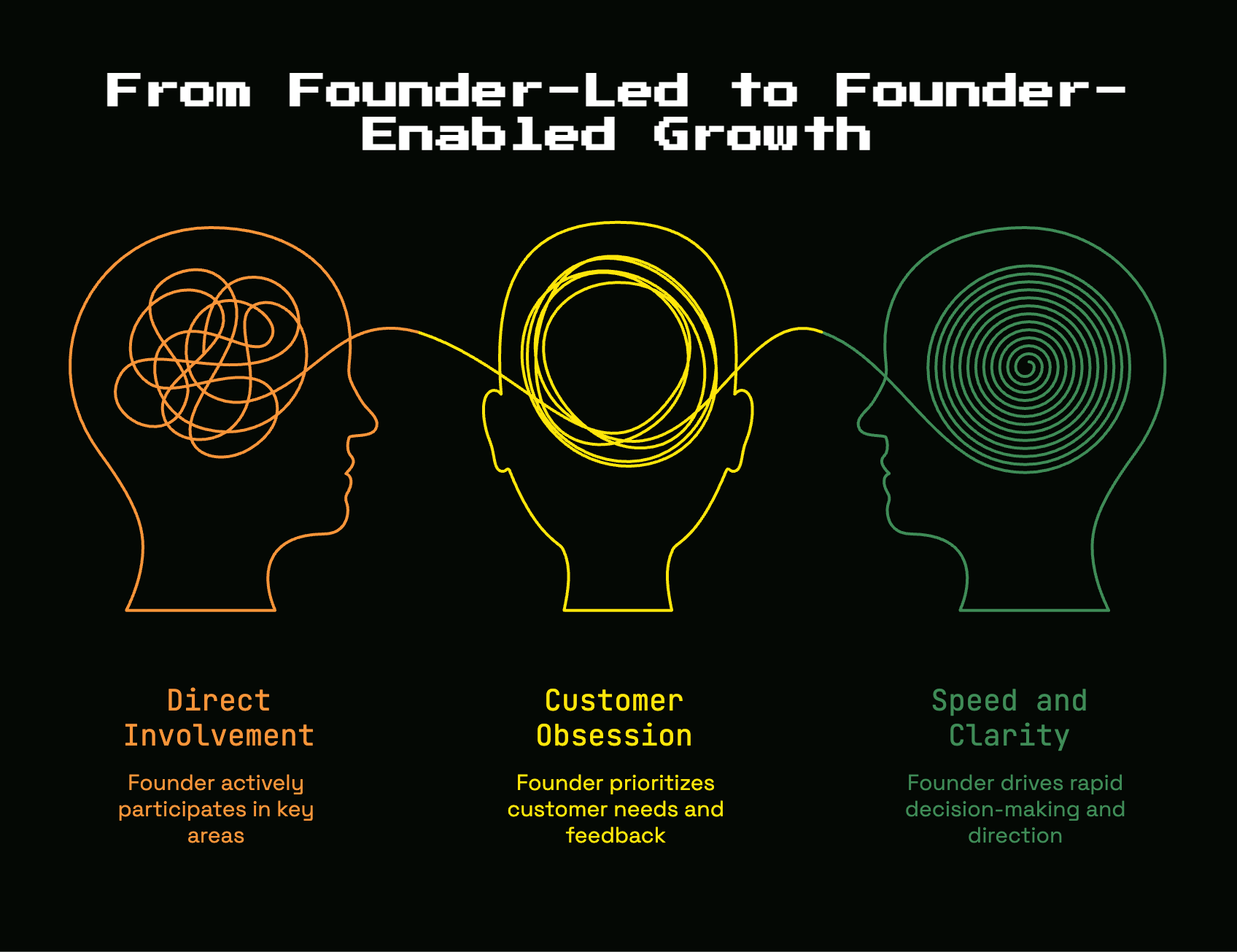
This is the shift that actually matters: moving from “you do the motion” to “you design, coach, and reinforce the motion.”
Founder-enabled growth keeps the strengths of founder-led growth but removes the fragility. Your instincts still matter. Your voice still matters. Your customer understanding still matters. But instead of delivering everything personally, you turn those strengths into assets your team can use.
That is how the business stops orbiting one person.
Turn your instincts into repeatable assets
A lot of founder knowledge feels too intuitive to document. Do it anyway.
Document your pitch. Write down your qualification logic. Record how you handle the top five objections. Define pricing principles so every exception does not become an emergency. Save exact customer phrases that consistently trigger interest. Turn great calls into training assets. Build a message library from real conversations, not brand fluff.
A playbook is not bureaucracy when it captures hard-won judgment. It is memory that scales.
Build a founder-plus system
The strongest model is not founder versus brand. It is founder plus system.
Your perspective fuels the story. Brand content expands the reach. Reps carry the conversation. Product marketing sharpens the message. RevOps creates visibility and consistency. Paid distribution extends what is already resonating. Customer research keeps the message honest.
In that setup, founder energy becomes the spark, not the whole fire. Fractional growth leadership is often how that system gets built without hiring a full team to do it.
Give ownership before you feel fully ready
This part is uncomfortable because handoff always feels a little early. If you wait until everything is perfectly documented and every scenario is covered, you will stay trapped much longer than necessary.
Ownership grows through guided reps, not perfect preparation. Give someone real responsibility with clear guardrails. Review outcomes closely. Tighten the system. Repeat. The trick is not to disappear overnight. It is to stop being the only path to a good outcome.
How to Make the Transition Without Killing What Made Growth Work
The best transitions are lighter than founders expect. You do not need an enterprise process map and six committees. You need visibility into dependency, one bottleneck chosen on purpose, and a few simple systems that reduce repeated founder intervention.
That is enough to start changing the shape of the company.
Audit where revenue still depends on your direct involvement
Map your customer journey from first touch to expansion. Then mark every point where progress slows or stops without you. Look at lead generation, demo flow, pricing approvals, proposal creation, onboarding, renewal conversations, roadmap escalations, and major content production.
This exercise is useful because dependency often hides in plain sight. You may think you are “just helping” on a few deals when, in reality, your involvement is still required at four separate moments in the revenue path.
Choose one bottleneck to fix first
Do not try to solve everything at once. Pick the single dependency causing the most drag.
Maybe every serious deal needs a founder demo. Maybe nothing gets published unless you rewrite it. Maybe pricing approvals are clogging Slack. Maybe onboarding still depends on your personal product walkthrough. Pick one. Fixing one bottleneck well teaches the company how to fix the next one.
Replace heroics with simple systems
Most early-stage teams do not need heavy process. But they do need a few reliable tools and habits. Call recordings. Shared templates. Objection notes. Approval rules. Clear CRM stage definitions. Weekly review loops. Message libraries built from customer language.
Simple beats impressive here.
The point is not to make the company feel bigger. The point is to make good decisions easier without summoning you every time.
Keep the founder voice, but distribute the work
You do not need to stop showing up publicly to reduce founder dependence. You need to stop producing every asset from scratch.
Use recorded calls, internal interviews, rough voice notes, customer Q&A, and meeting transcripts as source material. Let someone else turn those inputs into drafts, clips, posts, and sales enablement assets. AI can help with transcription, extraction, and repurposing, but your judgment still has to supply the actual point of view.
Authenticity is not about typing every word yourself. It is about the thinking being genuinely yours.
Common Misreads About Founder-Led Growth
A lot of confusion comes from taking an early success pattern and treating it like a permanent law.
That is how companies get stuck longer than they need to.
“If founder-led growth worked once, more of it will keep working”
The tactic that gets you from zero to one is often not the tactic that gets you from one to ten.
Early on, more founder involvement can create clarity. Later, more founder involvement can create congestion. The same behavior changes meaning as the company grows. What once created speed can later reduce it.
“Hiring one rep solves the problem”
A first sales hire does not fix founder dependence by default. If the message is unclear, the process is undocumented, and all meaningful judgment still lives in your head, the rep cannot own much.
Without structure, a new hire just inherits ambiguity and routes it back to you.
“Systems kill authenticity”
This one sounds true until you look closely. Good systems do not erase authenticity. Good systems protect it.
If your best thinking only appears when you are live on a call, it disappears too easily. A useful playbook spreads the parts of your voice that actually help customers: the framing, the clarity, the honest objection handling, the real examples. That is not corporate fluff. That is preserved signal.
What Founder-Led Growth Looks Like When It’s Working Again
The healthiest version of founder-led growth is not less founder energy. It is better leverage.
You still matter. Your presence still lifts trust, sharpens strategy, and helps the company stay close to reality. But the business no longer gasps for air every time you step away. That is the difference.
The team can sell the story without impersonating you
Strong teams do not need to mimic your tone word for word. They need to understand the logic underneath it. When that happens, sales conversations stay consistent, marketing stays sharp, and customer-facing people sound confident without sounding scripted.
That is what maturity looks like. Clear positioning, repeatable messaging, and room for people to sound like themselves.
Customers trust the company, not just the founder
This is the real transfer you are trying to make. Trust moves from your personality into the product, the team, the proof points, and the customer experience.
Once that happens, founder visibility becomes a multiplier instead of a crutch. Prospects may discover you through the founder, but they buy with confidence in the company.
One thing to try this week
Write down the last five revenue-critical moments that required your direct involvement. Not vague categories, actual moments. The pricing approval. The late-stage rescue call. The onboarding save. The content rewrite. The roadmap clarification after a prospect pushed back.
Then pick one and document how you handled it, well enough that someone else could run the next version without you. Start there. That one move is often the first real step from founder-led growth to something that can actually scale.


Discussion