

Founder-led sales means you, the founder, personally handle the early selling. Not occasionally. Not only for the biggest deal on the board. Sales lives close to your desk for a while, and that can be exactly why an early B2B SaaS company starts to move faster or gets stuck in place.
If your company sits somewhere between early traction and early scale, founder-led sales is usually both your unfair advantage and your future bottleneck. The trick is knowing which one it is right now.
What Founder-Led Sales Actually Means
Founder-led sales is the period when you drive the core revenue conversations yourself: outreach, discovery, demos, follow-up, pricing conversations, negotiation, and close. You are not just “supporting sales.” You are sales, or close enough that deals move because you are in the room.
That matters because the phrase gets used loosely. A lot of teams say they have founder-led sales when what they really mean is the founder joins a few late-stage calls. That is not the same thing. In true founder-led sales, your understanding of the customer, product, and market sits directly inside the sales motion.
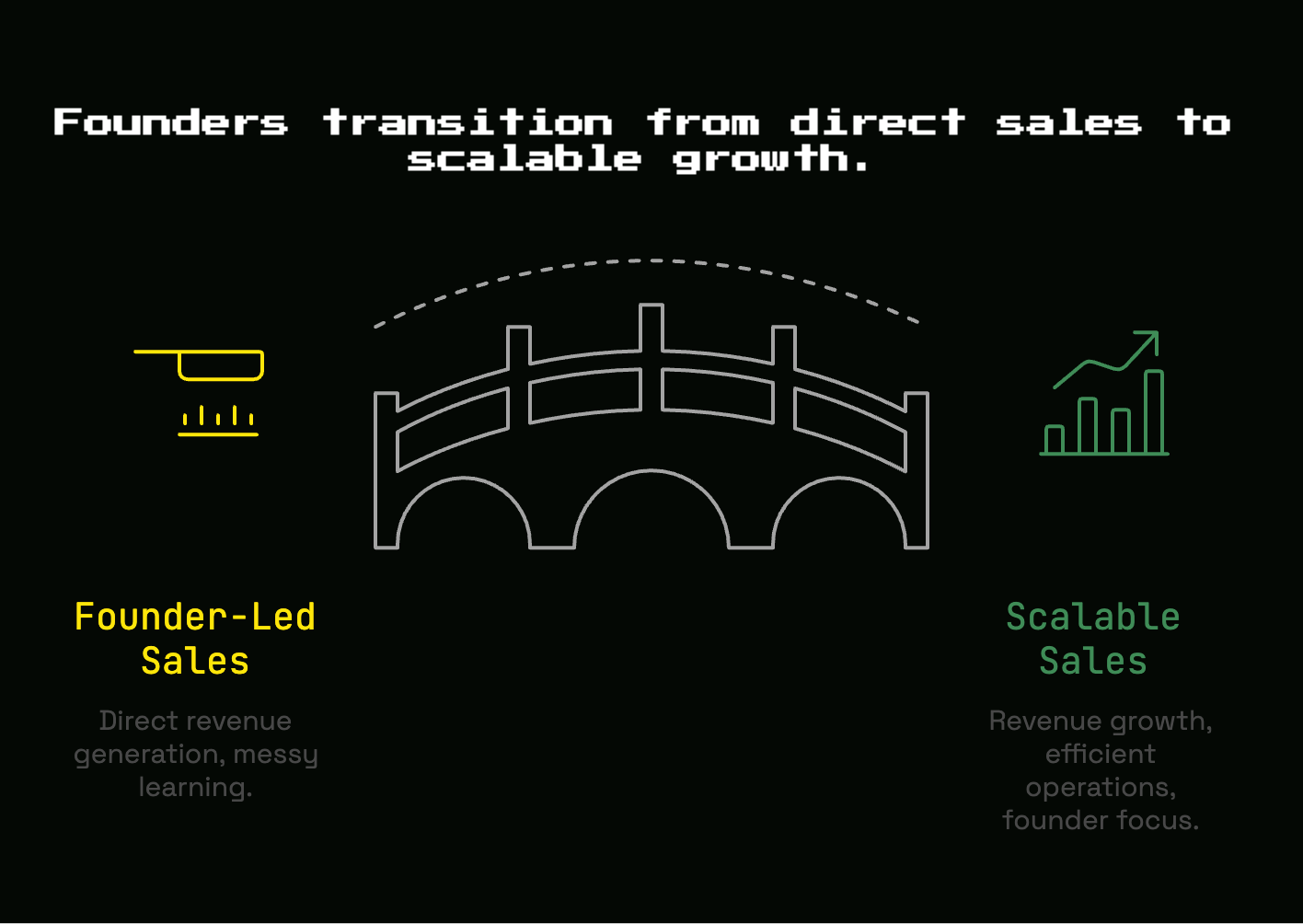
Think of it like cooking from a stove that is still being installed. In a mature company, recipes, prep stations, and timing already exist. In founder-led sales, you are still figuring out the heat, the ingredients, and whether dinner should even be pasta. That closeness is messy, but it is also where the learning happens.
Why Founder-Led Sales Works So Well Early On
Founder-led sales is often the fastest way to get from vague interest to real revenue in early B2B SaaS. That is the direct claim, because it is true more often than not.
At this stage, a polished process can actually hurt you if it hides the truth. You do not need smoother slides as much as you need sharper learning. You know the product context, the edge cases, the tradeoffs, and the roadmap. You can hear confusion on a call and adjust in real time. A rep with a neat script cannot do that if the script is still wrong. It's the kind of hands-on work that doesn't scale — and at this stage, it shouldn't have to.
Speed matters too. In an early company, delay kills momentum. If a prospect asks for a workflow that almost works but not quite, you can decide on the spot whether that gap is strategic, ignorable, or worth fixing. That kind of speed is hard to match once layers start forming.
You know the problem better than anyone
You usually know where the pain actually lives, not just how it gets described in a pitch deck. That lets you ask better discovery questions and notice when a prospect is being polite instead of interested.
It also helps with messy, specific questions. Maybe a buyer asks how your app handles permissions across a parent account and six child workspaces, or what happens when onboarding stalls after procurement signs. Those are not generic objections. They are the kinds of details that kill deals if nobody can answer clearly. You often can.
That makes your calls feel less scripted and more grounded. Buyers notice that.
You can shorten the gap between feedback and product changes
This is one of the biggest advantages, and it gets overlooked because it feels normal when you are living inside it.
A prospect says onboarding breaks at a certain step on Tuesday. You check the logs that afternoon, swap a step in the flow on Wednesday, and ship a fix by Friday. That is not just good product work. That is sales acceleration. Future prospects now hit a cleaner path because one real conversation made the product better.
When sales, product, and onboarding sit close together, learning compounds fast. You are not passing customer truth through three layers of interpretation before anything changes.
Buyers often want to talk to the person behind the product
Early customers are taking a risk. Your company may be smaller, your category may be less familiar, and your product may still have rough edges. Access to you lowers the perceived risk.
It signals commitment. If you are willing to spend 45 minutes unpacking a workflow, answer hard questions directly, and stay involved after the signature, the purchase feels more reasonable. Especially in B2B SaaS, where buyers are often choosing not just software but a relationship.
That founder access can carry real weight in a deal. It should not be your only advantage, but early on, it absolutely helps.
The Best Use Cases for Founder-Led Sales
Founder-led sales does not shine in every situation. It works best when the sale depends on context, trust, and learning, not pure volume.
For a lot of B2B SaaS companies between $1M and $5M ARR, the conditions are pretty familiar: the product still needs explanation, positioning is still tightening up, and hiring a full sales team before the story is clear would be expensive guesswork.
Complex or consultative sales
If your sale depends on discovery, education, and tailoring the story to the buyer, founder-led sales makes sense. You are not reading a script and hoping for the best. You are diagnosing.
Maybe your product touches finance workflows, RevOps data, compliance, or messy cross-functional operations. In those cases, the buyer’s problem is rarely clean on day one. You need to ask follow-up questions, translate product capability into business value, and sometimes reframe the problem better than the buyer can.
That is hard to delegate too early.
Early market categories or new product wedges
If buyers do not already understand the category, part of your job is teaching. You are not just explaining why your product is better. You are explaining why this problem deserves a budget line in the first place.
That changes the sales motion. Education-led sales needs conviction and nuance. You have to explain the cost of the old way, show a different path, and make the change feel worth it. Founders usually do this better early on because the category story lives in your head long before it lives in a deck.
Smaller teams that need signal before scale
If your team is lean, every hire has to count. That is especially true in bootstrapped companies, where one wrong sales hire is not a small experiment but a real setback.
Keeping sales close a little longer helps you collect signal first. You learn which buyer titles move fast, which use cases keep showing up, which objections are noise, and which are deal killers. Once patterns start repeating, you have something real to train against.
The Hidden Costs Nobody Mentions
Here’s the thing: founder-led sales works so well that it can hide its own downside.
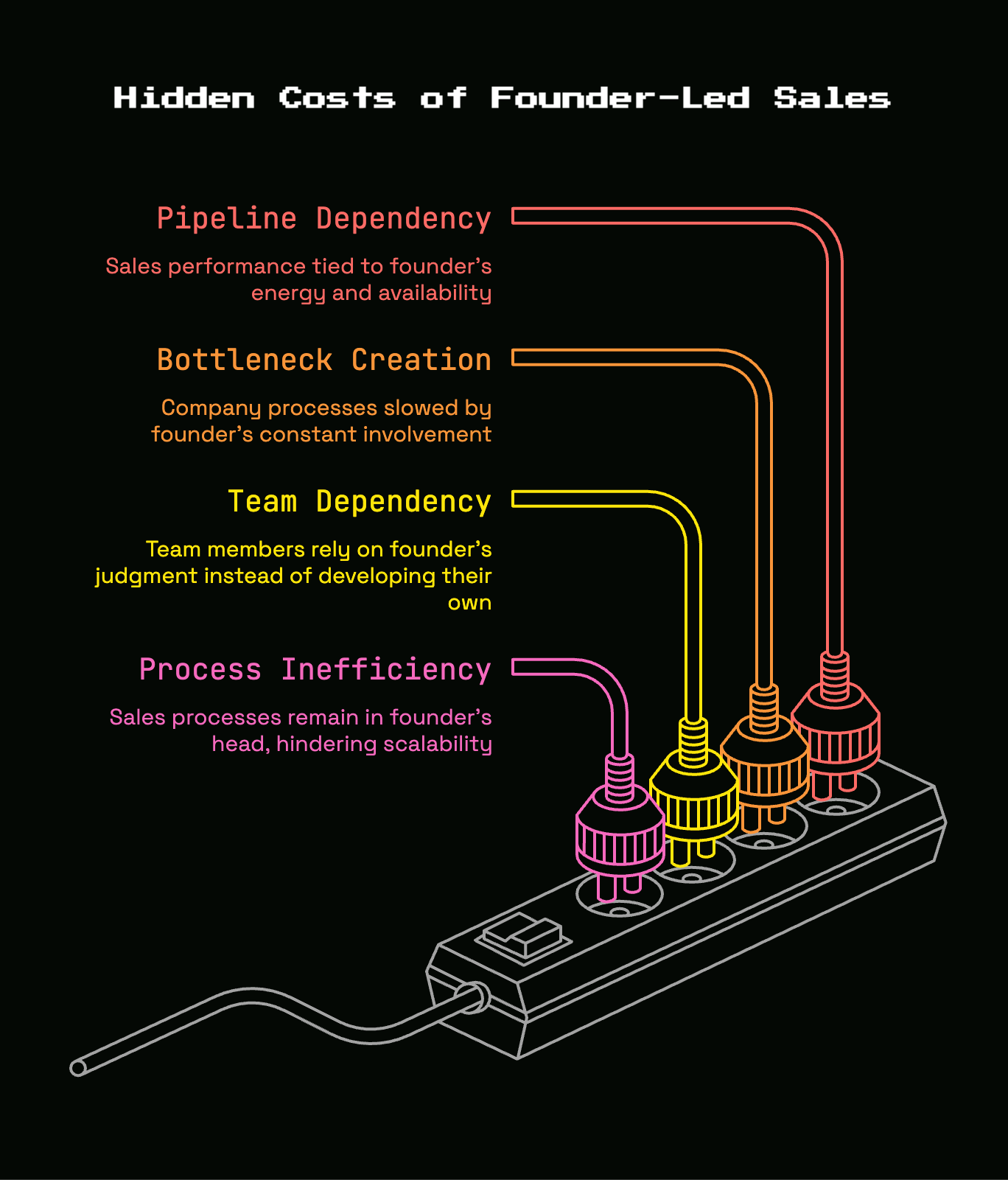
Deals close. Revenue grows. Everyone stays busy. But under the surface, your calendar gets warped, product work gets squeezed, and the company starts depending on your presence more than your systems.
Your pipeline starts depending on your personal energy
If revenue rises when you are on calls and falls when you are buried in hiring, customer issues, or roadmap work, that is fragile. It means the pipeline is tied to your available hours and your mental sharpness.
That is manageable for a while. Then real life shows up. A week of board prep, a key hire falling through, a family trip you actually want to take, and suddenly follow-ups slow down. Deals stall. Nothing is broken, exactly, but nothing moves unless you push.
A sales motion that disappears when you do is not a motion. It is a habit.
You can become the bottleneck without noticing
This one creeps in quietly. A rep wants you to approve pricing. A customer success lead wants you on a renewal call. A prospect needs “just ten minutes” with you to get comfortable. Product wants your input before promising a fix. None of this feels unreasonable on its own.
But stack enough of those moments together and the company learns a bad reflex: wait for you.
That slows everything down. Worse, it trains the team not to build judgment because your judgment is always one Slack away.
The process stays in your head
A lot of founder-led sales motions look productive from the outside and impossible to scale from the inside. Deals are closing, but nobody can explain why in a way another person could repeat.
Maybe your discovery calls sound natural but are never written down. Maybe your best objection handling happens in the moment and never gets captured. Maybe every handoff to onboarding depends on context you remember from a call two weeks ago. That works until somebody else needs to run the same path.
Then the gaps show up fast.
When Founder-Led Sales Starts to Break
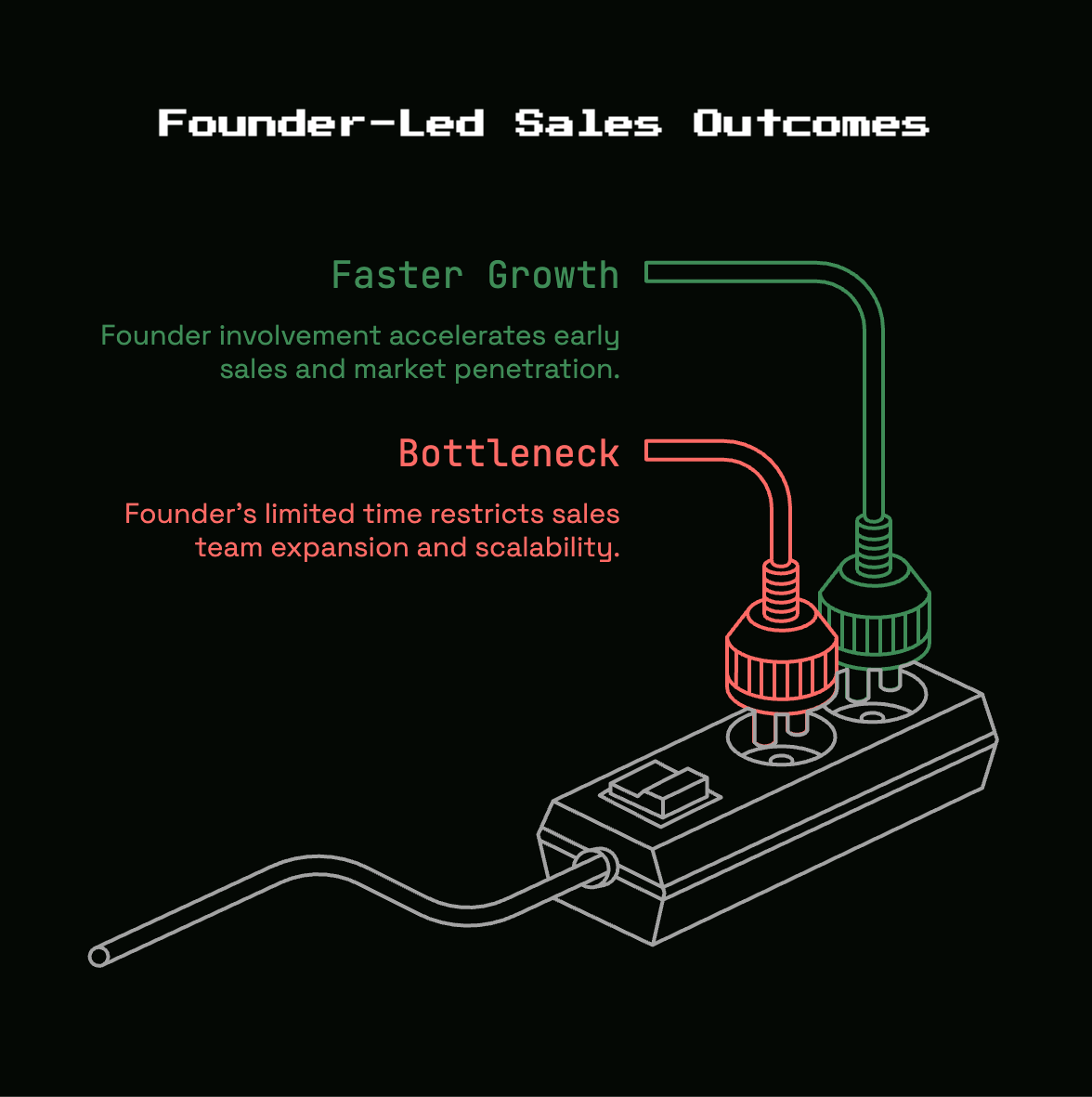
Founder-led sales does not break when it stops producing wins. It breaks when the wins stop being transferable and start blocking the next stage.
That distinction matters. Plenty of founders stay in the motion too long because revenue still looks decent. But decent revenue can mask a weak operating model.
Every deal needs your personal rescue
If opportunities keep stalling until you jump in as closer, fixer, or product interpreter, your sales motion is leaning too hard on your presence.
Sometimes that is fine for strategic deals. Sometimes a founder should join. But if standard mid-market opportunities cannot move without your voice on the call, you have not built a process. You have built a dependency.
Messaging still changes every week
Changing the pitch a lot is not always a problem. Sometimes it means you are still learning the market, which is normal.
The catch is that a constantly shifting message is hard to hand off. If your story sounds different every Monday, no rep can internalize it, no onboarding handoff stays clean, and no one knows which version is actually working. Learning is good. Permanent improvisation is not.
You are missing product, hiring, or customer success work
Sales can become the loudest function because it comes with obvious short-term rewards. Close a deal, feel progress. Skip a roadmap review, no alarm goes off that day.
But if sales is eating the hours needed to fix onboarding, improve retention, or hire well, the company can look healthier than it is. New revenue hides operational weakness for a while. Then churn, delays, and team confusion collect interest.
Revenue is real, but repeatability is not
This is the trap. You can absolutely prove that you can sell before proving that your company has a sales motion.
Those are different things. One means you can persuade people. The other means a process exists that can survive contact with another person, another quarter, and another workload. Many teams confuse traction with a machine. The result is almost always a rough first sales hire.
The Most Common Mistakes in Founder-Led Sales
Most founder-led sales mistakes come from overcorrecting. You either hand things off too early or keep everything informal too long.
Hiring a sales rep too early
A first rep cannot solve unclear positioning. If your ideal customer profile is fuzzy, your discovery flow changes every call, and your close reasons live in your gut, a rep is not inheriting opportunity. A rep is inheriting fog.
That is why early sales hires so often look worse than expected. The problem is not always talent. Sometimes the system is incomplete.
Waiting too long to build any process
The opposite mistake is just as common. You keep treating every deal like a special case long after patterns have started showing up.
Capture the basics while the learning is fresh: notes, call recordings, objections, decision criteria, reasons deals stall, why some accounts move in ten days while others die after a month. You do not need a giant playbook. A simple shared document and a few organized folders can go a long way.
Confusing founder charisma with market fit
Some early deals close because buyers believe in you. Your conviction is strong, your access is high, and you are willing to be flexible. That can absolutely help get early traction.
But do not mistake that for a mature sales motion. If customers are buying because you personally reduce the risk, the product story may still need work. That does not make the revenue fake. It just means you need to separate what is truly repeatable from what is founder-specific.
Over-customizing every sale
A little flexibility helps early on. Too much turns into a mess.
Special terms, bespoke workflows, one-off integrations, unusual pricing, and side promises made to get a deal over the line all create future drag. Support gets harder. Product direction gets muddy. Margins get weird. The company starts carrying around a backpack full of exceptions.
If every customer gets a different version of the promise, scale gets painful.
What Good Founder-Led Sales Looks Like in Practice
Done right, founder-led sales is disciplined, not chaotic. It can feel conversational and still be structured underneath.
A simple sales process you can explain in five minutes
Your process does not need enterprise software and six stage gates. It needs clarity. A healthy early motion usually includes a target account, an inbound response or first outreach, discovery, demo, proposal, close or loss, and onboarding handoff.
If you cannot explain how a deal moves through those stages in five minutes, the process is too fuzzy. Simplicity wins here. Everyone should know what happens next and what “good” looks like at each step.
A running library of customer language
Start saving exact phrases prospects use. Not polished summaries. Actual words.
When buyers say, “spreadsheets break the minute finance asks for a new cut,” or “nobody trusts the numbers by Thursday,” that language is gold. It improves copy, demos, objection handling, and onboarding. Later, it becomes some of your best enablement material because it reflects reality instead of internal jargon.
Tight loops between sales, product, and onboarding
This is where founder-led sales earns its keep.
Sales calls should shape positioning. Product feedback should shape the roadmap. Onboarding friction should reshape the handoff. If a deal keeps slowing down after signature because setup takes three weeks, that is not just a customer success problem. It is part of your sales motion, because buyers feel that friction too.
The tighter those loops get, the faster your company learns.
How to Know You’re Ready to Transition Away From Pure Founder-Led Sales
The goal is not for you to vanish from revenue. The goal is to stop being the only person who can move it forward.
You can describe your ideal customer clearly
If you can name the company type, buyer title, trigger event, pain point, and the signals that predict urgency, you are getting close.
Clarity here matters more than vanity metrics. “Mid-market SaaS” is too broad. “VP of Finance at a 50 to 200 person SaaS company that just outgrew spreadsheet-based forecasting” is useful.
Objections and win reasons are starting to repeat
Repetition is a gift. Once the same concerns, buying triggers, and close reasons show up again and again, you can train against them.
At that point, sales starts becoming teachable. You can build call guides, test messaging, and improve follow-up based on patterns instead of instinct alone.
Another person can shadow your calls and understand the playbook
Here is the practical test. If someone listens to five call recordings and can explain how you qualify, demo, and move a deal forward, your motion is becoming portable.
Not perfect. Portable. That is enough to begin the handoff.
How to Hand Off Founder-Led Sales Without Breaking Momentum
The cleanest transition happens when your first sales hire amplifies what already works instead of trying to invent the motion from scratch.
Hire a rep after the motion is clearer, not as a substitute for clarity
A first rep should not be your outsourced strategy. If your sales motion is still too blurry for you to teach, it is too blurry to hire into.
Rough edges are fine. Missing foundations are not.
Document the parts that actually matter
Capture the essentials: ideal customer profile, discovery questions, common objections, demo path, pricing logic, follow-up templates, and deal review notes.
Keep it practical. Nobody needs a 74-slide deck that goes stale by next month. A living document with real examples is far more useful.
Stay involved in key deals, but stop joining everything
You can still show up where your presence carries unusual weight: strategic accounts, tricky product credibility moments, or pricing shifts. But stop treating every active deal like it needs founder supervision.
A new rep needs room to build pattern recognition. If you keep rescuing every wobble, that never happens.
Measure transfer, not just closed revenue
During the handoff, the question is not only “did the rep close business?” It is “can the rep run the motion without you?”
Watch for signs of transfer: solid discovery, clean handling of common objections, clear next steps, thoughtful loss analysis, and fewer moments where a deal freezes until you join.
These same tasks, documenting the motion and reviewing early deals, are usually the first beginner fractional head of growth responsibilities a part-time hire takes on, before they touch anything more strategic.
What Founder-Led Sales Looks Like After the First Hire
Founder-led sales does not end the day you hire a rep. It just changes shape.
You still own the story
Your role in positioning, category education, and testing new wedges still matters a lot. You are often the first person to notice when a segment starts leaning in or when the old pitch stops landing.
The story should keep evolving, and you should stay close enough to keep sharpening it.
You join the highest-leverage moments
Some calls are worth your time because they change the company’s trajectory more than others. Strategic deals, expansion paths, partnership conversations, and major pricing shifts usually fit that category.
That is a very different job from taking every demo. Better, honestly.
You build the machine instead of being the machine
This is the real shift. Your work moves from selling every opportunity to improving the system: messaging, hiring, call reviews, onboarding loops, qualification standards, and feedback flow.
Revenue should stop depending on your calendar alone. Once that happens, the company gets sturdier.
A Simple Checklist: Is Founder-Led Sales Helping or Hurting Right Now?
A quick diagnostic helps because founder-led sales can feel productive even when it is creating drag.
Signs it’s helping
It is helping if calls are making your positioning clearer, if feedback is turning into product or onboarding improvements quickly, and if close rates are healthy because you deeply understand the pain. It is helping if each deal teaches you something reusable and your sense of the market is getting sharper every month.
It is also helping if your presence is creating trust without becoming a permanent crutch.
Signs it’s hurting
It is hurting if product work keeps slipping because your calendar is packed with demos. It is hurting if every proposal needs your approval, every rep needs your rescue, and every handoff gets messy because context stays in your head.
It is hurting if revenue exists but nobody can explain the motion well enough to repeat it. That is usually the clearest signal of all.
The One Shift to Make Next
Do one simple thing this week: review your last 10 deals and mark exactly where each one depended on you.
Look for the pattern. Maybe you are still needed in discovery because the pitch is fuzzy. Maybe pricing logic is unclear. Maybe onboarding concerns are what really win or lose the deal. Once you can point to the dependency, you can start fixing it.
That is the real job now. Not escaping founder-led sales, but turning it from personal effort into something your company can carry without you in every room.


Discussion