

A founder bottleneck is what happens when your go-to-market motion depends on you for too many decisions, approvals, and rescue missions to keep revenue moving. It usually shows up at the worst possible moment: right after GTM starts working well enough to hire help, and suddenly growth feels slower with more people involved than it did when you were doing half of it from a laptop at 6:40 a.m.
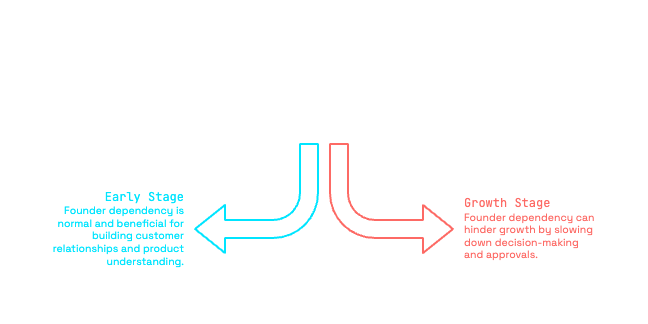
Why Founder Bottlenecks Show Up Right When GTM Starts Working
This problem rarely appears when your company is tiny and chaotic. Back then, founder dependency is just called building. You are close to customers, close to the product, close to every deal, and honestly, that is often the right move.
The trouble starts when the things you did that didn't scale survive longer than the stage they were built for.
You hire your first sales rep, or your first true GTM generalist. A prospect asks for pricing. Another wants a custom term in the agreement. A third says, “Can I get 15 minutes with the founder?” Your new hire waits on you for the answer, the follow-up, the approval, or the positioning tweak. Nothing is fully broken, but nothing moves cleanly either.
That is the founder bottleneck in plain English: too many revenue-moving decisions, relationships, or workflows still depend on you to keep going.
At first, it feels flattering. Then it gets expensive.
What a Founder Bottleneck Actually Is in GTM
A founder bottleneck in GTM is not just a busy calendar or a founder working hard. It is a systems problem. Your judgment has quietly become a required step inside the revenue engine, even in places where it should have become teachable by now.
That distinction matters.
If a deal needs your input because it is unusually strategic, that is normal. If ordinary deals, routine pricing questions, and standard follow-ups all pause until you weigh in, your GTM motion is built around your availability instead of a repeatable system.
GTM systems, in plain English
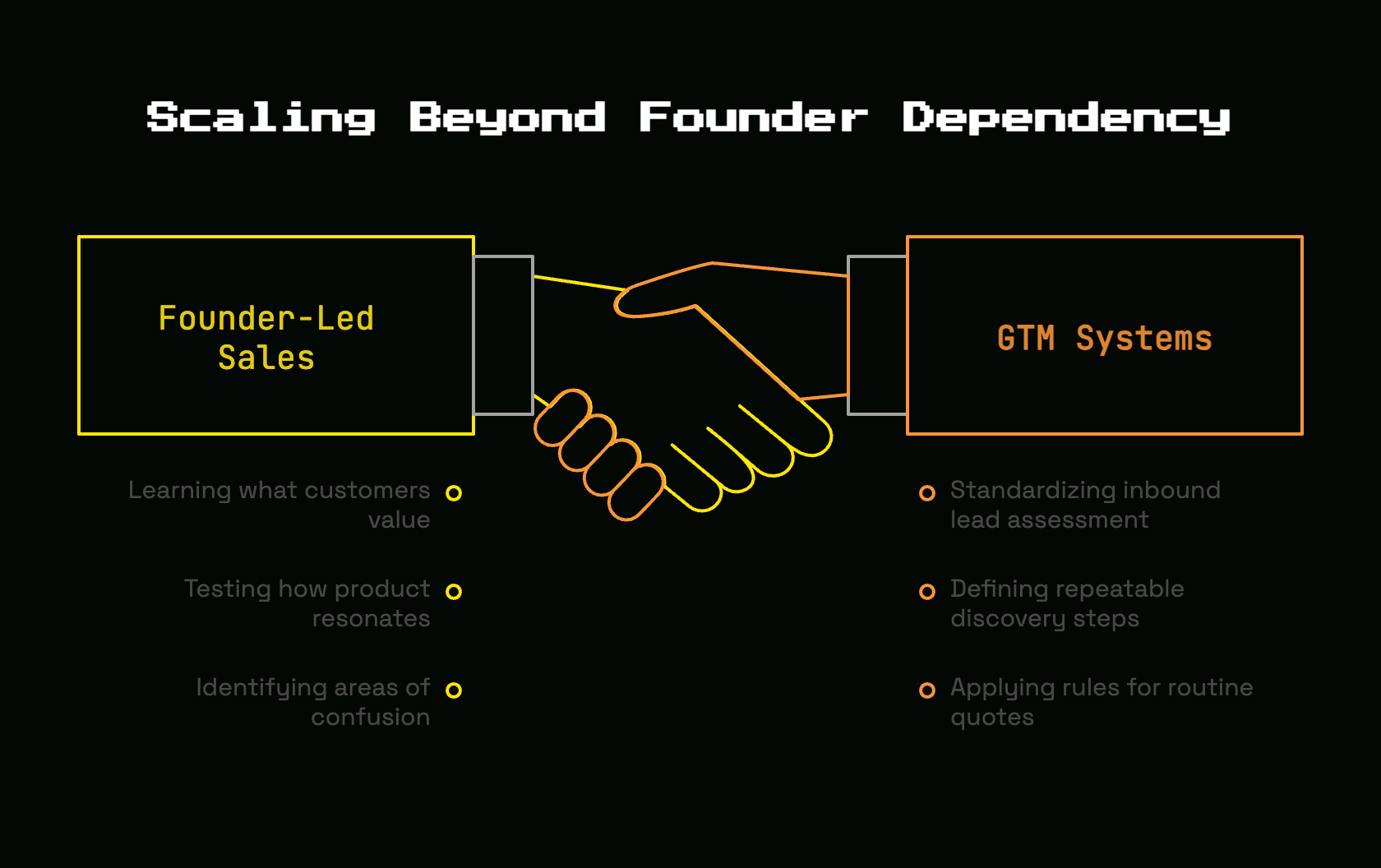
GTM systems are the repeatable steps, rules, handoffs, and tools that turn market interest into revenue. That includes how leads get found, how inbound gets qualified, how discovery calls are run, how demos are framed, how pricing gets handled, how customers are onboarded, and how expansions happen later.
Think of it like a restaurant kitchen. A good kitchen does not depend on the owner personally touching every plate. The recipes, prep flow, stations, and standards make the meal come out right. If every order still needs the owner to taste the sauce before it leaves the pass, the kitchen is not really a system yet.
Same idea here.
The difference between founder-led sales and founder bottlenecks
Founder-led sales is normal early on. In many B2B SaaS companies, it is the fastest way to learn what customers care about, what messaging lands, and where the product still confuses people. You should expect to be deeply involved at the start.
A bottleneck begins when the motion cannot run without your constant intervention.
That means your involvement has stopped being a source of learning and started being an operational dependency. You are no longer just helping shape the system. You are the missing gear every time it turns.
The Early Signs You’re the One Slowing the System Down
This pattern is easier to spot than most founders think. The signs are usually small, repetitive, and easy to excuse one by one. Put them together, though, and the picture gets obvious.
Deals stall when a prospect asks for “one quick call” with you
At first, founder calls near the finish line feel normal. A prospect wants confidence. A big account wants access. A nervous buyer wants proof that the company is serious.
The catch is when those calls stop being occasional and start becoming standard operating procedure. If your rep expects every meaningful deal to end with a founder rescue call, that is not a closing tactic. That is a signal that the core sales motion cannot carry enough trust on its own.
You may still be winning deals. But the system is teaching everyone that the real closer is you.
Pricing, proposals, or discounts wait in your inbox
This one feels harmless because the delay is often short. Maybe a rep pings you in Slack for a discount approval. Maybe a proposal sits for three hours while you are in product meetings. Maybe procurement language waits until after dinner because only you know what is flexible.
Three hours here, four hours there, one day lost on Friday. It adds up fast.
Revenue systems do not usually break from one dramatic blockage. They get dragged down by small founder-dependent pauses spread across dozens of moments a month.
Messaging changes every time you join a call
If your positioning shifts depending on your mood, the prospect, or the exact question asked, your team cannot build consistency around it. One day the product is sold as an efficiency tool. The next day it is a workflow layer. The next day it is a revenue analytics play.
That instinctive adjustment can be useful when it comes from pattern recognition. But if that pattern only exists in your head, your team ends up guessing which version is correct.
A GTM system needs a message that survives your absence.
Your CRM looks active, but nobody knows the real next step
You can have notes, stages, tasks, sequences, recordings, and still not have a working system. Activity is not the same thing as clarity.
If the CRM only becomes understandable after you explain what really matters in the account, you are still the operating layer. Your team is collecting information, but not converting it into decisions without you.
That is a bottleneck hiding behind software.
Why This Happens So Often at $1M, $5M ARR
This stage is where founder bottlenecks thrive. You have enough traction to justify hiring, enough complexity to feel strain, and not quite enough structure to make scale feel smooth.
For bootstrapped companies, the pressure is even sharper. Every hire matters. Every deal matters. Every mistake feels personal because the burn is real and the margin for waste is thin.
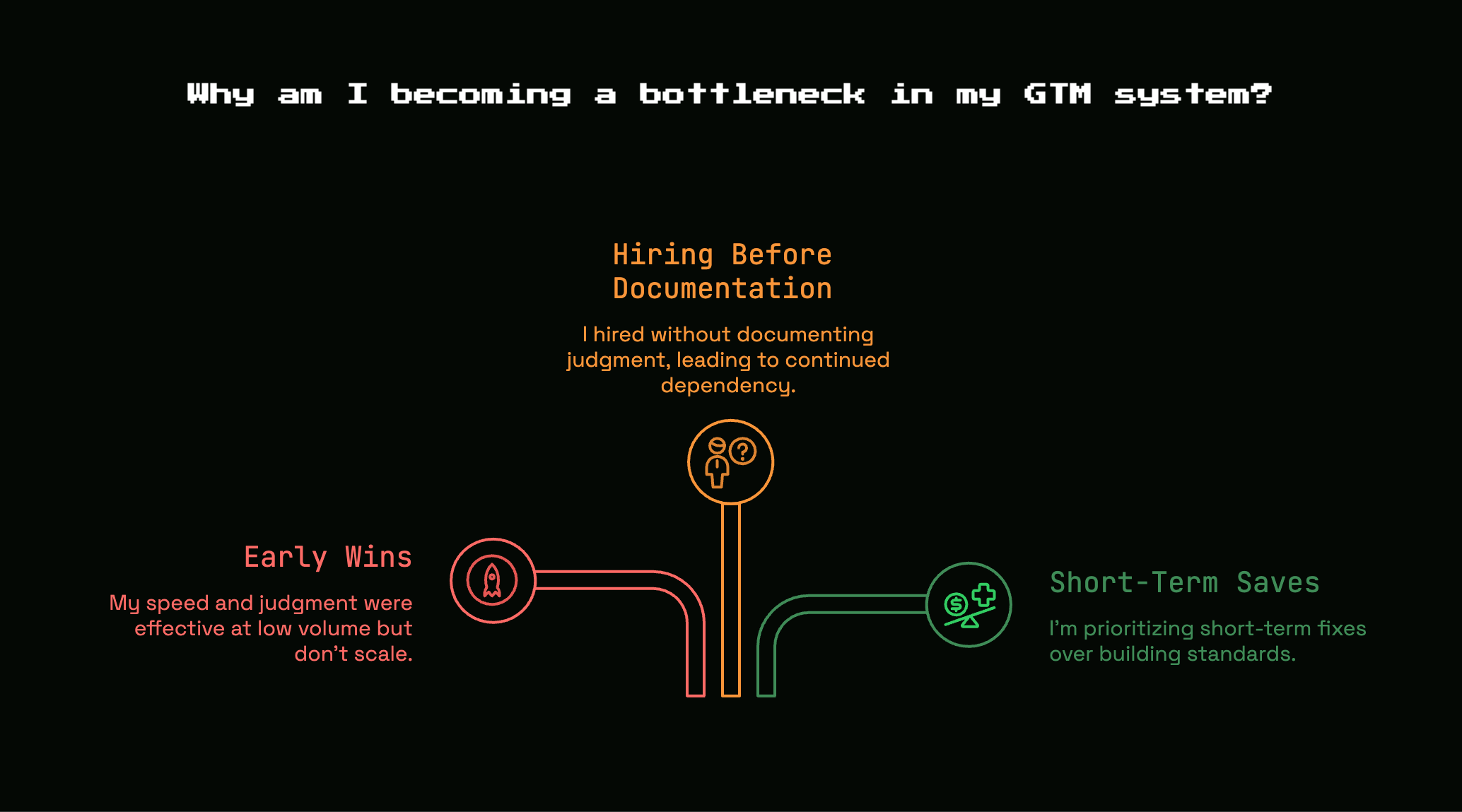
Your early wins came from speed, taste, and direct contact
You probably got here by moving fast. You jumped into calls. You rewrote outbound emails at night. You noticed weak discovery questions and fixed them on the spot. You adjusted packaging during live deals because you could feel where the buyer was leaning.
That style works brilliantly at low volume. It stops working once more people need to run the same motion.
What got you to $1M or $2M ARR often depends on your speed and judgment. What gets you past it depends on making that judgment portable.
You hired people before you documented judgment
This is one of the most common mistakes, and it is understandable. Revenue starts coming in, bandwidth gets tight, and hiring feels like the solution. So you hire a rep.
But hiring does not transfer context by magic.
If the real logic behind qualification, pricing flexibility, objection handling, and ICP choices is still unwritten, your new hire inherits tasks without inheriting judgment. So the work still routes back to you. The org chart changes, but the dependency map does not.
Revenue pressure rewards short-term saves
Jumping in saves deals. That is why this pattern survives.
If a discount approval from you closes something today, it feels smart. If your founder call rescues a late-stage opportunity, it feels smart. If rewriting the proposal gets the signature across the line, it feels smart.
In the short term, it often is smart.
But every save teaches the system the wrong lesson. Instead of building standards, you reinforce escalation. Instead of improving the motion, you patch around it.
The Hidden Costs of Being the GTM Safety Net
Most founders understand that bottlenecks slow things down. The bigger problem is what gets distorted while you are busy keeping everything afloat.
Pipeline quality gets harder to trust
If qualification depends on your gut-check, the pipeline becomes harder to read. Stage definitions blur. Forecasting gets soft around the edges. A deal is “promising” because you feel it is promising, not because the same standard was applied across accounts.
That makes revenue planning shakier than it looks on paper.
A healthy pipeline should mean roughly the same thing no matter who entered the notes. If only your interpretation makes the stages credible, the system is not producing reliable signal.
New hires learn dependency instead of ownership
Smart hires adapt quickly to the environment around them. If every meaningful decision gets redone, overruled, or rescued by you, the lesson is obvious: wait.
People stop making calls. Not because they are lazy, but because the faster path is to ask you. Over time, initiative starts to look risky and escalation starts to look responsible.
That is how capable people become tentative inside founder-heavy GTM teams.
Customers get an uneven buying experience
Some prospects get the full version of the story because you joined the call and translated everything beautifully. Others get a thinner version from someone still trying to reconstruct your thinking.
That inconsistency shows up in close rates, but it also shows up later in onboarding. Customers who bought based on one version of the value prop may arrive with expectations the broader team never clearly heard.
When the founder is the glue between promise and delivery, the buying experience becomes uneven by default.
You stay busy but the company stays fragile
Here is the direct claim: being essential to every deal is not a strength once you are trying to scale. It is a single point of failure.
You can be fully booked, deeply informed, and admired internally, while the company remains fragile underneath. A business that only moves at your speed is not really growing capacity. It is stretching dependency across a larger surface area.
That is a rough place to build from.
The Psychology Behind the Founder Bottleneck
This is not just an operating issue. It is also human.
You do not drift into this pattern because you are careless. You drift into it because it often feels responsible, useful, and earned.
Letting go feels risky because your standards are real
Your concern is usually valid. Early hires probably will do parts of the motion worse than you do, at least for a while. Discovery may be sloppier. Demos may miss nuance. Objection handling may feel too rigid.
That risk is real.
But protecting quality by staying central creates a different problem: nobody gets enough room to build judgment, and nothing gets repeatable enough to improve. You preserve quality in the moment while blocking learning in the system.
Your identity is tied to being the person who fixes things
If you have spent years being the closer, translator, and problem-solver, that role starts to feel like proof of value. When a deal gets weird and you step in, it is satisfying because your involvement visibly matters.
The catch is that your company eventually needs your value in a different form.
At this stage, your highest-value work is less about fixing individual moments and more about designing a motion that handles ordinary moments without needing a hero.
Ambiguity is uncomfortable, so you become the shortcut
When rules are unclear, your team will naturally come to you. Asking you is faster than guessing. It is also safer.
That means every vague area in the GTM motion creates demand for founder judgment. No discount boundaries? Ask you. No clear ICP? Ask you. No shared talk track for product nuance? Ask you.
You become the shortcut because the system has too many blank spaces.
Where Founders Most Commonly Become the Bottleneck in the GTM Motion
Founder bottlenecks can show up almost anywhere revenue moves. But a few zones are especially common.
Top-of-funnel: outbound, lead qualification, and ICP decisions
Top-of-funnel often looks active while still being founder-dependent underneath. Outreach is going out. Leads are coming in. Accounts are getting scored.
But if target account choices depend on your instinct, messaging tweaks need your rewrite, and lead quality is only trusted after your review, then demand generation is not actually running on shared rules. It is running on borrowed founder judgment.
This is common in nuanced B2B SaaS, where the best-fit customer is obvious to you and fuzzy to everyone else.
Mid-funnel: discovery, demos, and solution framing
This is where founder bottlenecks often get strongest. Discovery calls uncover messy customer problems. Demos require judgment about what to show and what not to show. Solution framing depends on translating product detail into business value.
If your product has any complexity at all, you may still be the clearest translator in the room.
That is understandable, but it creates a problem if every meaningful mid-funnel conversation improves only when you join. Your GTM motion cannot scale if product understanding is trapped inside live founder narration.
Bottom-of-funnel: pricing, procurement, and close plans
Bottom-of-funnel is where approval dependency gets painfully visible. Pricing exceptions, contract edits, payment terms, procurement asks, security reviews, and custom packaging all seem reasonable to route upward.
Soon your inbox becomes the closing desk.
This is especially common in bootstrapped teams because you care, rightly, about margin and precedent. But if ordinary negotiations cannot move inside clear boundaries, your close process inherits your schedule.
Post-sale: onboarding promises and expansion paths
The founder bottleneck does not end at signature.
It shows up when onboarding teams need you to explain what was really sold, when customer success asks you to decode product expectations, and when upsell opportunities only become clear after your interpretation. If post-sale handoffs depend on your memory of the deal, the system is still incomplete.
That creates risk twice: first in onboarding clarity, then again in expansion consistency.
How to Tell Whether the Problem Is You or a Missing System
Not every slowdown is a founder problem. Sometimes the market is tough. Sometimes a hire is weak. Sometimes the product story really is still changing.
Still, there is a simple way to tell whether your involvement is solving a temporary issue or covering for missing system design.
Ask which decisions require your judgment every single week
Look for repeat decisions, not dramatic ones.
If the same pricing call, qualification question, or demo framing issue comes back to you every week, that is usually not a one-off management task. It is a design issue. The system does not yet contain the rule, boundary, or training needed to handle that decision without you.
Recurring founder judgment is usually undocumented policy.
Look for repeat questions, not isolated mistakes
One bad demo is coaching. One messy follow-up is coaching. One off-target proposal is coaching.
But if five demos miss the same problem, or multiple reps ask the same qualification question, the issue is probably upstream. Something is unclear in your positioning, playbooks, definitions, or handoff logic.
That is actually good news, because systems can be fixed faster than personalities.
Check whether speed drops whenever you step away
A very practical test: step out on a Friday afternoon, get on a flight, or stay off Slack for a block of time. Then notice what stalls.
Which approvals wait? Which questions pile up? Which deals stop moving? Which follow-ups sit half-done until you return?
That gives you a rough dependency map. Not a perfect one, but a useful one. The places where speed drops fastest are usually where your hidden operating role is strongest.
How to Stop Being the Bottleneck Without Disappearing From Sales
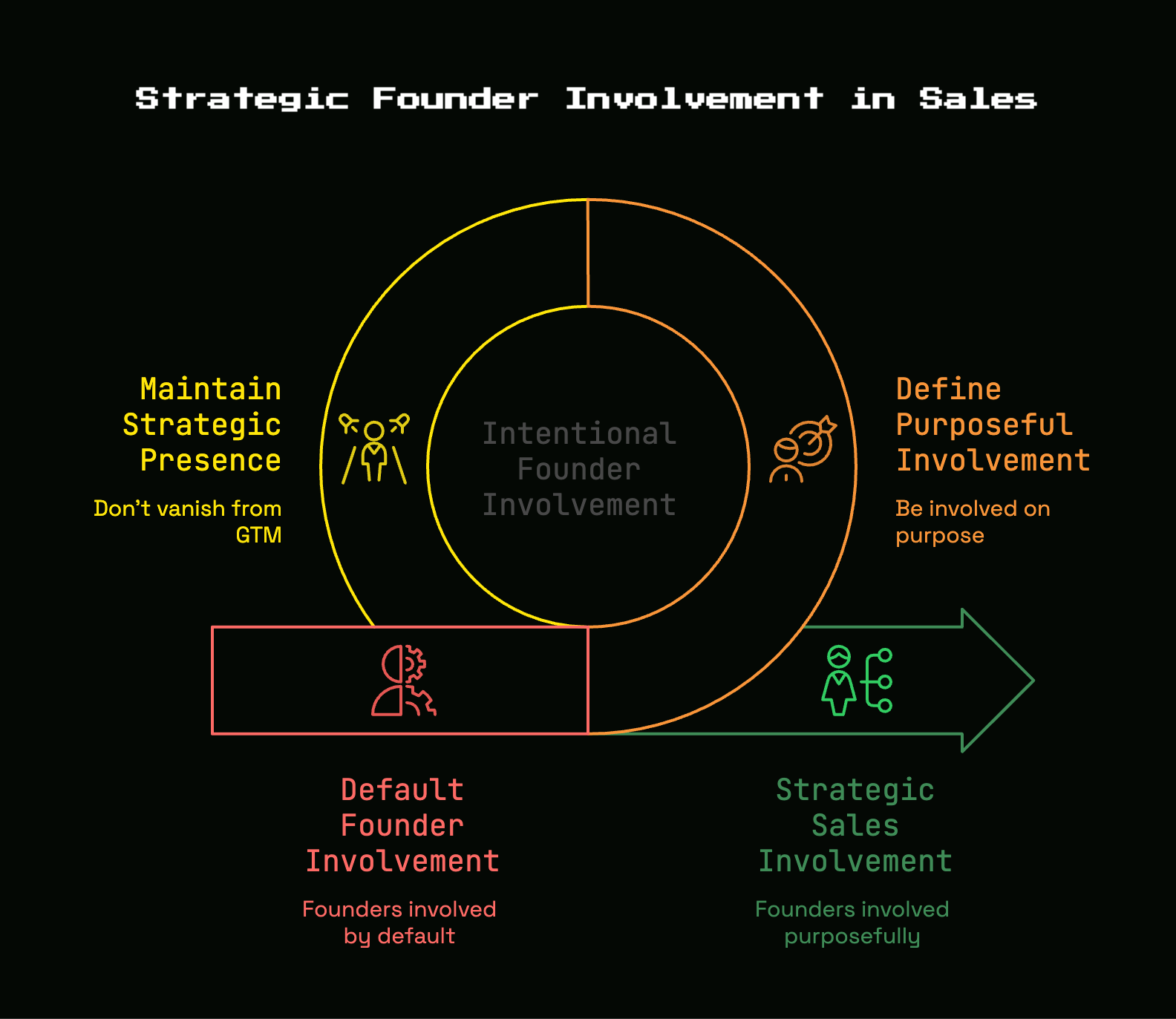
The goal is not to vanish from GTM. Founder involvement still matters, especially in early-stage B2B SaaS. The goal is to be involved on purpose instead of by default.
Turn your instincts into operating rules
Any recurring judgment call should become an artifact.
If you keep deciding which prospects are a fit, write down the qualification criteria. If you keep adjusting discounts, define pricing guardrails. If the same objections keep pulling you into calls, turn your best answers into objection notes or a talk track. If demos keep improving when you frame the problem a certain way, document that structure.
Your instincts are useful. They just stop scaling when they live only in your head.
Replace approvals with boundaries
Approvals feel safe, but boundaries move faster.
Instead of requiring every proposal to come through you, define what can happen without you. For example, what discount range is acceptable, what contract terms are non-negotiable, what customer traits disqualify an expansion, and what conditions trigger escalation.
People do better with clear fences than with constant permission-seeking. They may not get every call perfect, but the system gets dramatically faster.
Join fewer calls, but join them on purpose
Founder calls should become selective, not automatic.
Save your time for strategic moments: enterprise validation when the logo matters, market-learning calls that sharpen positioning, high-risk churn saves, or unusually complex deals where pattern recognition still needs to be harvested.
That shift matters because it turns your presence from routine support into targeted leverage. You stop being the daily traffic cop and start being the person who improves the map.
Build one source of truth for messaging
If messaging lives in scattered call recordings, Slack replies, and half-remembered comments, it will mutate constantly.
You need one living place where your ICP language, problem framing, product story, proof points, common objections, and demo narrative are kept current. It does not have to be fancy. A simple doc, wiki, or enablement hub is enough if it is real and updated.
The point is consistency. Your team should not need your memory to access the best version of the story.
A Practical Hand-Off Plan for the First Sales Rep or GTM Hire
Early handoffs fail when you delegate the hardest edge cases too soon or stay so close that nothing is actually transferred. A better approach is narrower and more deliberate — whether you’re handing off to a full-time hire or senior growth help brought in part-time to build the plan with you.
Start with the repeatable 60 percent, not the hardest 10 percent
Do not begin with custom enterprise negotiations or weird procurement loops. Start with the common path.
Hand off the standard demo, the routine follow-up, the usual qualification flow, the normal objection patterns, and the plain-vanilla proposal. Those are the reps your hire needs most, and they are where repeatability gets built.
If your first handoff starts in the hardest corner of the sales motion, you will get pulled back in immediately.
Shadow, split, then fully transfer
A clean handoff usually moves in three phases.
First, your hire shadows and watches for pattern recognition. Next, your hire runs a portion of the motion while you stay nearby, maybe discovery while you handle pricing, or demo while you handle final commercial terms. Then the whole step transfers, with review happening afterward instead of in the moment.
That last part matters. Review after the fact builds ownership. Real-time rescue builds dependence.
Document the moments that usually pull you back in
Some of your best GTM documentation will come from one simple exercise: notice the situations that make you say, “Let me take this one.”
Maybe it is a security objection. Maybe it is a prospect outside the usual ICP. Maybe it is a packaging conversation with multiple teams involved. Maybe it is a buyer who loves the product but keeps comparing you to a cheaper point solution.
Those moments are gold. Each one points to missing guidance that can be turned into a rule, a talk track, or an escalation path.
Common Misconceptions About Founder Bottlenecks
A few beliefs keep this pattern alive longer than it should.
“Nobody can sell this as well as you can”
That may be true today. In fact, it often is true.
But if it stays true, your GTM motion is not teachable yet, and that is the actual problem. The point is not to prove that someone else can sound exactly like you. The point is to make the core value story transferable enough that revenue does not depend on your personal delivery every time.
“More meetings with you means better conversion”
Sometimes it does. Founder presence can add confidence, urgency, and clarity.
But overusing it often masks weaker work upstream. A close rate bump from founder meetings may really be a sign that qualification is loose, messaging is fuzzy, or reps are not equipped to handle normal objections. In that case, your calendar is compensating for a system gap.
That is not a sales strategy. It is a patch.
“Delegation means lowering the bar”
Good delegation is not abdication. It is standards made clear enough to survive your absence.
You are not lowering the bar by documenting how deals should be qualified, how pricing should be handled, or when escalation is appropriate. You are making the bar visible. That is what gives your team a fair shot at meeting it consistently.
What a Healthy Founder Role in GTM Looks Like
A healthy founder role in GTM is not detached, and it is not omnipresent. It is focused.
Stay close to signal, not every task
Your highest-value place is near the signal. That means noticing shifts in customer language, changes in buying friction, repeated objections, product-market fit clues, and the deals that teach you something new about the market.
That is very different from approving every discount or rewriting every follow-up email.
You want to stay close enough to learn, but far enough from the daily mechanics that the system can breathe without you.
Own the system design, not the daily traffic jam
This is the shift.
Your job is not to personally keep every deal moving. Your job is to design a sales motion that still works on a Tuesday at 3:17 p.m. when you are not in the room, not in Slack, and not jumping on a “quick call.”
That means defining rules, tightening handoffs, clarifying messaging, and deciding where founder involvement genuinely belongs. Not because process is fun, but because freedom in GTM comes from shared clarity, not founder heroics.
One thing to try this week
Pick one recurring GTM decision that currently routes through you. Write the rule for it in plain English, hand that rule to the person closest to the work, and let the next deal move without your approval unless it breaks the boundary.
That one small swap is often where the founder bottleneck starts to loosen.


Discussion