

Product-market fit vs process-market fit is the difference between having something people truly want and having a dependable way to sell and deliver it. That sounds simple, but this is exactly where a lot of B2B SaaS companies get stuck: the product is working, revenue is real, and growth still feels oddly fragile. If you are somewhere around $1M to $5M ARR, this distinction can save you months of fixing the wrong thing.
Product-Market Fit vs Process-Market Fit: What Each One Means
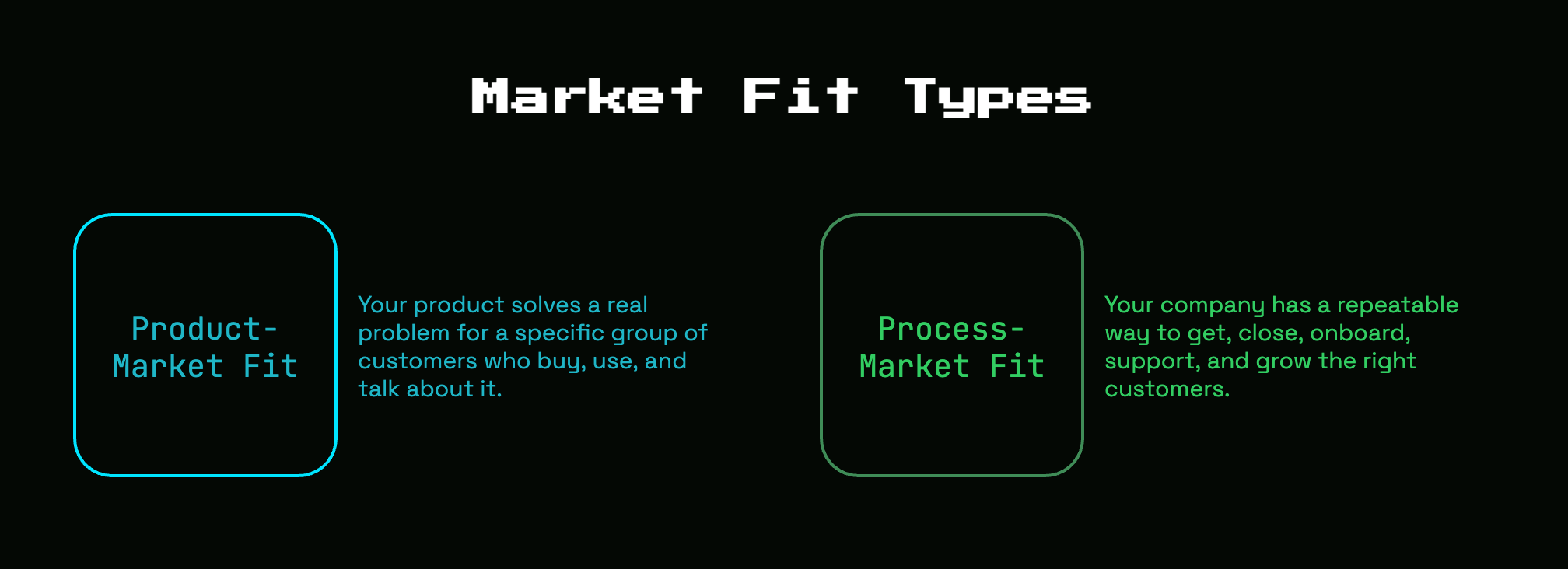
Product-market fit means your product solves a real problem for a specific group of customers well enough that they keep buying, using, and talking about it. In plain English, people do not just like the idea. They want the thing badly enough to change behavior, pay money, and stick around.
Process-market fit is different. It means your company has a repeatable way to get, close, onboard, support, and grow the right customers without everything depending on your memory, hustle, or late-night heroics. Your ICP, your sales motion, your onboarding flow, your pricing, and your customer handoffs all fit the way buyers actually buy and adopt your software.
Here’s the direct claim: at $1M to $5M ARR, your product can absolutely be working while your process is still broken. In fact, that is one of the most common states for early B2B SaaS companies.
Why This Difference Starts to Matter the Minute You Hire Sales
At first, founder-led selling can hide a lot. You know the product better than anyone, you can read between the lines on calls, and you can improvise your way through weird objections. Then you hire a first rep, and suddenly deals do not move the same way. The same leads look colder. The same demo sounds less convincing. The same pricing gets more pushback.
That moment is where “fit” gets blurry.
For a bootstrapped team, this matters even more because mistakes are expensive in time, not just cash. If growth slows, the instinct is often to assume the product needs more features or the rep is weak or the market is drying up. Sometimes the real issue is simpler: the product has pull, but the path from interest to value only works when it runs through your head.
The common trap: treating every growth problem like a product problem
A lot of teams respond to slower growth by shipping more. Another dashboard. Another integration. Another reporting filter requested by the loudest customer on last Tuesday’s call.
But growth problems are not always product problems.
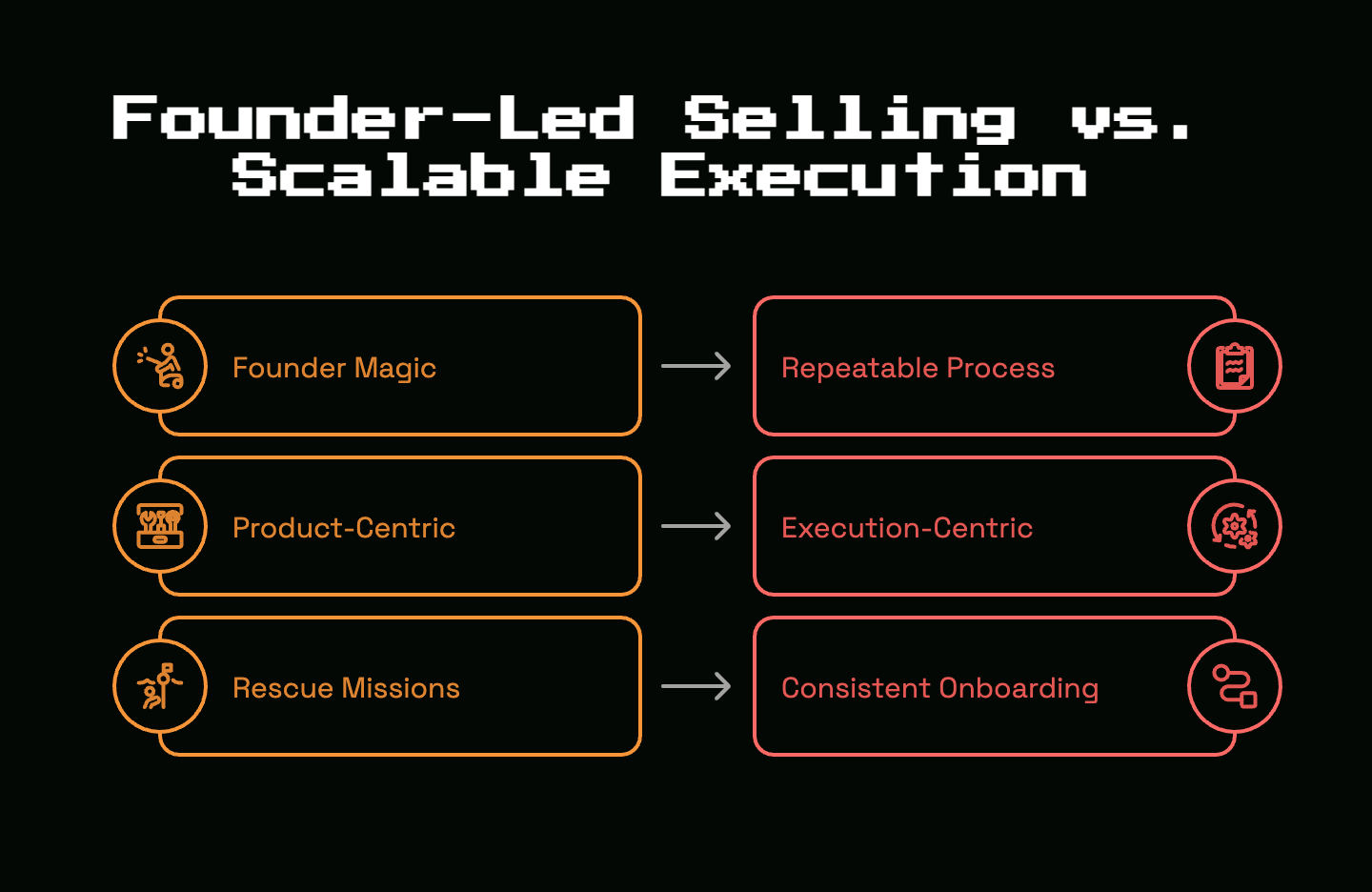
If leads are poorly qualified, demos wander, pricing changes every conversation, onboarding is inconsistent, or customers only succeed after a rescue mission, adding features will not fix the bottleneck. It just gives the team more surface area to support. In that case, the issue is not demand. It is execution.
This is often the right moment to look closely at what breaks when selling stops being founder magic. If outcomes change dramatically the second you step back, the product may be fine while the operating system around it is not.
The opposite trap: trying to systematize a product nobody urgently wants
The opposite mistake is just as real. Some teams build clean CRM stages, polished decks, tidy onboarding checklists, and a respectable pipeline review rhythm around a product that buyers do not urgently need.
That never ends well.
If retention is weak, activation is shallow, and deals die because the problem is a “nice to have,” process cannot save you. Better handoffs do not create demand. A stronger playbook does not make pain more painful. You can make a weak offer easier to sell for a little while, but not for long.
So the distinction matters because both problems exist, and the fixes are completely different.
What Product-Market Fit Actually Looks Like
Product-market fit is a strong match between your product, a specific customer, and a problem painful enough that people keep choosing your solution. Not once. Repeatedly.
A useful way to think about it: PMF is not just “people bought.” It is “the right people bought, got value, kept using it, and would notice if it disappeared.” In B2B SaaS, that usually shows up in retained accounts, faster second and third deals in the same segment, and less effort spent convincing buyers the problem matters in the first place.
The signs you’re getting close
You are probably moving toward PMF when customers start pulling the product through the funnel instead of needing constant pushing. Discovery calls spend less time on “why should I care?” and more time on “how fast can this work in my environment?” Retention strengthens. Referrals happen without asking. Expansion starts to appear because the value is deep enough to spread.
One of the best-known PMF checks is the Sean Ellis survey: if at least 40 percent of users say they would be “very disappointed” if your product went away, that is a strong signal of fit. Recent summaries also point to PMF looking more convincing when that signal lines up with organic growth above 15% month over month and net revenue retention above 100%, sustained for 3+ months rather than showing up in one lucky stretch.
That last part matters. Three good months in a row mean more than one weird quarter with a big customer or an unusually hot channel.
What PMF is not
PMF is not a launch. It is not a handful of recognizable logos. It is not founder hustle that drags deals across the finish line one by one.
It is also not feature demand from your noisiest customer. Somebody asking for a feature does not prove the market wants your product. It often just proves one account wants custom work.
And PMF is not binary. You can have strong fit in one segment and weak fit in another. Mid-market finance teams may love you while small agencies shrug. That still counts as PMF, just not broad PMF.
What Process-Market Fit Means in Practice
Process-market fit is the point where your revenue engine starts to behave consistently for your market. Your messaging lands. Your sales motion matches how buyers evaluate software. Your pricing is understandable. Onboarding gets customers to value without heroic intervention. Support, renewals, and expansion stop feeling improvised.
This is less glamorous than PMF, but honestly, it is what makes growth survivable.
A simple way to think about it
Think about cooking dinner. If every night starts with opening the fridge, staring into the void, and inventing a meal from random ingredients, you can still eat well sometimes. But it depends on energy, memory, and luck. A recipe changes that. Not because it removes judgment, but because it reduces randomness.
That is process-market fit.
If every deal needs a brand-new pitch, every onboarding call starts from scratch, and every renewal depends on somebody “going above and beyond,” you do not have a process. You have effort.
The parts of the process that usually need to fit
Process-market fit is cross-functional. It usually shows up across lead sources, qualification, discovery, demo structure, pricing, proof points, onboarding milestones, time-to-value, renewals, and expansion. If one part fights the others, the market feels harder than it really is.
This is why process work cannot sit only inside sales. Your buyers experience one journey, not five departments. A rough handoff from closed-won to onboarding is still part of the market fit problem. So is pricing that makes sense on a call but breaks in procurement.
Product-Market Fit vs Process-Market Fit: The Real Difference
Product-market fit answers one question: do people want this badly enough to buy and keep using it?
Process-market fit answers another: can you repeatedly get, close, onboard, and retain the right customers without relying on luck or founder instinct?
That is the real difference. One is about demand. The other is about repeatability.
Product answers demand; process answers repeatability
PMF creates pull. Buyers feel the pain, see the value, and move. Process-market fit turns that pull into a system that other people on your team can run.
This matters a lot when you hire early sales or customer success roles. If your success depends on instinctive timing, custom demos, and unwritten qualification rules, a new hire is not stepping into a process. A new hire is stepping into a maze.
If you are trying to build consistency, it helps to study how a buying motion becomes something prospects actually accept. Process-market fit is not about adding bureaucracy. It is about aligning your internal motion with external buyer behavior.
One can exist without the other
A strong product with weak process usually looks like this: customers love the software once they are in, but win rates swing wildly, sales cycles are erratic, onboarding varies by account, and only you seem able to close the best deals.
A strong process around a weak product looks different. Calls are organized. CRM data is neat. Handoffs are clean. Yet usage fades, retention disappoints, and expansion never really shows up because the value is too shallow.
Both states can produce revenue for a while. Only one is durable.
How to Tell Which Problem You Actually Have
This is where the conversation becomes useful. You do not need abstract theory. You need to know which issue is hurting growth right now.
Start by looking for patterns across pipeline, onboarding, retention, and customer conversations. Do deals die because buyers do not care enough, or because your team cannot consistently guide the right buyers to value?
Signs the product is the bottleneck
Low retention is one of the clearest signs. If customers buy, try the product, and drift away, that is rarely a sales process problem. Weak activation is another. If users do not hit the “aha” moment, the product is not solving the pain clearly enough or fast enough.
You may also hear the same kind of stall in deals: “interesting, but not a priority,” “we can solve this with spreadsheets for now,” or “circle back next quarter.” That language usually points to a problem that is not painful enough. Expansion is another clue. If accounts almost never grow, the value may be too narrow or too replaceable.
Signs the process is the bottleneck
Process problems look different. You close at 30 percent, the first rep closes at 8 percent, and nothing obvious changed in the market. Onboarding quality varies wildly between accounts. Sales cycles stretch for reasons nobody can explain. Pricing gets renegotiated from scratch every time. Customers succeed only when someone personally rescues the account.
Those are not classic PMF symptoms. Those are signs of poor repeatability.
This is where a simple look at where your funnel actually breaks can help. If the same friction keeps showing up in qualification, handoff, or onboarding, process is probably the limiting factor.
Signs both are still unfinished
Sometimes the messy answer is the right one. You can have a product that gets a strong reaction from one narrow segment but not enough consistency across adoption, while also lacking the process needed to test and scale that segment properly.
In day-to-day terms, this feels confusing. Some deals close fast and turn into happy customers. Others linger, churn, or require custom work. Your team can point to success stories, but not a reliable pattern.
That usually means both kinds of fit are still forming. Not a disaster, but not a scaling-ready system either.
How to Measure Product-Market Fit Without Overcomplicating It
PMF gets mystical fast if you let it. It does not need to be.
For B2B SaaS, the best PMF signals are the ones tied to behavior, not vibes. Look for evidence that customers get value, stay, and deepen usage.
Useful PMF signals to track
Retention is the anchor metric because it answers the hardest question: do customers keep choosing you after the excitement of the sale is gone? Activation matters too, especially how quickly new accounts reach first value. Frequency of use helps, though the right cadence depends on the product. A daily workflow tool should be used very differently from a monthly reporting tool.
Expansion revenue is a strong supporting signal because it suggests the value grows after purchase. Unsolicited referrals matter for the same reason. So do win reasons that repeat across deals. When customers keep buying for the same few reasons, your value proposition is getting sharper.
The Sean Ellis “very disappointed” survey is still useful, especially when paired with harder numbers. Sustained net revenue retention above 100% and healthy organic growth over multiple months are supporting signals, not universal rules. Treat them like smoke, not the fire itself.
Questions to ask customers
Ask customers what job your product gets done for them. Ask what they used before finding you. Ask what nearly stopped the purchase. Ask what changed after adoption. And ask the blunt one: what would happen if your product disappeared tomorrow?
That last question cuts through politeness fast. If the answer is “we would be annoyed,” you have something different from “our weekly reporting would break and two people would lose six hours.” One is convenience. The other is pain relief.
How to Measure Process-Market Fit
Process-market fit shows up as consistency. Not perfection, consistency.
If the same kinds of customers move through a similar path, reach value in a similar timeframe, and renew at similar rates regardless of who handled the account, your process is starting to fit the market.
Metrics that reveal repeatability
Conversion rates by stage are a good place to start. If discovery-to-demo or demo-to-close swings dramatically by rep or by month, your process is probably unstable. Sales cycle length matters too, especially variance. Some variation is normal. Huge variation often means qualification or proof is weak.
Ramp time for new reps is another clue. If a new hire takes forever to become productive because everything lives in your head, process-market fit is not there yet. Implementation time and time-to-value matter for the same reason. When those are predictable, your team can deliver outcomes without improvising every account.
Onboarding completion, gross retention, and how often deals follow the same path are also useful. Behind all of those sits buyer behavior. Your process needs to match how your market actually evaluates risk, urgency, and software change. If you want to get sharper here, spend time watching how buyers really move through decisions.
The founder test
Here is the simplest litmus test in the whole article: if results drop hard the moment you step back from demos, negotiation, or onboarding, your process probably has not fit the market yet.
That does not mean your hires are bad. It usually means too much signal is trapped inside instinct, memory, and unwritten judgment. You are still functioning as glue.
A healthy process can survive your absence for a week. A stronger one can survive your absence for a quarter.
How You Usually Get Product-Market Fit First
PMF usually starts with a tight customer definition and a sharp problem, not a giant feature set. Pick a narrow slice of the market, understand the pain in plain English, make a promise that is easy to care about, and test that promise with a product simple enough to learn from.
Then iterate. Not forever, but enough to separate real pull from polite interest.
Start narrow instead of broad
A tighter ICP helps because pain is easier to detect when you stop trying to be useful to everybody. “Operations leaders at multi-location healthcare groups” is easier to serve than “any team with workflows.”
If everybody could use the product, nobody feels the urgency clearly. Narrowing is uncomfortable, but it is usually how PMF starts to appear.
Iterate on the problem before the feature list
The trick is to sharpen the pain and the value promise before expanding the roadmap. More features can hide weak positioning for a while, but they rarely fix it.
If buyers do not quickly understand why this matters now, the answer is usually not ten more features. It is a clearer problem and a faster path to value.
How Process-Market Fit Usually Comes Next
Once PMF starts to show up, process-market fit becomes the natural sequel. Now the challenge is not proving anyone wants the product. It is building a repeatable way to turn that demand into durable revenue.
That means less randomness, cleaner handoffs, and a buying journey that feels easier for the right customers.
Tighten the ICP and buying journey
Process-market fit often improves when you get stricter about who buys fastest, who sticks longest, and who reaches value with the least friction. That can mean excluding prospects that look tempting but behave badly in your funnel.
The buying journey matters just as much. What does the buyer need to believe at each step? What proof lowers risk? Where does momentum stall? Those answers shape a process better than any generic sales template.
Standardize the parts that keep repeating
Standardize your discovery flow, your demo path, your pricing guardrails, your onboarding milestones, and your handoff rules. Not because scripts are magical, but because repeated friction deserves a repeated fix.
If you are hiring or preparing to hire, it helps to map the few sales steps a new rep can actually repeat. Standardize the recurring moments, and you make performance trainable instead of mysterious.
Keep iterating after the playbook exists
The catch is, a playbook is not the finish line. Process-market fit shifts as your segment changes, your ACV moves up, or your product gets broader.
A process that works at $8,000 ACV may break at $30,000 ACV. A motion that fits owner-led buying may fail when procurement gets involved. So yes, standardize, but keep watching for drift.
A Simple Example: PMF Without Process-Market Fit
Picture a founder in a cramped coworking room in Austin, closing deals on a painful reporting problem for finance teams. The product works. Prospects lean in during demos because the spreadsheet pain is real. Customers who get set up properly stick.
But the first rep struggles almost immediately. Qualification is fuzzy. The founder knows which messy data environments are fixable and which ones are traps, but that logic is nowhere documented. Pricing changes depending on how the call feels. Onboarding depends on ad hoc promises made in sales. Some customers get value in ten days. Others stall for six weeks.
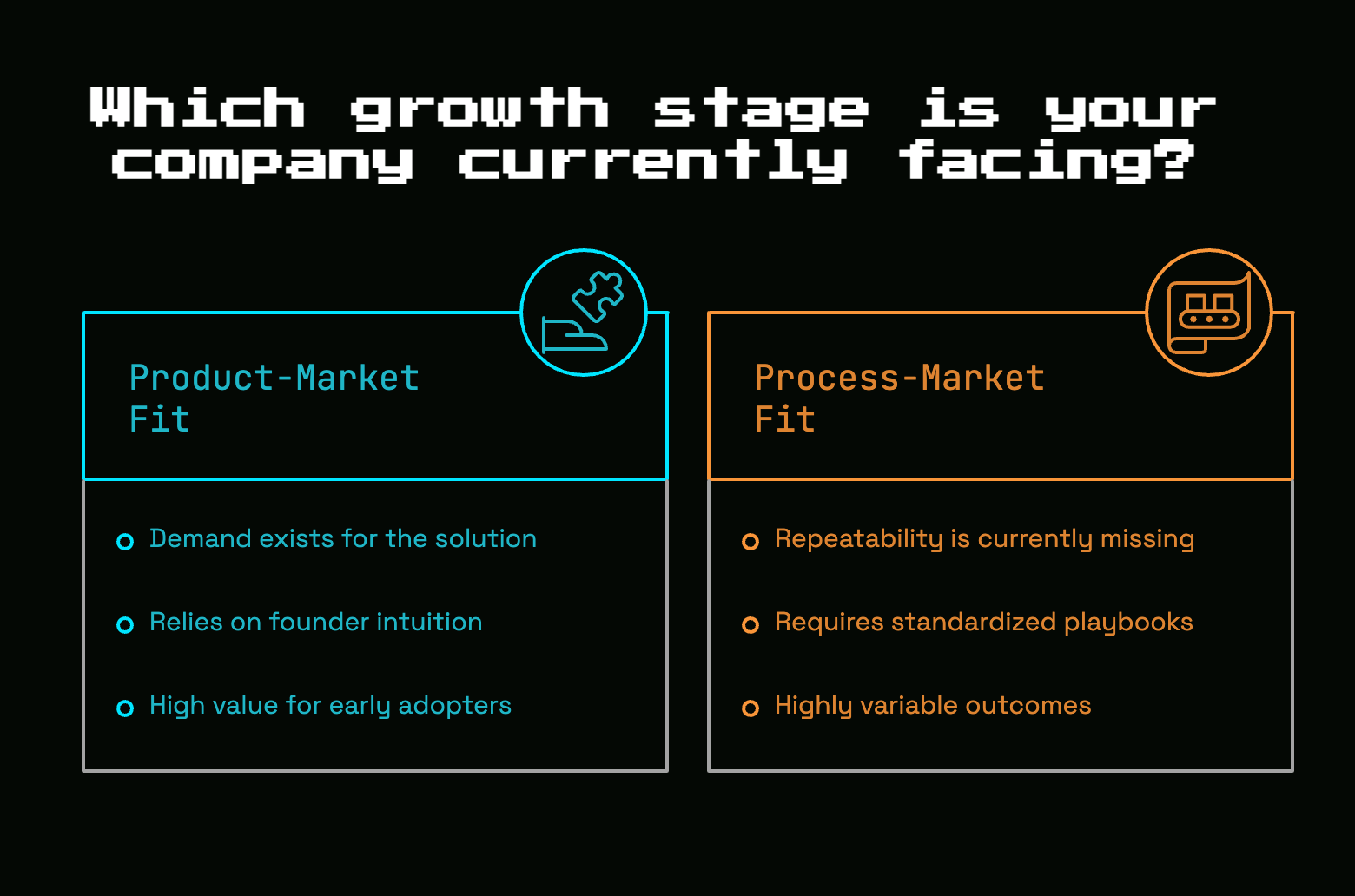
That company probably has PMF, at least in a real segment. But process-market fit is missing. Demand exists. Repeatability does not.
A Simple Example: Process-Market Fit Without Strong PMF
Now flip it.
Your sales calls are polished. CRM stages are clean. Discovery questions are consistent. Onboarding has a nice checklist and tidy milestones. Everybody sounds organized.
Yet customers do not keep using the product. Usage fades after the first month. Renewals feel tense. Expansion is rare. On calls, buyers understand the pitch, but the pain is not sharp enough to keep the software anchored in daily work.
That company has process discipline, not strong PMF. The machine is neat, but it is moving a product buyers can live without.
Common Misconceptions About Product-Market Fit vs Process-Market Fit
A lot of confusion comes from using revenue as proof of everything. Revenue matters, obviously, but it can hide a surprising amount of mess.
“If customers are buying, you have both”
Not necessarily. Customers can buy because your founder is unusually persuasive, because the service wrapped around the product is carrying the outcome, or because a few custom accounts are masking broader churn.
Revenue is evidence. It is not a full diagnosis.
“Process-market fit is just go-to-market fit with a new label”
There is overlap, yes. Go-to-market fit usually covers channel, pricing, positioning, and sales motion at a strategy level. Process-market fit zooms in on whether the operating system behind that motion actually works inside your company on a repeatable basis.
That difference matters because strategy can sound right while execution still breaks.
“Once you have fit, you’re done”
You are not done. PMF can weaken if buyer priorities shift or your product sprawls into less urgent use cases. Process-market fit can drift when team size changes, pricing changes, or you move upmarket.
Fit is more like balance than a trophy. You keep adjusting.
What to Focus on Next if You're at $1M, $5M ARR
At this stage, the smartest move is usually not “do more.” It is “name the actual bottleneck.” Growth gets easier once you stop mixing product issues and process issues into one blurry problem.
If demand feels real but growth still feels messy
Focus on process-market fit. Tighten ICP rules. Make qualification more explicit. Set pricing guardrails. Build onboarding consistency. Remove places where outcomes change based on who handled the account.
This is usually where small changes pay back quickly.
If every sale still needs a custom pitch
That can point to weak PMF, weak process, or both. The trick is to look past the pitch itself and inspect retention and time-to-value. If customers do not stick, the problem is deeper than sales polish. If customers do stick but only after a messy path, process is probably lagging.
One thing to try this week
Pull your last 10 wins and last 10 losses. For each one, mark the main issue as product, process, or both. Be strict. If the deal was won only because you improvised pricing and then onboarding turned into a rescue mission, that is not “a win.” That is process debt wearing a revenue costume.
Do that audit once, and the difference between product-market fit vs process-market fit gets a lot less theoretical.
Frequently Asked Questions
Can you have product-market fit before hiring sales?
Yes. In fact, that is common. You can have clear demand and strong customer value before any formal sales team exists. The trouble starts when that demand only converts consistently through your personal involvement.
Is process-market fit only a sales concept?
No. Sales is a big part of it, but process-market fit also includes onboarding, support, renewals, expansion, and handoffs between teams. If customers buy smoothly but struggle to get value, process still does not fit the market.
What is the fastest way to tell PMF from process problems?
Look at retention and founder dependence together. Weak retention usually points toward product issues. Strong retention paired with inconsistent selling, onboarding, or rep performance usually points toward process issues.
Does process-market fit matter for bootstrapped SaaS more than funded SaaS?
It often does, because wasted months hurt more when headcount and cash are tight. A funded company can sometimes absorb more inefficiency for a while. A bootstrapped company usually cannot.
Should you fix process before adding more reps?
Usually yes. If one rep cannot reliably repeat your motion, adding three more just spreads confusion faster. Get the path working with consistency before scaling headcount.
Is the 40% Sean Ellis survey enough to prove product-market fit?
No. It is a strong signal, not the full answer. Pair it with retention, activation, expansion, and results sustained over multiple months. PMF is best recognized through a pattern, not a single score.
Not sure which side of this you're on? Run the Process-Market-Fit diagnostic — 60 seconds, free.


Discussion