

Revenue ops problems are the breakdowns underneath the breakdowns: the hidden issues in how marketing, sales, and customer success pass work, data, and responsibility between each other. If your pipeline feels shaky even when everybody looks busy, revenue ops problems are usually what’s actually breaking it, and once you spot them, a lot of “sales problems” start making much more sense.
What Revenue Ops Problems Actually Are
Revenue ops problems are failures in the system that moves prospects and customers through your revenue engine. In plain English, that means something is off in the way your teams share information, define stages, route leads, update records, or hand off ownership. The result shows up as stalled deals, weird forecasts, missed follow-up, and that nagging sense that pipeline never feels as healthy as the activity level suggests.
Here’s the thing: pipeline is an output. It reflects how your operating model behaves. So when pipeline looks thin, bloated, inconsistent, or unpredictable, the problem often started earlier, inside process design, data quality, team alignment, or tooling.
That matters a lot for an early-stage SaaS company. Around $1M to $5M ARR, your go-to-market setup often grows in layers. Founder-led sales turns into a first rep. Marketing adds campaigns. Customer success exists, sort of, but may still live in Slack threads, inboxes, and memory. Nothing looks totally broken on its own. Put together, though, the cracks start costing real revenue.
Why Your Pipeline Breaks Even When Your Team Is Busy
A full CRM can be misleading. Calls are happening, demos are booked, follow-ups are being sent, and your team still cannot answer a simple question with confidence: is pipeline actually moving toward revenue, or just moving around?
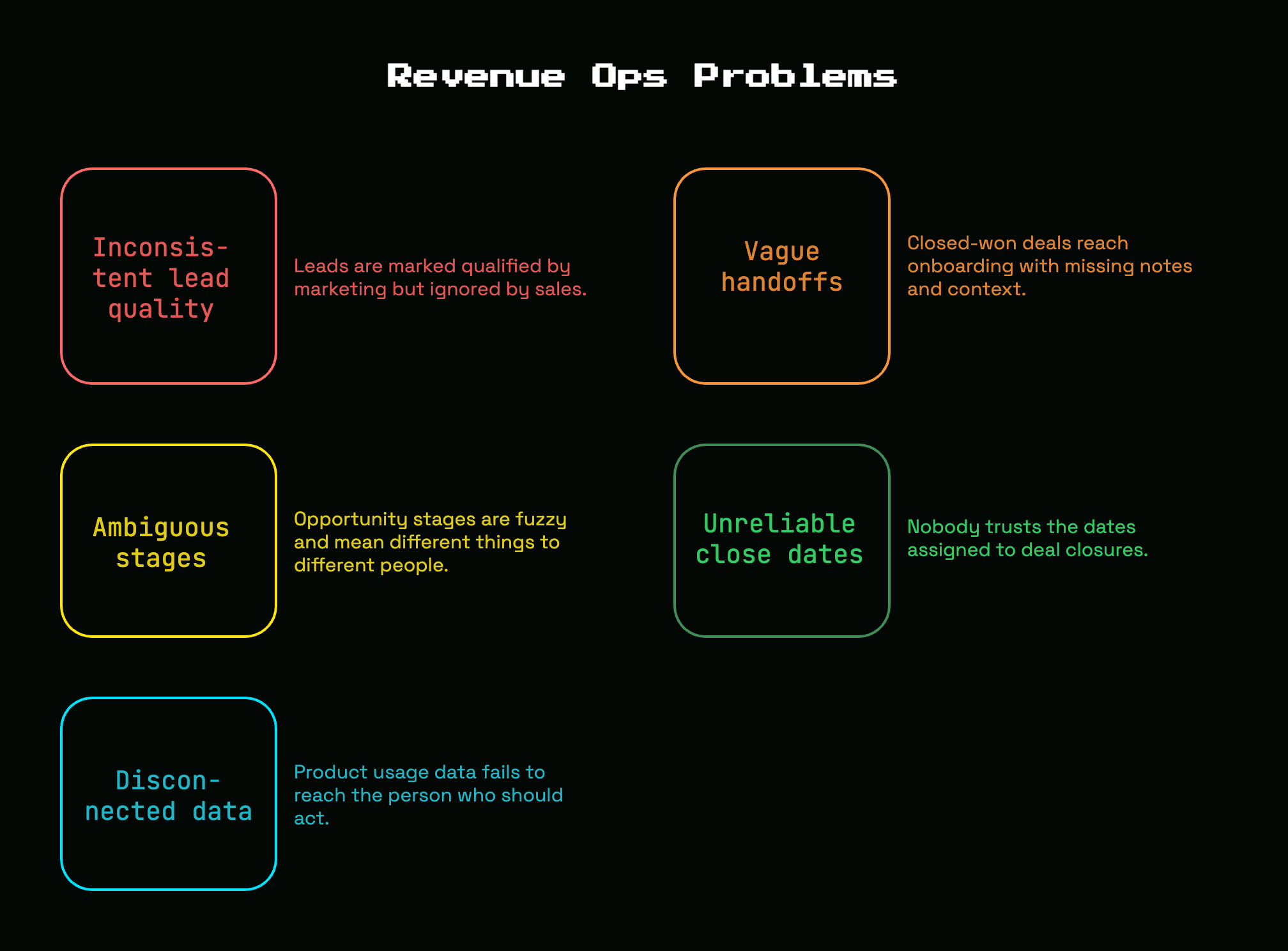
That happens because activity hides structural problems. A rep can be hustling. Marketing can be producing leads. Customer success can be saving accounts one by one. But if lead quality is inconsistent, handoffs are vague, stages mean different things to different people, and nobody trusts close dates, all that effort turns into motion without control.
Pipeline problems are usually process and alignment problems before they are people problems. That is the direct claim worth keeping in front of you. If the same kinds of deals keep stalling, if the forecast keeps missing in the same direction, or if every rep seems to invent a slightly different workflow, the system is telling on itself.
RevOps is an operating model, not a reporting function
RevOps is the way your revenue teams share data, goals, systems, and handoffs across the full customer journey. It is not just the dashboard layer. It is not a prettier CRM. It is not a cleanup project somebody does before the board meeting.
Think of it like the plumbing behind a house. You mostly notice it when something backs up. Reports are the faucet. RevOps is the full set of pipes, pressure, connections, and shutoff valves behind the wall. If the plumbing is wrong, polishing the faucet does nothing.
This is why mature RevOps setups are so valuable. Research cited by Gartner says companies with strong RevOps are twice as likely to exceed revenue targets. Not because the title sounds modern, but because the operating model is tighter.
The difference between a sales problem and a revenue ops problem
A sales problem usually looks like poor execution inside a functioning system. A rep is weak on discovery. Follow-up is sloppy. Pricing conversations fall apart. Objections are handled badly.
A revenue ops problem looks different. Leads route inconsistently. Opportunity stages are fuzzy. Marketing marks a lead qualified, sales ignores it, and nobody agrees why. A closed-won deal reaches onboarding with missing notes and missing context. Expansion opportunities never get flagged because product usage data never reaches the person who should act on it.
One clue is repetition across people. If one rep struggles, that may be performance. If every rep keeps hitting the same wall, the wall is probably operational.
The Biggest Revenue Ops Problems That Break Your Pipeline
This is where pipeline usually starts leaking.
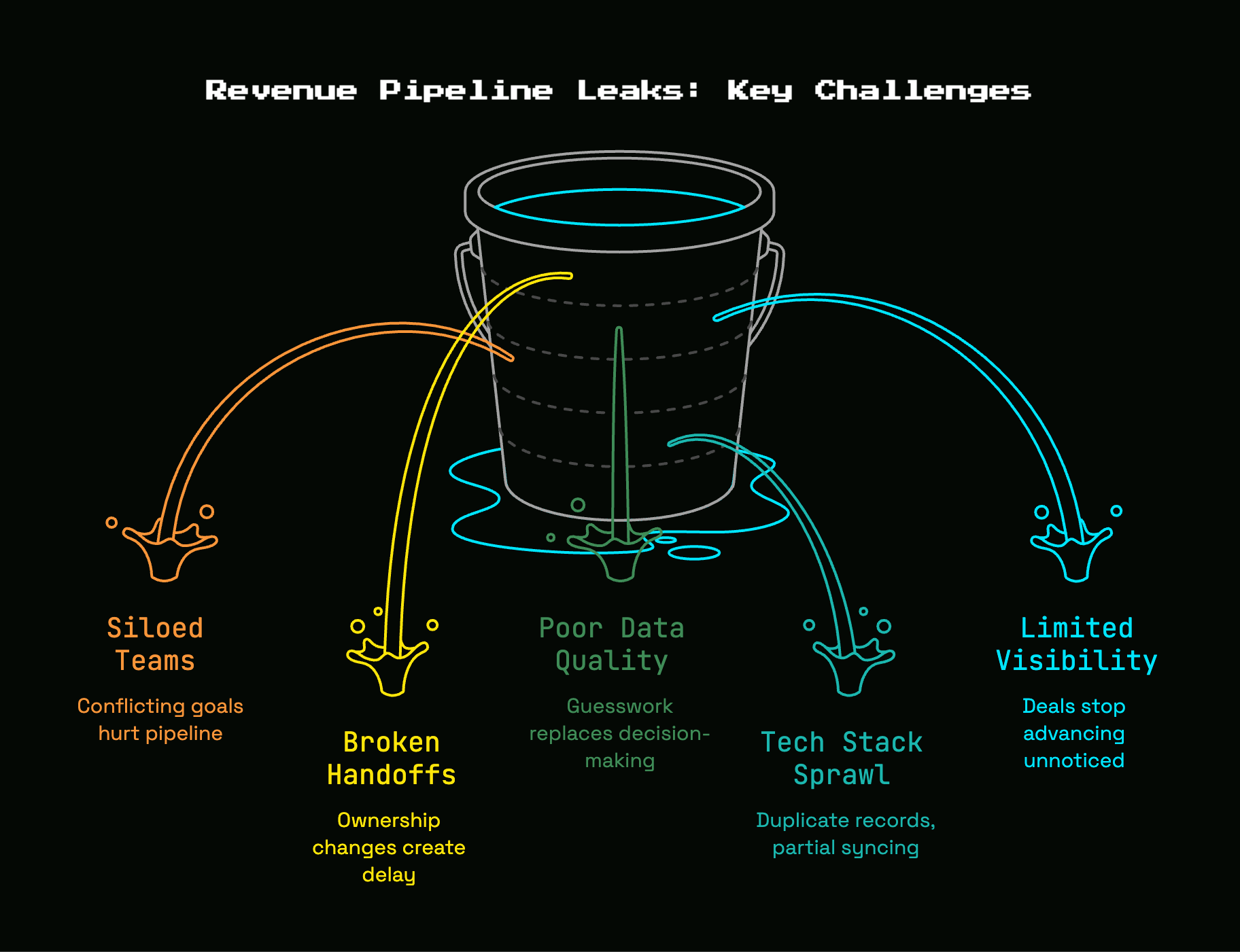
Siloed teams and conflicting goals
Marketing, sales, and customer success can all hit local targets while your overall pipeline suffers. Marketing celebrates lead volume. Sales complains those leads are junk. Customer success protects renewals but never loops expansion signals back into pipeline creation. Everybody is doing something useful, but the system between teams is weak.
That kind of misalignment is common, not rare. In one roundup of current alignment data, only 30% of sales pros say teams are strongly aligned, and 53% of companies still report broken handoffs. No surprise, then, that pipeline quality gets fuzzy.
Misalignment usually starts with definitions. What counts as a qualified lead? When does a meeting become an opportunity? Who owns pipeline quality, the lead source, or the renewal conversation? If those answers differ by team, your metrics are already unstable.
Broken handoffs between teams
Handoffs are where revenue quietly disappears. A lead gets scored but sits untouched. A demo goes well but never becomes a real opportunity. A customer mentions budget for a bigger plan during onboarding, but that signal stays in a call note nobody else sees.
Broken handoffs matter because ownership changes create delay, and delay kills momentum. If no rule defines who acts next, how fast, and with what information, the pipeline slows down in ways your dashboard may not immediately show.
The ugly part is how normal this can feel. Somebody says, “I thought that was with sales.” Somebody else says, “I didn’t know it was qualified yet.” Meanwhile, the buyer has moved on.
Poor data quality and messy CRM hygiene
Bad data turns every revenue conversation into guesswork. Duplicate records inflate lead counts. Missing fields break routing. Outdated lifecycle stages make stale deals look active. Rep-by-rep note habits mean important details live in five different formats.
Clean CRM data is not about neatness. It is about decision quality. If your opportunity report includes non-ICP deals, old close dates, and stages nobody uses consistently, you are not looking at pipeline. You are looking at a scrapbook.
This is especially painful in smaller SaaS teams because the system often starts informal and works fine until it doesn’t. On a Tuesday afternoon in August, when your first rep asks why a lead was disqualified three days after booking a demo, you do not want the answer to be “somewhere in Slack.”
Tech stack sprawl and weak integrations
More tools rarely create more clarity. More often, you get duplicate records, partial syncing, ownership confusion, and a fresh place for data to go stale.
The catch is simple: buying another tool does not fix a process that was already broken. If routing logic is vague, an automation layer will just move vague decisions faster. If stage definitions are inconsistent, a reporting tool will surface cleaner-looking nonsense.
That pattern shows up far beyond RevOps. In PwC’s operations survey, technology didn’t meet expectations was one of the most common barriers, alongside leadership, adoption, and data issues. Tools fail a lot because teams ask software to solve operating discipline.
Limited visibility into stage conversion
A lot of teams track total pipeline volume and stop there. That is like checking the number of people who walked into a restaurant without checking whether anybody ordered, ate, or paid.
Stage-by-stage conversion is your early warning system. It tells you where deals stop advancing before the quarter is already gone. Outreach makes this point clearly: stage-level conversion data shows where pipeline breaks before revenue misses compound.
The plain-English formula is simple: deals advancing divided by deals entering the stage, multiplied by 100. Use a rolling 90-day or 180-day window instead of staring at one quarter in isolation, because short snapshots can lie, especially with a smaller sample.
Inaccurate forecasting
Forecasting breaks when stage definitions are weak, close dates are fantasy, and reps update deals based on hope instead of evidence. Then the forecast starts to feel like optimism dressed up as math.
This matters because forecast accuracy is not just a finance concern. It is one of the clearest signs that your revenue process is believable. If deals keep slipping late, if commit means something different for every rep, or if upside constantly shows up as pipeline padding, the forecast is exposing operational cracks.
Late-stage slippage is especially expensive. Research cited by Outreach found that late-stage deals slip at a real cost to win rates once delays stretch too far. Time in stage is not a side metric. It is part of deal quality.
Unclear ownership of expansion and retention signals
This one gets missed all the time. Many teams think RevOps is mostly about top-of-funnel and sales execution. But revenue continues after closed-won, and plenty of pipeline problems start on the customer side.
If nobody clearly owns renewals, upsell triggers, churn risk, and product usage signals, expansion pipeline stays smaller than it should and churn risk gets noticed too late. A customer starts hitting plan limits, or usage drops sharply, or a champion leaves. If that signal stays trapped in support tickets, product analytics, or customer calls, the revenue engine never gets to act on it.
For a SaaS business in your range, this is often one of the cheapest fixes with the fastest payoff.
What These Problems Look Like in Real Life
Revenue ops issues sound abstract until you see how they show up in daily work.
Your pipeline report changes depending on who pulls it
One person filters by created date. Another filters by close date. Somebody excludes self-sourced deals. Somebody else includes recycled opportunities. Suddenly there are three versions of pipeline in the same Monday meeting.
That is not a reporting inconvenience. It means your definitions are weak. If “active pipeline” changes by user, your team is debating spreadsheet logic instead of running the business.
Leads are coming in, but qualified pipeline is not growing
This is one of the most common symptoms. Lead volume looks healthy. Meetings may even rise. But real pipeline, the kind that matches buyer intent and can close, stays flat.
That gap usually points to bad qualification or poor alignment between marketing and sales. Maybe lead scoring is too loose. Maybe the ICP drifted. Maybe PPC leads and referral leads are being treated the same when intent is completely different. Outreach notes that source mix can create huge conversion differences, which is why segmenting by source matters more than broad averages.
Deals pile up in one stage for too long
When one stage fills like a traffic jam, something specific is broken. Maybe discovery is weak. Maybe pricing approval takes forever. Maybe no one knows the exact criteria for moving from demo to opportunity. Maybe follow-up after a technical validation goes dark for six days.
Stage aging makes this visible. Once you start looking at how long deals sit, not just how many exist, bottlenecks get easier to spot.
Your first sales hire is working around the system
This is a big one for early-stage SaaS. If your first rep keeps notes in Notion, tracks follow-up in a private spreadsheet, or ignores half the CRM fields, the lazy explanation is “bad process discipline.”
Usually, though, the system is getting in the way. Fields may be unclear. Stages may not match how deals actually move. Required data may feel pointless because nobody uses it. When reps work around the system, the system is often the problem first.
How to Diagnose What’s Breaking Your Pipeline
Start with the bottleneck, not with a reorg and definitely not with a shopping spree for software.
Start with one conversion point, not the whole funnel
Trying to fix the whole funnel at once is how teams end up in six-week audit mode with nothing changed. Pick one conversion point where revenue is leaking most visibly. Lead to meeting. Meeting to opportunity. Opportunity to close. Renewal to expansion.
One stage is enough to start. If that stage improves, the downstream data usually gets clearer too.
Use stage conversion rates as your early warning system
Stage conversion rate tells you the share of deals that move forward from a specific stage. The formula is straightforward: deals advancing divided by deals entering the stage, times 100.
Use a rolling 90-day or 180-day window. That gives you a better read on the real process, especially if deal count is still modest. One quarter alone can distort everything, particularly if you had one whale deal, one slow summer month, or one campaign spike that brought in the wrong crowd.
Benchmarks can help, but only in context. For example, Outreach benchmark data shows B2B SaaS SMB teams often see MQL-to-SQL conversion in the low-to-high 30s and opportunity-to-close in the high 30s to mid 40s. Useful reference point. Not gospel.
Check stage aging and handoff speed together
Low conversion tells you where deals die. Long delays tell you how they die.
If leads sit for two days before first touch, if demos wait a week before an opportunity is opened, or if closed-won accounts take too long to reach onboarding, your issue is not just conversion quality. It is handoff speed and response discipline.
A strong handoff needs four things: a trigger, an owner, a time expectation, and a fallback if nothing happens. Miss one of those and deals start collecting dust.
Audit your definitions before you trust your dashboard
Before believing any chart, check what the terms mean in practice. What is an SQL? What counts as an opportunity? What makes a deal active rather than stale? When does a customer become expansion-qualified?
If those definitions differ across teams, your dashboard is just rendering disagreement in color. Shared definitions are not admin work. They are the foundation that makes reporting useful.
The Metrics That Actually Help You Find RevOps Problems
Vanity metrics make noise. Diagnostic metrics show where the machine is breaking.
Funnel conversion by stage
Stage conversion is the core diagnostic. Look at MQL to SQL, SQL to opportunity, opportunity to close, and renewal to expansion if your motion includes account growth.
The most common bottleneck is often MQL-to-SQL conversion, because that is where lead quality, routing, response time, and qualification all collide. If this stage is weak, adding more leads usually just increases waste.
Pipeline velocity and sales cycle length
Pipeline velocity tells you how quickly real opportunities turn into revenue. Sales cycle length shows how long deals actually take to close. Both help you spot friction in qualification, procurement, approvals, legal review, or plain old follow-up discipline.
When cycle length stretches without a change in deal size or segment, something operational has shifted. That shift is worth chasing early, before it turns into a quarter-end surprise.
Forecast accuracy
Forecast accuracy is one of the cleanest signs of RevOps maturity. If your forecast keeps missing the same way, your process is revealing a pattern. Maybe close dates are too aggressive. Maybe stages are too generous. Maybe underqualified deals are getting counted as likely revenue.
It is tempting to treat forecast misses as a morale problem. Usually, it is a definition and inspection problem.
Lead response time, routing accuracy, and SLA adherence
SLA just means the agreed response window or handoff standard. Nothing fancy. It is the rule for how quickly the next owner acts and what “done” means.
These operational metrics often expose problems faster than win rate does. ZoomInfo cites a case where tightening routing and enrichment cut speed-to-lead from 20 minutes to 60 seconds. You do not need that exact setup to learn the lesson: handoff speed is pipeline quality.
Why More Tools Usually Don’t Fix the Problem
A missing dashboard is almost never the root issue.
The process has to exist before the automation can help
Automation is like adding smart shelves to a closet you never organized. You still have a mess, just one with sensors.
If your qualification policy is vague, automating it spreads vagueness. If your lead routing has exceptions nobody documented, automation turns hidden confusion into fast confusion. Process has to exist before automation can improve it.
That is why so many RevOps efforts disappoint. The project gets framed as CRM cleanup, enrichment, scoring, or dashboards, while the actual rules underneath stay fuzzy.
Integration without governance just spreads bad data faster
Syncing tools sounds productive until the wrong field overwrites the right one in three systems at once. Integration is useful only when ownership, field mapping, source-of-truth rules, and update permissions are clear.
Otherwise, bad data does not stay contained. It multiplies.
How RevOps Fixes Pipeline Problems
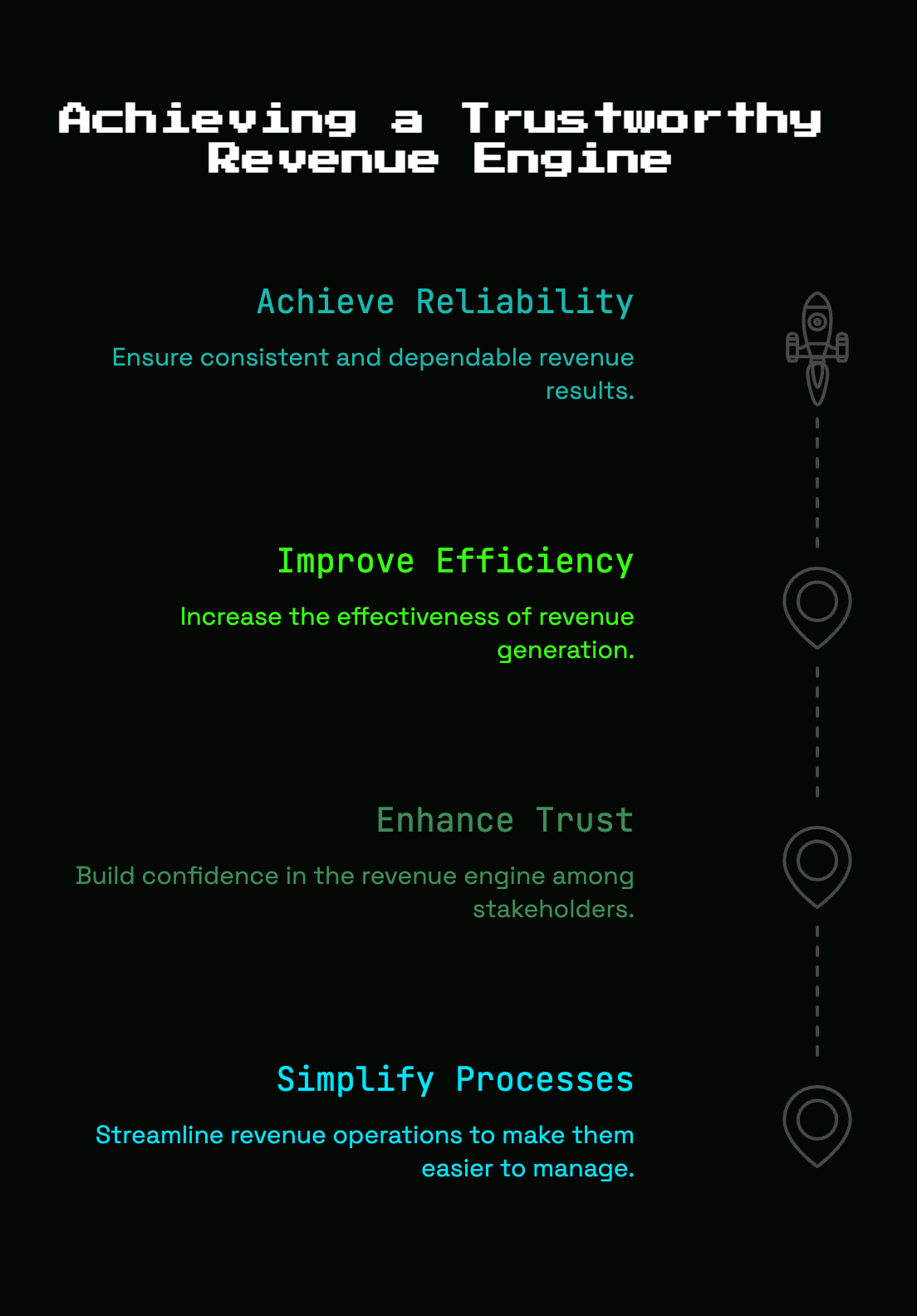
Good RevOps does not make your business look more sophisticated. It makes your revenue engine easier to trust.
Shared definitions across marketing, sales, and customer success
Healthy RevOps starts with shared language. Lifecycle stages mean the same thing across teams. Qualification rules are explicit. Opportunity criteria are documented. Renewal and expansion ownership are not implied.
This is one of the highest-leverage fixes you can make. Alignment is not soft. Research shows aligned teams are 67% better at closing deals and also see stronger retention. Shared definitions are where alignment becomes operational.
Clear handoffs with accountable owners
Every transition should have a trigger, an owner, a time expectation, and a fallback path. When a lead hits the threshold, who acts? How quickly? What information must be present? What happens if the owner misses the window?
That level of clarity sounds simple because it is simple. But simple is not the same as common.
One source of truth for revenue data
For a $1M to $5M ARR SaaS company, one source of truth does not mean launching a giant warehouse project. It usually means choosing a core system, often your CRM, defining which fields matter, deciding which tool is authoritative for what, and making sure the team trusts the output.
Reliable beats fancy here. A smaller clean system wins over a sprawling stack full of half-used fields and mystery sync behavior.
A focused tech stack that supports the process
Fewer connected tools with a clear purpose beat a pile of overlapping systems every time. Your stack should support qualification, routing, visibility, and handoffs. If a tool does not clearly improve one of those, it may be noise.
This is where restraint pays off. Every extra tool creates another place for governance to fail.
A Simple Way to Prioritize Your First RevOps Fix
You do not need a transformation program to get started. You need one good working session and a willingness to fix the actual leak.
Pick the bottleneck that costs the most revenue
Choose the break that has the clearest revenue impact. Maybe top-of-funnel quality is poor. Maybe routing is slow. Maybe opportunities stall after demo. Maybe forecast misses are making hiring and cash planning harder. Maybe renewals happen, but expansions never surface.
Start where the biggest leak is, not where the loudest complaint is. Those are often different.
Fix the rule, then the workflow, then the reporting
This sequence matters. First define the policy. What is the qualification standard, stage exit rule, or handoff requirement? Then build the workflow around it. After that, update the reporting to reflect the new reality.
Most teams do this backward. They build the dashboard first, then wonder why the numbers still feel slippery.
Review the result after 30 days
Give the fix a month, then check whether the process is behaving differently. Look for faster response times, cleaner stage movement, fewer stale deals, and forecast calls that feel less like guesswork.
Check it in your Monday morning pipeline review, not at quarter end when panic has already taken over. If the fix worked, you should feel the difference before the quarter closes.
Revenue Ops Problems Early-Stage SaaS Teams Run Into First
Early-stage teams get a very specific version of this problem set.
Founder knowledge lives outside the CRM
When your pipeline knowledge lives in your head, inbox, call recordings, and memory, the business works only as long as you stay in the middle of everything. Once another rep joins, that hidden context becomes a liability.
A CRM that lacks the founder’s judgment starts producing weaker qualification, shakier follow-up, and worse forecasts. Not because the rep is weak, but because the real process was never captured.
Your first rep inherits a process that was never written down
Founder-led sales often works on instinct. That can be effective, but it does not scale cleanly. Your first rep inherits unwritten rules about qualification, timing, pricing, follow-up, and deal risk. Naturally, inconsistency shows up fast.
This is where RevOps helps most. Not with complexity, but with making the implicit explicit.
Customer success is “everyone’s job,” so expansion gets missed
If customer success belongs to everybody, it usually belongs to nobody at the exact moment ownership matters. Renewal prep gets delayed. Product usage signals go unreviewed. Upsell moments pass quietly.
That creates a strange kind of pipeline problem. New business may look urgent, while expansion revenue slips away because no rule turns customer signals into action.
Common Misconceptions About Revenue Ops Problems
A few bad assumptions keep teams stuck longer than they need to be.
“This is just a sales problem”
If the same breakdown keeps showing up across lead flow, forecasting, and handoffs, it is not just about rep performance. Sales execution matters, of course. But repeated friction across multiple stages usually points to a broken system.
“We need more pipeline”
Maybe. But more top-of-funnel often makes the leak worse if qualification and handoffs are weak. Pouring more leads into a bad process is like turning up the water pressure when the pipe already has a crack.
“We’re too small for RevOps”
You are not too small for basic operating discipline. RevOps at this stage is not a department. It is shared definitions, clean handoffs, and data you trust. That is it.
“Once the CRM is cleaned up, the issue is solved”
Clean data matters, but cleanup is a moment. Governance is what keeps it clean. Without ownership, rules, and process, your CRM slowly slides back into chaos.
The One Thing to Try This Week
Pick one stage in your funnel and trace every handoff and rule inside it from start to finish. Look for the first point where ownership gets fuzzy, response time slows, or data goes stale. Fix that one spot before touching anything else.
That sounds small. It is also how pipeline starts getting reliable again.


Discussion